
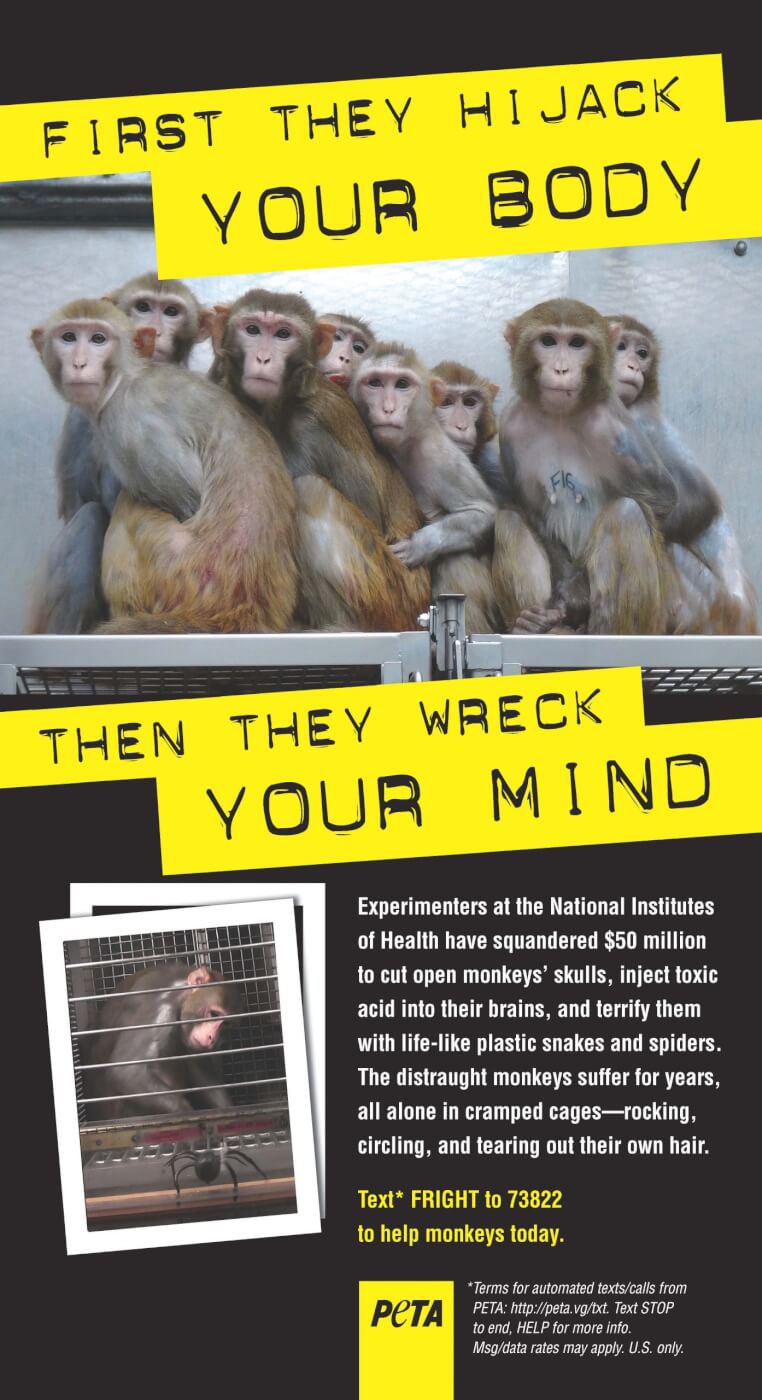
The post First They Hijack Your Body. Then They Wreck Your Mind appeared first on PETA.
Screaming, Struggling Cubs at Yellowstone Bear World Bring On PETA Complaint to Feds
PETA has observed bear cubs crying, struggling to escape being passed around like toys, and lying limp with apparent exhaustion and from overheating at recent Rexburg-based Yellowstone Bear World (YBW) events, prompting the group to fire off a formal complaint to the U.S. Department of Agriculture (USDA) today seeking an investigation into apparent federal Animal Welfare Act violations.
PETA’s complaint covers the following events:
- Over four days at the International Sportsmen’s Expo near Salt Lake City, YBW subjected nine 9-week-old cubs to near-constant, stressful handling by employees and customers who paid to touch and take photos with the babies, who often screamed and writhed as they were passed back and forth. The relentless photo ops went on for up to nine hours—and by day’s end, the cubs were draped listlessly over the arms of YBW workers. One employee resorted to fanning an evidently overheated cub with a sheet of paper.
- At YBW’s ongoing “Cub Palooza” event at its tawdry roadside zoo in Rexburg, employees pulled cubs out of their artificial cave enclosures so crowds of customers could touch them. Cubs writhed and cried, and one sucked on a handler’s face—a comfort-seeking behavior that can be a sign of distress, particularly among cubs prematurely separated from their mothers.
- At a “Baby Animal Days” event in Wellsville, Utah, YBW displayed cubs for many hours without adequate rest or retreat from the public in a room where the noise reached 85 decibels—a volume potentially damaging to human hearing, let alone a bear cub’s, which is twice as sensitive.
“Yellowstone Bear World brings a spectacle of suffering baby bears wherever it goes,” says PETA Foundation Associate Director of Captive Animal Law Enforcement Debbie Metzler. “PETA is calling on the government to hold this outfit accountable for exploiting vulnerable cubs and is urging the public to stay away from its seedy photo op stunts.”
PETA’s complaint also reports that a deer in the YBW petting zoo defensively lunged at a group of children, with no attendant or barrier present, posing a risk to everyone involved.
PETA—whose motto reads, in part, that “animals are not ours to use for entertainment”—opposes speciesism, a human-supremacist worldview. For more information on PETA’s newsgathering and reporting, please visit PETA.org or follow the group on Twitter, Facebook, or Instagram.
The post Screaming, Struggling Cubs at Yellowstone Bear World Bring On PETA Complaint to Feds appeared first on PETA.
Meat-Eaters Blasted in PETA Earth Day Ad Blitz in Jefferson Parish: ‘Put a Cork in It’
People for the Ethical Treatment of Animals (PETA) has a message for people riding the bus today, Earth Day, that can help them minimize their carbon footprint: To really fight the climate catastrophe, you’ve got to go vegan. PETA has plastered this urgent message on buses across the city to drive home the point, as Louisiana is projected to see one of the nation’s largest increases in heat wave days by 2050 and as New Orleans—the country’s 15th hottest city—becomes increasingly threatened by coastal flooding.
According to the United Nations, a global shift to vegan eating is vital to combat the worst effects of the climate catastrophe, as animal agriculture alone is responsible for approximately one-fifth of all human-induced greenhouse-gas emissions. PETA notes that hurricanes and wildfires have increased in intensity and destructive potential because of these emissions.
“The difference between taking the bus and driving a gas guzzler is nothing compared to the emissions slashed and lives saved by going vegan,” says PETA Executive Vice President Tracy Reiman. “PETA is asking everyone to take personal responsibility for this planetary crisis by eating animal-free foods on Earth Day and every day.”
In addition to helping the planet, each person who goes vegan saves nearly 200 animals each year from daily misery and terrifying deaths in slaughterhouses; reduces the risk of suffering from cancer, heart disease, diabetes, and obesity; and even helps prevent future pandemics. COVID-19 is largely believed by experts to have stemmed or spread from a live-animal meat market, and SARS, swine flu, and bird flu have also been linked to confining and killing animals for food.
The ad will run on 12 buses with routes throughout the city for a month.
PETA—whose motto reads, in part, that “animals are not ours to eat”—opposes speciesism, a human-supremacist worldview. For more information, please visit PETA.org or follow the group on Twitter, Facebook, or Instagram.
The post Meat-Eaters Blasted in PETA Earth Day Ad Blitz in Jefferson Parish: ‘Put a Cork in It’ appeared first on PETA.
PETA Remembers Dr. Steve Ross, Champion of Great Apes
Anyone who knew Dr. Steve Ross, director of the Lincoln Park Zoo’s Lester E. Fisher Center for the Study and Conservation of Apes in Chicago, would surely describe him as a bold fighter for a better world for great apes. With his passing, the great ape advocacy community has lost one of its greatest champions. Describing all of Ross’ groundbreaking work in behalf of great apes is an impossible task, but in his memory—and in an effort to inspire others to advocate for animals, too—PETA has summarized a few highlights:
- Ross oversaw the on-the-ground work of Lincoln Park Zoo (a facility accredited by the Association of Zoos & Aquariums, or AZA) to conserve wild populations of chimpanzees and gorillas in the Republic of Congo.
- He was an early champion of the concept of true sanctuaries for chimpanzees retired from the biomedical industry, pet trade, and entertainment industry. He was an advisor to Chimp Haven, a sanctuary accredited by the Global Federation of Animal Sanctuaries, and served on its board for more than 15 years. “[Ross’] impact on Chimp Haven, for chimpanzees throughout the world, and for countless individuals who work with great apes today cannot be overstated,” says a Chimp Haven Instagram post.
- Ross personally secured the rescue of countless chimpanzees who were living in poor conditions as well as their placement to accredited sanctuaries and other facilities through Project ChimpCARE, which also completed and maintained an unprecedented census of captive great apes and serves as a resource for advocates, regulatory officials, scientists, and the public.
- He worked with a coalition that helped end the captive chimpanzee “split-listing,” which denied Endangered Species Act (ESA) protections to captive chimpanzees. The end of the split-listing made it essentially impossible for the chimpanzee pet trade to continue legally and paved the way for PETA to negotiate the release of a young chimpanzee named Lisa Marie (below), who lived in a cell in the basement of a house in Chicago. It also allowed PETA to file ESA lawsuits on behalf of captive chimpanzees in the U.S., including against The Mobile Zoo and the Missouri Primate Foundation (Ross served as an expert witness for PETA in the latter case), and the two cases led to the retirement of nine additional chimpanzees to accredited sanctuaries.
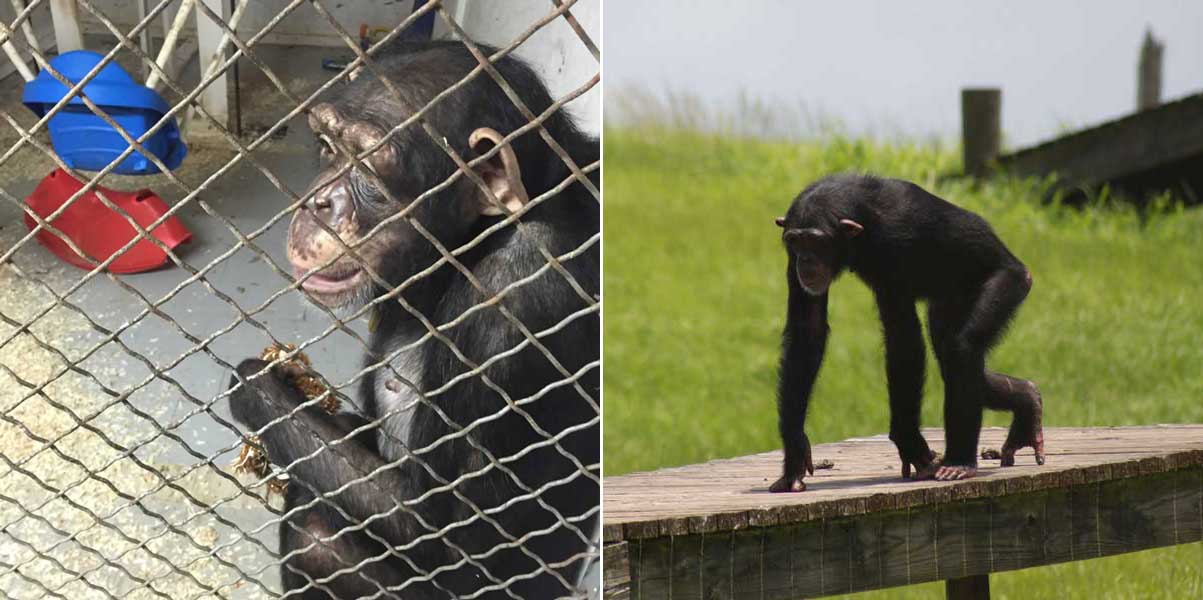
Left: Chimpanzee Lisa Marie was born at the former breeding hellhole known as the Missouri Primate Foundation before she was sold to a private owner as a “pet” and forced to live in a basement in Chicago. | Right: Here’s Lisa Marie after PETA helped rescue and transfer her to a lush, spacious sanctuary in 2015.
- Ross published many important works, including a study showing that using great apes on greeting cards as well as in films, on television, and in advertisements can lead the public to believe that the endangered species isn’t in need of the protection that’s so desperately called for.
- He was one of the first AZA-affiliated experts to consult with PETA on captive wildlife welfare and gave critical advice that guided our work in behalf of captive chimpanzees.
What better way to celebrate Ross’ life than by advocating for the animals he spent his life sticking up for?
To honor Ross’ memory, we must actively oppose the exploitation of great apes, as he did so soundly for so many years. Here are three things you can do right now to honor him and all the great apes he spoke out for:
-
- Urge Hallmark Cards to stop profiting from clownish images of chimpanzees featured on several of its greeting cards.
- Be sure not to spend any of your vacation time at places where animals will still languish in misery long after you’re back home—never visit a roadside zoo!
- Share this post on Facebook and Twitter—encourage your family, friends, and other social media followers to speak up for great apes, too.
The post PETA Remembers Dr. Steve Ross, Champion of Great Apes appeared first on PETA.
PETA Statement re Whipping Ban Overturned by NJ Racing Commission
Please see the following statement from PETA Senior Vice President Kathy Guillermo regarding the New Jersey Racing Commission’s vote to repeal the whipping ban on Thoroughbreds. The commission cited new rules promulgated under the Horseracing Integrity and Safety Act—even though stronger rules can be followed by individual tracks.
The New Jersey Racing Commission should be put out to pasture for voting to allow horses to be beaten again. Today, it eagerly rescinded the whipping ban on Thoroughbreds, using the Horseracing Integrity and Safety Act rules—which aren’t even in place yet—as an excuse to undo progress and allow jockeys to repeatedly strike the animals it is supposed to protect. PETA urges Gov. Phil Murphy to veto the new rule immediately.
PETA—whose motto reads, in part, that “animals are not ours to use for entertainment or abuse in any other way”—opposes speciesism, a human-supremacist worldview. For more information, please visit PETA.org or follow the group on Twitter, Facebook, or Instagram.
The post PETA Statement re Whipping Ban Overturned by NJ Racing Commission appeared first on PETA.