Talbots Commits to Banning Alpaca Fleece

Hats off to Talbots! After hearing from PETA that gentle alpacas are kicked, hit, and slammed onto tables—some even while pregnant—then shorn so quickly and violently that many are left bleeding from deep wounds, the retailer made the compassionate decision to eliminate all alpaca fleece from its merchandise by the end of 2022. Please urge Anthropologie and others to join the more than 65 companies that have banned the cruelly derived material.

The post Talbots Commits to Banning Alpaca Fleece appeared first on PETA.

Toronto Educator Named PETA’s National ‘Teacher of the Year’

Just in time for World Teachers’ Day (October 5), TeachKind—PETA’s humane education division—has crowned the recipient of its 2022 Canadian Teacher of the Year Award: University of Toronto Schools educator Mike Farley. In his classroom of middle school and high school students, Farley helps young people explore the animal issues they’re passionate about—and by founding an animal advocacy conference for educators, he’s helping other teachers incorporate humane education into their own lessons.

A geography teacher, Farley weaves in animal-friendly teaching opportunities whenever he can. Student projects have included comparing the environmental and animal welfare effects of the meat, egg, and dairy industries to those of the vegan protein industry—and after a field trip to a local donkey sanctuary, students designed their own animal sanctuaries in diverse biomes. Farley has also encouraged students to explore animal issues and form their own conclusions. For example, after a lesson involving the documentary The Cove, about Japan’s dolphin trade and slaughter, several students told Farley that they were swearing off entertainment that exploits animals.

In addition to inspiring other teachers at his school to add animal rights issues into their curricula, Farley founded the Educators for Animals Conference, which brings together hundreds of educators from around the world to celebrate animals and explore how to work animal advocacy into classrooms and school communities.

“Whether he’s starting classroom conversations about vegan eating or connecting with educators from around the world, Mike Farley is teaching compassion for all and helping others do the same,” says PETA Senior Director of Youth Programs Marta Holmberg. “TeachKind is delighted to honor him for building innovative curricula that cultivate empathy and curiosity in young people.”

In addition to a framed “Teacher of the Year” certificate, Farley will receive a gift box filled with goodies, including a “Teaching Kindness Like It’s My Job” mug and a “Bringing Home the Bagels” tote bag.

TeachKind—whose motto reads, in part, that “animals are not ours to abuse in any way”—opposes speciesism, a human-supremacist worldview. The group offers free presentations, lessons, and other resources to help teachers add compassion to their curriculum.

For more information, visit TeachKind.org or follow the group on Facebook or Instagram.

The post Toronto Educator Named PETA’s National ‘Teacher of the Year’ appeared first on PETA.

Victory: Avoyelles Parish School Board Votes to Evict Dangerous Monkey Warehouse

After PETA shared concerns about Jeffrey Quebedeaux’s plan to build a dangerous monkey prison in the area, the Avoyelles Parish School Board—angry that Quebedeaux hadn’t fulfilled the terms of his—voted to keep the monkey business out of town and initiated eviction proceedings to terminate Quebedeaux’s lease and collect past-due rent. If completed, the facility would have been a waystation for thousands of endangered monkeys destined for experiments. It would have violated state laws prohibiting the possession of primates and risked the spread of diseases.

As PETA explained in letters to the school board and local and federal authorities, monkeys can carry simian hemorrhagic fever virus, Ebola-like viruses, tuberculosis, West Nile virus, malaria, Chagas disease, simian immunodeficiency virus, herpes B, hepatitis, and other infectious pathogens and diseases, which they can shed in their feces, saliva, blood, and urine and which are transmissible to humans.

“This hell on Earth for monkeys would primarily have held long-tailed macaques, whom experimenters have driven to the brink of extinction, and it would have posed a serious biohazard to the local community,” says PETA Senior Vice President Kathy Guillermo. “The Avoyelles Parish School Board has made the right ethical and fiscal decision—and will be protecting public health.”

Quebedeaux owns the transportation company behind the high-profile crash earlier this year of a truck carrying 100 long-tailed macaques imported from Mauritius, which sent dozens of crates holding monkeys—who had not yet been quarantined or tested for dangerous pathogens—flying into the air, and three escaped monkeys were ultimately shot dead. Quebedeaux Transport was also involved in a 2020 incident in which a truck hauling monkeys caught fire.

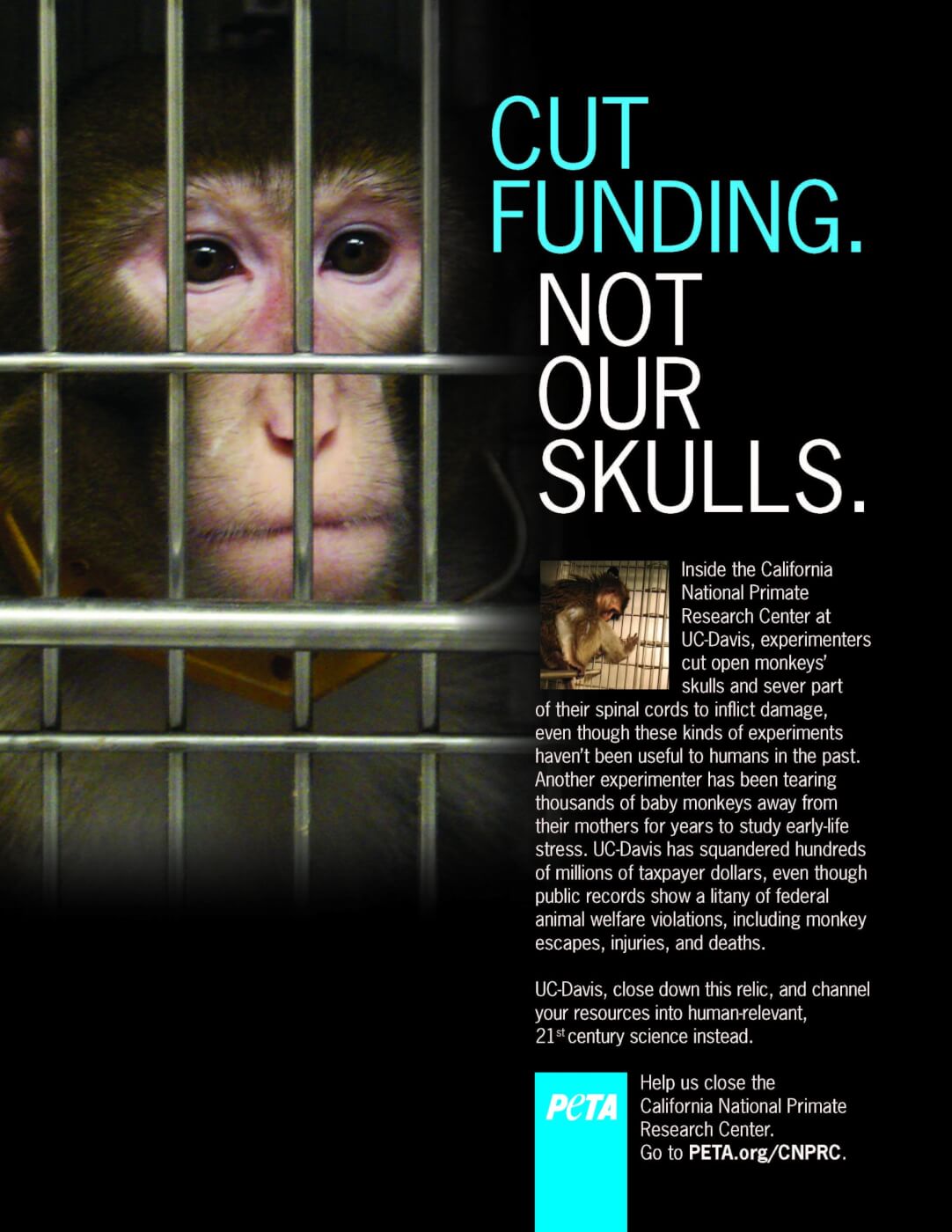
Monkeys imported to the U.S. for use in experiments are torn from their homes in nature or raised on squalid breeding farms in Africa or Asia. At the laboratories where they end up, they’re imprisoned in barren cages, force-fed chemicals, addicted to cocaine or other drugs, harmed when holes are drilled into their skulls, and eventually killed.

After PETA learned of Quebedeaux’s plans from state records, the group sent complaints to the Centers for Disease Control and Prevention, the U.S. Department of Agriculture (USDA), the mayor of Bunkie, and the Avoyelles Parish Police Jury as well as the school board. The USDA subsequently turned down Quebedeaux’s application for a research permit.

PETA—whose motto reads, in part, that “animals are not ours to experiment on”—opposes speciesism, a human-supremacist worldview. For more information on PETA’s investigative newsgathering and reporting, please visit PETA.org or follow the group on Twitter, Facebook, or Instagram.

The post Victory: Avoyelles Parish School Board Votes to Evict Dangerous Monkey Warehouse appeared first on PETA.

U.S. Army Quietly Reverses Ban on ‘Weapon Wounding’ Studies on Animals, PETA Finds

PETA has filed an appeal with the U.S. Army requesting the release of public information on weapons testing that inflicts wounds on dogs, cats, monkeys, and/or marine mammals. The military branch confirmed to the group that at least one such study protocol existed yet refused to release it, claiming that it’s “classified … ‘in the interest of national defense or foreign policy.’” PETA also sent a letter to Secretary of the Army Christine Wormuth urging her to reinstate the ban on such tests.

In 1983, PETA exposed and successfully campaigned to shut down a U.S. Department of Defense “wound lab” in which dogs, goats, and other animals were shot with high-powered weapons in order to inflict injuries, resulting in the first-ever permanent ban on the shooting of dogs and cats in wound labs, which was issued by then–Secretary of Defense Caspar Weinberger. In 2005, the Army issued Regulation 40-33, which prohibited the use of dogs, cats, nonhuman primates, and marine mammals in “[r]esearch conducted for development of biological, chemical, or nuclear weapons.” Yet in 2020, the Army issued a memorandum that apparently reversed its position by permitting “[t]he purchase or use of dogs, cats, nonhuman primates, or marine mammals to inflict wounds upon using a weapon for the purpose of conducting medical research, development, testing, or evaluation.”

The Army denied PETA’s March 18, 2022, Freedom of Information Act (FOIA) request for photos, videos, and other documentation relating to experiments approved by the U.S. Army Medical Research and Development Command (USAMRDC) Animal Care and Use Review Office “that involve the use of a weapon … to inflict wounds” on such animal species—even though a redacted version of the requested information should have been provided, as PETA believes is legally required. USAMRDC initially stated that it possessed “in excess of 2,000 pages” of records responsive to PETA’s FOIA request before backtracking and claiming that it has “only (1) one protocol that meets the criteria of the request,” which is prohibited from release due to national or foreign security concerns.

“Taxpayers deserve to know what the U.S. Army is hiding by refusing to release details of its horrific weapon wounding experiments on animals,” says PETA Vice President Shalin Gala. “PETA is demanding that the Army ban weapon wounding tests on dogs, cats, monkeys, and marine mammals and release all non-sensitive information about these tests that it marked as ‘classified’—a designation that speaks volumes about what animals likely endure in the Army’s secret torture labs.”

PETA—whose motto reads, in part, that “animals are not ours to experiment on”—opposes speciesism, a human-supremacist worldview. For more information on PETA’s investigative newsgathering and reporting, please visit PETA.org or follow the group on Twitter, Facebook, or Instagram.

The post U.S. Army Quietly Reverses Ban on ‘Weapon Wounding’ Studies on Animals, PETA Finds appeared first on PETA.