Following 20-year-old Caleb Daniel Dewald’s guilty plea this week to 10 counts of felony cruelty to animals—based in part on video evidence taken during his time at The North Carolina Leadership Academy (NCLA) of various wildlife species being drowned, stabbed, burned, or bludgeoned—TeachKind, PETA’s humane education division, rushed a letter today to The NCLA, providing educators with kindness-to-animals curricula and “Empathy Now,” a guide to preventing all kinds of violence by young people.
PETA provided the Forsyth County Sheriff’s Office with some of the video evidence showing Dewald torturing and killing animals. According to the sheriff’s office, NCLA administrators stated that before Dewald graduated in 2020, they had repeatedly been told that he possessed images of animals being “tortured and flayed” and that they had even found a journal containing drawings and confessions of attacks on animals—but the school apparently returned the journal to Dewald and took no adequate steps to address the abuse.
“This man has admitted to spending his teenage years setting vulnerable animals on fire, drowning them, and cutting off their body parts,” says PETA Senior Director of Youth Programs Marta Holmberg. “TeachKind is on standby to help his alma mater prevent future killing sprees by teaching young people that all violence is wrong, regardless of the victims’ species.”
TeachKind notes that research shows that 43% of school shooters, including the perpetrator at Robb Elementary School in Uvalde, Texas, first committed acts of cruelty against animals—so juvenile animal abusers potentially pose a serious threat to the community at large. The group is also offering to send its resources—including its free high school empathy-building curriculum, Challenging Assumptions, and its “Share the World” program kit for elementary school students—to other schools in the area.
TeachKind—whose motto reads, in part, that “animals are not ours to abuse in any way”—opposes speciesism, a human-supremacist worldview. For more information, please visit TeachKind.org or follow the group on Facebook or Instagram.
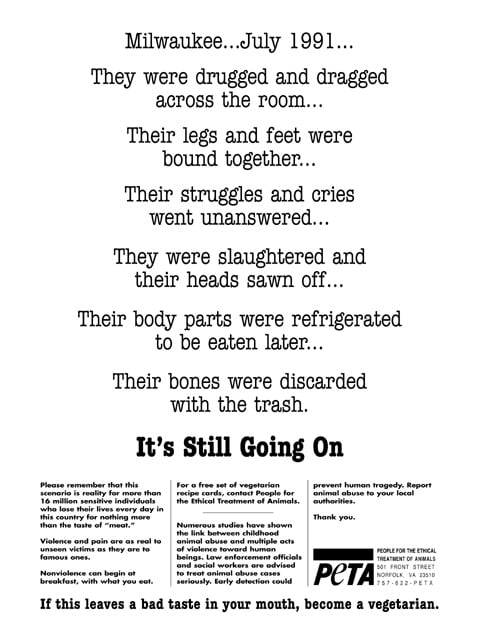
There’s a reason the FBI keeps track of cases of cruelty to animals: It’s often a precursor to escalated levels of violence, most famously illustrated by serial killers and mass shooters such as Jeffrey Dahmer, Ted Bundy, and Nikolas Cruz, who abused other animals before attacking humans.
Studies have shown that animal abuse is a better predictor of sexual assault than previous convictions for homicide, arson, or weapons offenses: Psychology Today reported that 70% of criminals who were most violent to humans in one prison also had a history of animal abuse, and other studies have found that 43% of school shooters have a history of abusing animals. Animal abuse is also one of the most significant factors in someone’s becoming a domestic abuser. How many killers abused our fellow animals before harming humans?
David Berkowitz
Before he began terrorizing New York City in the summer of 1976, David Berkowitz, also known as the “Son of Sam,” lived in Yonkers, where he shot one of the neighborhood dogs whom he thought was possessed by demons. He killed six people and wounded seven in eight separate shootings throughout New York City’s outer boroughs. When he was finally caught, he claimed that he’d received instructions to kill people from a demon named Sam that possessed his neighbor’s dog, a black Labrador retriever named Harvey. Berkowitz eventually shot Harvey.
Ted Bundy
Ted Bundy was the confirmed killer of at least 30 humans, and he reportedly derived pleasure from tormenting small animals, such as dogs and cats. According to family members, Bundy’s grandfather was a violent man who abused animals—reportedly kicking dogs until they howled and swinging cats by their tails—and Bundy cited his grandfather as one of the few people he felt close to. A criminal defense attorney who represented him in the 1970s reported that as a child, Bundy would buy mice at a local pet shop and “play God” to determine their fate. A woman who claimed to have grown up with him said that he liked to tear apart neighbors’ animal companions and set them on fire. It’s speculated that he had around 100 human victims, and the violence he was responsible for increases exponentially when victims of other species are added to the count.
Nikolas Cruz, who confessed to killing 17 students and teachers at Marjory Stoneman Douglas High School in Parkland, Florida, committed many acts of cruelty before he opened fire that day. In elementary school, he shot squirrels and chickens, and as a teenager, he reportedly killed frogs, tried to maim a neighbor’s pot-bellied pigs, and tried to crush animals trapped in rabbit holes. In a video shown at his trial Cruz described how he used to skin lizards with a knife after taping them to a table at age 4. His now-defunct social media accounts also reportedly showed many photos of dead animals, presumably more victims of his cruelty.
Jeffrey Dahmer
A young Jeffrey Dahmer caught tadpoles as a gift for his teacher. When his teacher gave them to another student, Dahmer was furious. He went to the student’s home and poured motor oil into the tadpoles’ jar, killing them. Dr. Carl Wahlstrom, a forensic psychiatrist who interviewed and evaluated Dahmer, recalled that he said, “If you want to call that torturing animals, I tortured animals.”
His father, a scientist who believed his son was taking an interest in biology when Dahmer collected dead animals, taught him how to bleach and preserve their bones—the same techniques he would later employ to attempt to preserve his human victims. He allegedly liked to cut open live fish to see their insides and strangled neighborhood dogs and cats. Neighbors found frogs and cats impaled on or staked to trees. In 1975, he went so far as to decapitate the carcass of a dog, place the head on a stick, and nail the body to an adjacent tree—all as a “prank.” He would murder his first human victim just three years later and went on to kill 16 other men and boys between 1978 and 1991.
Albert DeSalvo
Albert DeSalvo, who confessed to killing 13 women as the “Boston Strangler,” also confessed to stealing dogs and cats in his youth, confining them to a box or crate, and then shooting arrows into the enclosure to injure or kill them.
Payton Gendron
Payton Gendron was indicted by a federal grand jury on 27 firearm and hate crime counts in addition to facing New York state murder charges for the Buffalo grocery store attack that killed 10 and injured three people in May 2022. Gendron allegedly targeted Black people in a premeditated act of terrorism.
Just two months prior to the shooting, according to one of his own social media posts, he had found a feral cat attacking his own feline animal companion in his garage and spent 90 minutes chasing the cat, stabbing the animal with a hunting knife, and swinging a hatchet at the cat’s throat. He posted a photo of the mutilated cat online with a caption detailing how he felt “blank” about the killing and a photo of his own face sprayed with the animal’s blood.
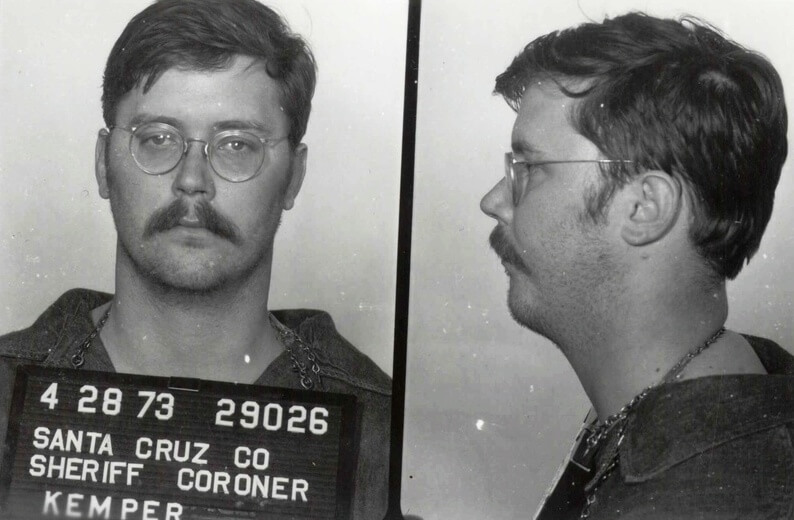
Edmund Kemper
Two cats were among the first victims of Edmund Kemper, who would later kill his paternal grandparents, his mother, her best friend, and several college-age women. At the age of 10, Kemper buried the family cat alive, then dug up and decapitated the animal and put the head on a stick. Just three years later, he killed another family cat because he perceived the animal to be favoring his younger sister over him. He kept pieces of the dismembered feline in his closet until his mother found them. Just over a year later, at age 15, Kemper used a rifle that his grandfather had confiscated from him for shooting animals to kill both of his grandparents, the first of 10 human victims. As an adult weighing around 300 pounds and standing at 6 feet 9 inches tall, he was known as “Big Ed” and then “The Co-Ed Butcher.”
Dennis Rader
“BTK,” the name serial killer Dennis Rader submitted to newspapers while on a murder spree in the 1970s, stood for “Bind, Torture, Kill.” He reportedly practiced this killing method on other species. As a child, he allegedly developed “violent sexual fantasies that involved bondage” after killing cats and dogs by hanging and strangling them. He enjoyed watching animals struggle until they died, and he got excited when he saw chickens who would soon be killed for their flesh. After he became a dogcatcher and compliance officer in 1991, numerous complaints were filed against him—including for killing his neighbor’s dog. In 2005, Rader was convicted of 10 murders committed between 1974 and 1986.
Michael Bruce Ross
Michael Bruce Ross grew up on his family’s chicken farm in Connecticut. When he was 8 years old, he was put in charge of feeding chicks and giving them water. When he deemed a chick too small or unlikely to produce enough eggs, his job was to kill them, which he did by strangling them. He grew up to become known as “The Egg Man” and “The Roadside Strangler” for raping and murdering three women and five teenage girls. In addition to the murders, Ross confessed to about two dozen rapes.
The killing of baby chicks isn’t just committed by growing serial killers. It’s standard in the egg industry, where more than 200 million male chicks are killed each year because they’re “useless” in terms of profit. This happens on all farms: Eggs labeled “free-range” and “cage-free” come from hatcheries that kill day-old male chicks and farms that exploit their mothers and sisters for their reproductive parts and flesh.
Help PETA Lead With Empathy and Reach Children Before Violence Occurs
PETA keeps an updated list of reported incidents in which young people have committed acts of cruelty to animals. It’s meant to illustrate how prevalent the problem is and provide educators with tools to teach students what it means to have compassion for all living, feeling beings, and it can be shared with your local school district and community members. Early intervention is key to saving lives, and simply reporting an incident can make a difference. Please share this resource with any educator you know:
Pennsylvania State Police have charged five former Plainville Farms workers with 18 counts of cruelty to animals in Perry County following a PETA undercover investigation that revealed workers kicking and stomping on turkeys, including birds who were sick, injured, and unable to walk. PETA’s exposé has resulted in 139 counts of cruelty to animals against 11 former workers—the largest number in any factory-farmed animal case in U.S. history. New Oxford–based Plainville Farms is a supplier to top grocers nationwide, including Wegmans, Publix, and Harris Teeter.
PETA’s investigator documented that after failing to break turkeys’ necks, workers left the birds to convulse and die in agony on the shed floor. Instead of trying to stop this abuse, a supervisor joined in, kicking turkeys and berating the investigator for not doing the same. Workers threw hens at one another like basketballs. One worker pretended to masturbate with a dying bird, and another sat on and pretended to rape a live turkey.
“Nothing can undo the suffering that these helpless, gentle turkeys endured at Plainville Farms, but these charges show other meat companies that cruelty has consequences,” says PETA Vice President of Evidence Analysis Daniel Paden. “PETA encourages anyone upset by what these battered birds endured to avoid complicity in the abuse on factory farms by choosing vegan meals.”
Following PETA’s investigation, Global Animal Partnership suspended Plainville Farms’ “humane” certification and Whole Foods pulled its turkey “products” from the shelves. Plainville terminated the workers and pledged to start monitoring operations using body cameras—a move PETA deemed meaningless unless the footage was livestreamed so that the public could review it and call out any further acts of cruelty.
PETA has also submitted a complaint to the Federal Trade Commission alleging that Plainville Farms is engaging in false advertising by making claims on its packaging that turkeys on its suppliers’ farms are “humanely raised” in a “stress-free environment.”
Broadcast-quality video footage from PETA’s investigation is available here.
PETA—whose motto reads, in part, that “animals are not ours to eat”—opposes speciesism, a human-supremacist worldview. For more information on PETA’s investigative newsgathering and reporting, please visit PETA.org or follow the group on Twitter, Facebook, or Instagram.
PETA Kids has just launched its first-ever bilingual coloring and reading book, All About Animals (Todo Sobre los Animales)—with a delivery today of 1,000 copies of the book, along with colored pencils, to immigrant children in Southern California who are being helped by The Coalition for Humane Immigrant Rights, World Relief Southern California, the International Institute of Los Angeles, the Central American Resource Center of Los Angeles, and the Long Beach Immigrant Rights Coalition.
All About Animals is full of sweet illustrations for kids to color, interesting facts about wildlife (such as “elephants live in close-knit families”), and age-appropriate lessons about showing kindness to animals (such as “dogs need a loving home and fresh water, healthy food, exercise, and attention every day”).
“Kids love animals, and we want them to love reading, too, so the exercises and coloring activities in All About Animals are designed to build kids’ English vocabulary and their empathy for animals in a fun, familiar way,” says PETA Kids Senior Director of Youth Programs Marta Holmberg. “PETA Kids is proud to help immigrant support organizations ease the transition for children in a stressful situation.”
PETA Kids—whose motto reads, in part, that “animals are not ours to abuse in any way” and which opposes speciesism, a human-supremacist worldview—notes that according to a recent study, children are less likely than adults to see a moral hierarchy between humans and other animals.
All About Animals—which PETA Kids also sent another 1,000 copies to immigrant support groups in Chicago as well as in metro areas in New York and Texas—can be downloaded free of charge on the PETA Kids website. For more information, please visit PETAKids.com or follow the group on Facebook or Instagram.