Campus or Crime Scene? PETA’s ‘Dead Monkeys’ to Haunt UW President’s Speech

On Friday, during homecoming week at the University of Washington (UW), PETA supporters wearing monkey masks and covered with “blood” will lie on the ground inside chalk outlines of monkeys. This “crime scene” will draw attention to the school’s Washington National Primate Research Center (WaNPRC), where experimenters cut into endangered monkeys’ bodies and infect them with deadly pathogens.

When:    Friday, October 14, 3:30 p.m.

Where:    University of Washington, at the western entrance to The HUB, 4001 E. Stevens Way N.E., Seattle

The action will coincide with UW President Ana Mari Cauce’s keynote lecture and alert attendees to the WaNPRC’s multiple violations of federal animal protection laws as well as state laws designed to protect public health. UW was cited by the U.S. Department of Agriculture after a monkey strangled to death. Days-old monkeys have been mutilated and killed by other caged and stressed primates, and monkeys have died from veterinary errors and even from choking on their own vomit. Zoonotic pathogens have infected endangered pig-tailed macaques in UW’s Arizona breeding colony.

“The University of Washington is a crime scene where vulnerable monkeys have been mutilated, strangled, starved, and killed in an underground laboratory, despite laws designed to protect them,” says PETA Senior Science Advisor Dr. Lisa Jones-Engel. “PETA is calling on UW to end its cruel, archaic experiments and embrace cutting-edge, animal-free research methods.”

PETA—whose motto reads, in part, that “animals are not ours to experiment on”—opposes speciesism, a human-supremacist worldview. For more information, please visit PETA.org or follow the group on Twitter, Facebook, or Instagram.

The post Campus or Crime Scene? PETA’s ‘Dead Monkeys’ to Haunt UW President’s Speech appeared first on PETA.


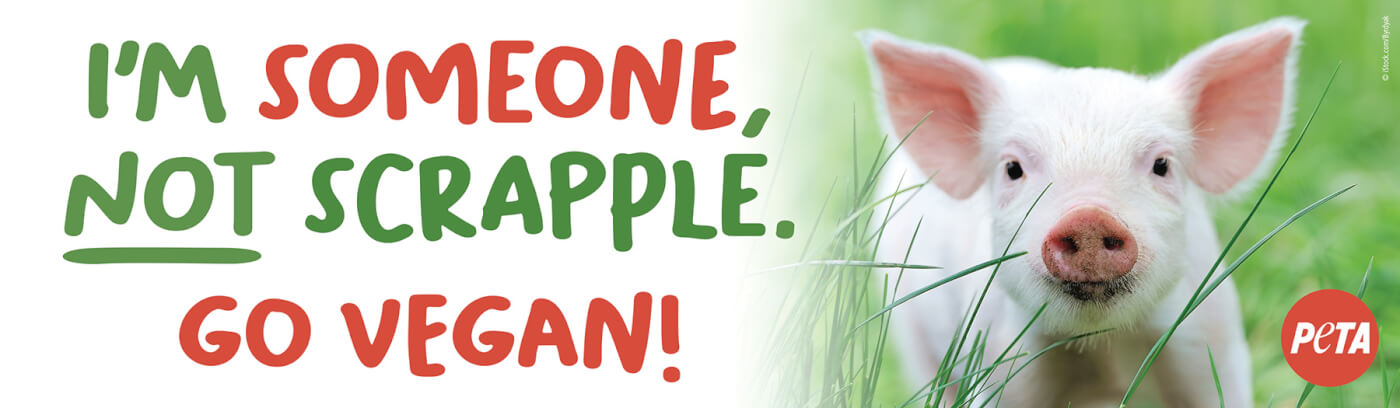
‘I’m Someone, Not Scrapple’: PETA’s Pig Plea Hits Local Streets

Ahead of the Apple Scrapple Festival on Friday and Saturday, PETA has plastered 10 local buses with a can’t-miss plea encouraging everyone to recognize pigs as thinking, feeling individuals and to keep their plates clear of scrapple—a congealed gray loaf often made with main-cut castoffs like snouts, tails, and other fleshy parts of pigs. The vegan messaging blitz comes as Bridgeville-based RAPA Scrapple continues to produce the largest amount of scrapple worldwide.

“Every time someone chooses oatmeal, fruit salad, vegan sausage, or tofu scramble instead of scrapple and other pig parts, they prevent a gentle, playful pig from feeling pain,” says PETA President Ingrid Newkirk. “PETA encourages Delawareans to enjoy foods that save lives—perhaps, given the fat and cholesterol in meat, even their own!”

Nearly all of the 121 million pigs killed for food in the U.S. each year—including for scrapple—are confined to filthy enclosures so small they can barely turn around. Workers chop off piglets’ tails, cut their teeth with pliers, and castrate the males—all without pain relief. At the slaughterhouse, workers hang pigs upside down, sometimes while they’re still conscious, and bleed them to death. Each person who goes vegan spares nearly 200 animals every year; reduces their own risk of suffering from cancer, heart disease, strokes, diabetes, and obesity; and dramatically shrinks their carbon footprint.

PETA—whose motto reads, in part, that “animals are not ours to eat” and which opposes speciesism, a human-supremacist worldview—notes that many pig-friendly options are available today, such as Sweet Earth’s Benevolent Bacon, Tofurky’s Ham Style Roast, and Gardein’s Breakfast Saus’ge.

For more information, please visit PETA.org or follow the group on Twitter, Facebook, or Instagram.

The post ‘I’m Someone, Not Scrapple’: PETA’s Pig Plea Hits Local Streets appeared first on PETA.

Sustainable Fashion Is Vegan Fashion—PETA Participates in Vegan Fashion Week Panel

On October 10, PETA Director of Social Media Ashley Frohnert spoke at Vegan Fashion Week in Los Angeles about the importance of vegan fashion in the sustainability movement—because sustainable fashion is vegan fashion.

The fourth annual Vegan Fashion Week was also a collaboration with Ukrainian Fashion Week in an effort to invite people to choose compassion and highlight the impact of human activity on the planet. The Sustainability & Ethics panel included Sylven New York designer and founder Casey Dworkin; Sentient designer, founder, and CEO Jimena Suárez Ibarrola; and Desserto cofounder Adrian Velarte.

Vegan Fashion Week has been a leader in the fashion industry by bringing together both emerging and established designers to showcase innovations in animal-free fashion. Brands and designers are pushing fashion forward with everything from leather made from food waste to down made from flowers.

Animal-derived materials like leather, wool, fur, feathers, and exotic skins are all major contributors to the climate catastrophe. Cow leather has nearly 10 times the negative environmental impact of non-animal leathers, like Desserto and Piñatex. Sheep “dip”—the toxic liquid used in the wool industry to rid sheep of parasites—contaminates waterways, damaging ecosystems and killing wildlife.

These materials also come at the cost of animals’ lives. Playful cows want to live, not be killed so that their skin can be made into shoes or a handbag. Sheep don’t want to endure terrifying and painful shearing—they’d much rather spend time with their flock and chomp on tasty plants.

PETA has worked for decades to expose cruelty to animals in the fashion industry. Even now, we’re pushing companies like Urban Outfitters Inc. to do better for animals and the planet by dropping cruelly obtained materials.

Take Action for Animals—Urge Urban Outfitters Brands to Change

The post Sustainable Fashion Is Vegan Fashion—PETA Participates in Vegan Fashion Week Panel appeared first on PETA.

Harris Teeter Asked to Act After Cruelty Charges Filed Against ‘Humane’ Turkey Supplier

Over the last few days, 11 former workers at Plainville Farms, a supplier to locally based grocer Harris Teeter, have been charged with 139 counts of cruelty to animals, including six felonies—the largest number in any factory-farmed animal case in U.S. history. So PETA fired off a letter this morning to Harris Teeter President Tammy DeBoir calling on the company—which still sells Plainville turkeys with a “humanely raised” label and a highly misleading “Earthwise” seal—to assess whether Plainville has taken any measures to stop animal abuse and asking Harris Teeter to take a PETA representative with it for inspections of farms.

The “Earthwise” seal is designed to look good to consumers, but it turns out that it’s simply Plainville’s own invention.

PETA’s investigative evidence, which led Pennsylvania State Police to file the charges, shows Plainville workers “kicking, stomping on, beating, throwing, and cruelly killing turkeys on a nightly basis.” Staff even mimicked masturbation and rape with injured and dying birds.

“Video footage of workers beating turkeys at Plainville suppliers was too horrific for police to ignore, yet Harris Teeter continues to profit from selling shoppers a ‘humane’ lie,” says PETA Executive Vice President Tracy Reiman. “PETA is calling on Harris Teeter to take a long hard look at its relationship with Plainville—and everyone else to take personal responsibility by eating vegan.”

Following PETA’s investigation, Global Animal Partnership suspended Plainville’s “humane” certification and Whole Foods pulled its turkey products from the shelves. Plainville terminated the workers and pledged to start monitoring operations using body cameras—a meaningless move, PETA notes, unless the footage is livestreamed so that the public can review it and call out any additional acts of cruelty.

PETA has also submitted a complaint to the Federal Trade Commission alleging that Plainville is engaging in false advertising by making claims on its packaging that turkeys on its suppliers’ farms are raised in a “stress-free environment.”

Broadcast-quality video footage from PETA’s investigation is available here.

PETA—whose motto reads, in part, that “animals are not ours to eat”—opposes speciesism, a human-supremacist worldview. For more information on PETA’s investigative newsgathering and reporting, please visit PETA.org or follow the group on Twitter, Facebook, or Instagram.

The post Harris Teeter Asked to Act After Cruelty Charges Filed Against ‘Humane’ Turkey Supplier appeared first on PETA.