
Justice for Juan is justice for the environment
By: Graciela Martínez, senior campaigner, and Adeline Neau, researcher for Central America at Amnesty International.
A year ago, in Tocoa, northern Honduras, environmentalist Juan López was shot dead in front of his family, friends and neighbours as he was leaving a religious service. The alleged perpetrator of the shooting and two alleged accomplices have been formally charged and are being held in pretrial detention. However, those who may have ordered his murder have not yet been held to account. Since then, his family and fellow activists have launched a legal battle to seek justice, truth and reparation.
Juan’s murder, like that of Berta Cáceres almost ten years earlier, has left a huge void in the leadership of environmental defence in Honduras. For his community role in promoting ecology and the environment within the Catholic Church, Pope Francis himself at the time mourned Juan’s death.
Juan’s murder, like that of Berta Cáceres almost ten years earlier, has left a huge void in the leadership of environmental defence in Honduras.
Honduras tops the list of per capita killings of environmental defenders worldwide over the last decade, according to reports by Global Witness. In addition to lethal violence, environmental defenders often face threats, harassment, arbitrary detention and even enforced disappearance. All this in a climate of impunity.
At the start of her term in office, the president of Honduras, Xiomara Castro, promised to protect the environment and those who defend it. However, with just a few months of the term remaining, we note with concern her repeated failure to fulfil those human rights commitments.
Regarding the right to a healthy environment, in 2024 Congress approved a decree to protect the Carlos Escaleras National Park defended by Juan López and his community, a decree that is yet to be implemented. However, Congress also promoted a controversial bill to ease the granting of environmental licences for certain projects. In addition, the president has not yet signed the Regional Agreement on Access to Information, Public Participation and Justice in Environmental Matters in Latin America and the Caribbean, known as the Escazú Agreement, which, among other issues, includes specific provisions for the protection of environmental defenders.
The murder of Juan López shines a harsh light on these contradictions. The crime was committed in Tocoa, in the Aguán Valley, an area rich in biodiversity and among the most conflict-ridden in the country. Although Juan had precautionary measures granted in his favour by the Inter-American Commission on Human Rights, the Honduran authorities failed to guarantee his protection. The National Protection System, responsible for his safety, has been strongly criticized by local and international organizations for its inefficiency.
The history of violence in Aguán goes back a long way. Throughout the 20th and 21st centuries, banana, palm oil and mining companies have disputed its lands, with the endorsement of the authorities, thereby weakening protection of communal property. Unofficial figures suggest that nearly 200 people have disappeared or been murdered in the region since 2009. In February 2022, to address this serious situation, farmer organizations signed an agreement
with the Honduran government that included the creation of a tripartite commission to investigate human rights violations. However, three years later, no significant progress has been made. Furthermore, in 2023, three individuals associated with the Municipal Committee for the Defence of Common and Public Goods (CMDBCP) – led by Juan – were murdered, with no justice having been served in these cases to date. Others have been forced to leave the region due to the violence.
Juan moved as a child to Bajo Aguán with his family, who were looking to work on the land. It was there that he learned of the challenges facing farming communities and began to get involved in defending their rights. Years later, in 2015, he and other colleagues who shared his faith and activism, concerned about community issues, in particular regarding water, founded the Municipal Committee for the Defence of Common and Public Goods.
The mobilization of the communities of Tocoa came about in response to a series of decisions taken by the Honduran authorities. In 2012, Congress declared what is today the Montaña de Botaderos Carlos Escaleras Mejía National Park, to protect the area from the effects of heavy industries, including mining. However, a year later, that same Congress decided to extend the Park’s buffer zone, thereby reducing the extent of its most protected area. This opened the door for the government to grant mining permits there. As a result, between 2014 and 2015, the Honduran authorities granted exploration and exploitation concessions to a mining company. Since then, Juan and the Committee organized peacefully to defend the National Park, challenging the legality of the mining concessions and denouncing their impact on the water quality of the Guapinol and San Pedro rivers.
Attacks against Juan and the Committee soon materialized after the mobilizations, with smear campaigns, threats and trials. Several activists, including Juan, were wrongfully imprisoned. Amnesty International declared eight Committee activists prisoners of conscience in 2021; they spent more than two years in prison solely for peacefully defending the environment.
Juan’s murder is not an isolated incident. It is indicative of a systematic pattern of violence and institutional negligence that must stop. In the face of a global climate emergency, protecting the planet cannot come at the cost of human lives.
Juan’s murder is not an isolated event. It is indicative of a systematic pattern of violence and institutional negligence that must stop. In the face of a global climate emergency, protecting the planet cannot come at the cost of human lives.
Honduras will hold presidential elections on 30 November. It is time to demand that protecting the environment and those who defend it becomes a priority on the political agenda. Justice for Juan is a debt owed to his wife and two daughters, to his community and to our planet. Juan López is one of nine cases selected for Amnesty International’s annual global Write for Rights 2025 campaign.
OpEd Originally published in El País Americas: https://elpais.com/america-futura/2025-09-14/justicia-para-juan-es-justicia-para-el-medio-ambiente.html
The post Justice for Juan is justice for the environment appeared first on Amnesty International.
Haiti: Labodri massacre exposes state ineffectiveness in protecting the population
Amnesty International condemns the massacre that took place on 11 and 12 September in Labodri, Haiti, where more than forty people were killed and dozens of homes set on fire by gangs, according to civil society organizations.
“The massacre in Labodri is a painful reminder of how precarious state protection is in Haiti. The international community and national authorities cannot remain indifferent while the country’s people continue to be victims of atrocity crimes. We demand immediate action to ensure effective protection and justice for the victims,” said César Marín, Amnesty International’s Deputy Regional Director for Campaigns in the Americas.
The massacre in Labodri is a painful reminder of how precarious state protection is in Haiti.
César Marín, Amnesty International’s Deputy Regional Director for Campaigns in the Americas.
Amnesty International reiterates the call to members of the UN Security Council to act urgently in the face of the crisis in Haiti by implementing measures that guarantee the enjoyment of human rights and the humanitarian needs of Haitians.
The OAS, CARICOM, donor countries and Haitian national authorities must increase their commitment to finding long-term solutions to the human rights crisis in Haiti by ensuring the active participation of Haitian civil society.
“The Haitian population has the right to live in dignity and safety, without the constant fear of armed gang attacks.As we have already warned during previous episodes of violence, the ineffective response to this crisis only perpetuates the cycle of impunity and exposes more communities like Labodri to the same fate”, concluded César Marín.
The Haitian population has the right to live in dignity and safety, without the constant fear of armed gang attacks.
César Marín.
Amnesty International urges gangs to end attacks on the Haitian population.
The post Haiti: Labodri massacre exposes state ineffectiveness in protecting the population appeared first on Amnesty International.
Volcanic activity worldwide 17 Sep 2025: Santiaguito volcano, Fuego, Popocatépetl, Merapi, Semeru, …

Map of today’s active volcanoes
Bezymianny (Kamchatka): Volcanic Ash Advisory Center Tokyo (VAAC) issued the following report: VA IS NOT IDENTIFIABLE IN SATELLITE IMAGERY.
Kusatsu-Shirane (Honshu): The Japan Meteorological Agency (JMA) reported that unrest activity increased at Kusatsu-Shiranesan between 15 September 2025 (local) and 16 September 2025 (local). The alert level remained at „Level 2 – Restriction on proximity to the crater“ (on a 5-level scale).
Source: Japan Meteorological Agency (JMA)
… [read more]
Suwanose-jima (Ryukyu Islands): The Japan Meteorological Agency (JMA) reported that the eruption continued at Suwanosejima on 16 September 2025 (local). The alert level remained at „Level 2 – Restriction on proximity to the crater“ (on a 5-level scale).
Source: Japan Meteorological Agency (JMA)
… [read more]
Canlaon (Central Philippines): The Philippine Institute of Volcanology and Seismology (PHIVOLCS) reported that the eruption continued at Kanlaon on 16 September 2025 (local). Plume(s) rose to a maximum of 300 meters (984 feet) above the vent. The alert level remained at „2 – Moderate Level of Volcanic Unrest“ (level 2 on a 0–5 level scale).
Source: Philippine Institute of Volcanology and Seismology (PHIVOLCS)
… [read more]
Taal (Luzon, Philippines): The Philippine Institute of Volcanology and Seismology (PHIVOLCS) reported that unrest continued at Taal on 16 September 2025 (local). Plume(s) rose to a maximum of 600 meters (1,969 feet) above the vent. A total of 4 episodes of volcanic tremor were recorded. The continuous tremor episode that began at approximately 0150 on 16 September continued. The alert level remained at „1 – Low-Level Unrest“ (on a 0–5 level scale).
Source: Philippine Institute of Volcanology and Seismology (PHIVOLCS)
… [read more]
Mayon (Luzon Island, Philippines): The Philippine Institute of Volcanology and Seismology (PHIVOLCS) reported that unrest continued at Mayon on 16 September 2025 (local). Plume(s) rose to a maximum of 500 meters (1,640 feet) above the vent. Very faint crater incandescence, observable only through a telescope, was reported. The alert level remained at „1 – Abnormal“ (on a 0–5 level scale).
Source: Philippine Institute of Volcanology and Seismology (PHIVOLCS)
… [read more]
Bulusan (Luzon Island, Philippines): The Philippine Institute of Volcanology and Seismology (PHIVOLCS) reported that unrest continued at Bulusan on 16 September 2025 (local). Plume(s) were reported. The alert level remained at „1 – Low Level of Volcanic Unrest“ (level 1 on a 0–5 level scale).
Source: Philippine Institute of Volcanology and Seismology (PHIVOLCS)
… [read more]
Karangetang (Siau Island, Sangihe Islands, Indonesia): The Center for Volcanology and Geological Hazard/Pusat Vulkanologi dan Mitigasi Bencana Geologi (CVGHM/PVMBG) reported that unrest continued at Karangetang on 16 September 2025 (local). Gas and vapor plume(s) rose to a maximum of 50 meters (164 feet) above the vent. The alert level remained at „Level 2 – Alert“ (on a 4-level scale).
Source: Center for Volcanology and Geological Hazard/Pusat Vulkanologi dan Mitigasi Bencana Geologi (CVGHM/PVMBG)
… [read more]
Raung (East Java): The Center for Volcanology and Geological Hazard/Pusat Vulkanologi dan Mitigasi Bencana Geologi (CVGHM/PVMBG) reported that the eruption continued at Raung on 16 September 2025 (local). Gas and vapor plume(s) rose to a maximum of 100 meters (328 feet) above the vent. The alert level remained at „Level 2 – Alert“ (on a 4-level scale).
Source: Center for Volcanology and Geological Hazard/Pusat Vulkanologi dan Mitigasi Bencana Geologi (CVGHM/PVMBG)
… [read more]
Ibu (Halmahera, Indonesia): The Center for Volcanology and Geological Hazard/Pusat Vulkanologi dan Mitigasi Bencana Geologi (CVGHM/PVMBG) reported that the eruption continued at Ibu on 16 September 2025 (local). There were 80 explosions reported, with plumes rising to a maximum of 400 meters (1,312 feet) above the vent. The alert level remained at „Level 2 – Alert“ (on a 4-level scale).
Source: Center for Volcanology and Geological Hazard/Pusat Vulkanologi dan Mitigasi Bencana Geologi (CVGHM/PVMBG)
… [read more]
Lewotobi (Flores): The Center for Volcanology and Geological Hazard/Pusat Vulkanologi dan Mitigasi Bencana Geologi (CVGHM/PVMBG) reported that eruptive activity decreased at Lewotobi (Laki-Laki) on 16 September 2025 (local). The public was advised to maintain a minimum distance of at least 6 km from Lewotobi Laki-laki. The alert level was lowered to „Level 3 – Standby“ (on a 4-level scale) on 16 September 2025 at 15:00by CVGHM/PVMBG due to decreased eruptive activity. Gas and vapor plume(s) rose to a maximum of 200 meters (656 feet) above the vent.
Source: Center for Volcanology and Geological Hazard/Pusat Vulkanologi dan Mitigasi Bencana Geologi (CVGHM/PVMBG)
… [read more]
Lewotolo (Lesser Sunda Islands): The Center for Volcanology and Geological Hazard/Pusat Vulkanologi dan Mitigasi Bencana Geologi (CVGHM/PVMBG) reported that the eruption continued at Lewotolok on 16 September 2025 (local). There were 214 explosions reported, with plumes rising to a maximum of 500 meters (1,640 feet) above the vent. There was 1 seismically detected rockfall. The alert level remained at „Level 3 – Standby“ (on a 4-level scale).
Source: Center for Volcanology and Geological Hazard/Pusat Vulkanologi dan Mitigasi Bencana Geologi (CVGHM/PVMBG)
… [read more]
Merapi (Central Java, Indonesia): The Center for Volcanology and Geological Hazard/Pusat Vulkanologi dan Mitigasi Bencana Geologi (CVGHM/PVMBG) reported that the eruption continued at Merapi on 16 September 2025 (local). Gas and vapor plume(s) rose to a maximum of 50 meters (164 feet) above the vent. There were 12 hot rockfalls, traveling up to 2,000 m. There were 104 seismically detected rockfalls. The alert level remained at „Level 3 – Standby“ (on a 4-level scale).
Source: Center for Volcanology and Geological Hazard/Pusat Vulkanologi dan Mitigasi Bencana Geologi (CVGHM/PVMBG)
… [read more]
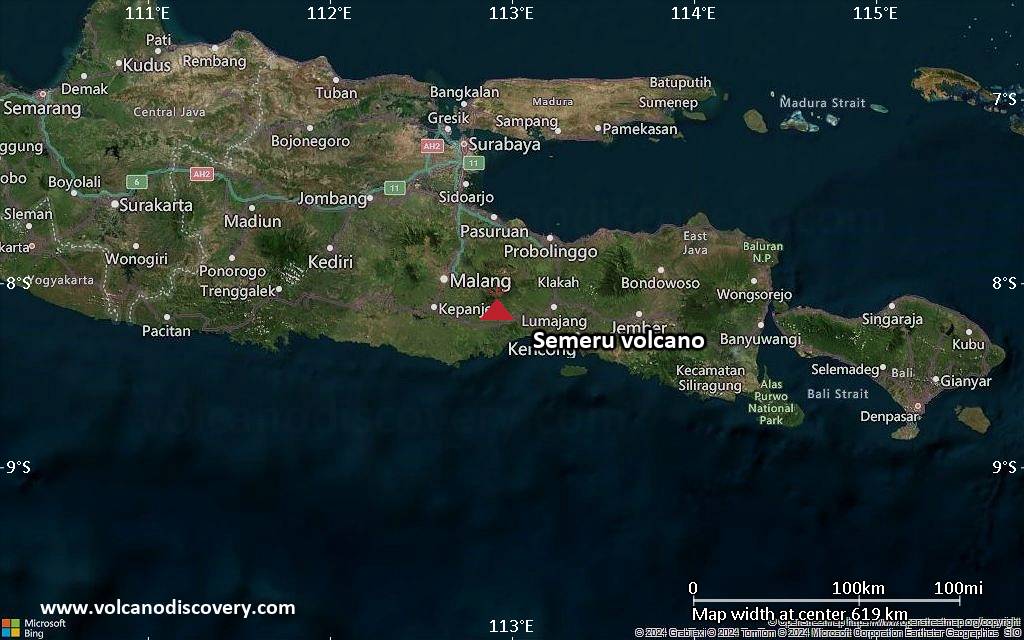
Semeru (East Java, Indonesia): Volcanic Ash Advisory Center Darwin (VAAC) issued the following report: ERUPTION LAST REPORTED AT 17/0931Z EST VA DTG:17/1620Z
…17 Sep:
The Center for Volcanology and Geological Hazard/Pusat Vulkanologi dan Mitigasi Bencana Geologi (CVGHM/PVMBG) reported that the eruption continued at Semeru on 16 September 2025 (local). There were 54 seismically detected explosions reported. There were 9 seismically detected rockfalls. The alert level remained at „Level 2 – Alert“ (on a 4-level scale).
Source: Center for Volcanology and Geological Hazard/Pusat Vulkanologi dan Mitigasi Bencana Geologi (CVGHM/PVMBG)
… [read more]
Marapi (Western Sumatra, Indonesia): The Center for Volcanology and Geological Hazard/Pusat Vulkanologi dan Mitigasi Bencana Geologi (CVGHM/PVMBG) reported that the eruption continued at Marapi on 16 September 2025 (local). There was 1 seismically detected explosion reported. The alert level remained at „Level 2 – Alert“ (on a 4-level scale).
Source: Center for Volcanology and Geological Hazard/Pusat Vulkanologi dan Mitigasi Bencana Geologi (CVGHM/PVMBG)
… [read more]
Dempo (Sumatra): The Center for Volcanology and Geological Hazard/Pusat Vulkanologi dan Mitigasi Bencana Geologi (CVGHM/PVMBG) reported that the eruption continued at Dempo on 16 September 2025 (local). The alert level remained at „Level 2 – Alert“ (on a 4-level scale).
Source: Center for Volcanology and Geological Hazard/Pusat Vulkanologi dan Mitigasi Bencana Geologi (CVGHM/PVMBG)
… [read more]
Dukono (Halmahera): The Center for Volcanology and Geological Hazard/Pusat Vulkanologi dan Mitigasi Bencana Geologi (CVGHM/PVMBG) reported that the eruption continued at Dukono on 16 September 2025 (local). Ash and gas plume(s) rose to a maximum of 400 meters (1,312 feet) above the vent. The alert level remained at „Level 2 – Alert“ (on a 4-level scale).
Source: Center for Volcanology and Geological Hazard/Pusat Vulkanologi dan Mitigasi Bencana Geologi (CVGHM/PVMBG)
… [read more]
Awu (Sulawesi & Sangihe Islands): The Center for Volcanology and Geological Hazard/Pusat Vulkanologi dan Mitigasi Bencana Geologi (CVGHM/PVMBG) reported that unrest continued at Awu on 16 September 2025 (local). Gas and vapor plume(s) rose to a maximum of 200 meters (656 feet) above the vent. The alert level remained at „Level 2 – Alert“ (on a 4-level scale).
Source: Center for Volcanology and Geological Hazard/Pusat Vulkanologi dan Mitigasi Bencana Geologi (CVGHM/PVMBG)
… [read more]
Kerinci (Sumatra): The Center for Volcanology and Geological Hazard/Pusat Vulkanologi dan Mitigasi Bencana Geologi (CVGHM/PVMBG) reported that unrest continued at Kerinci on 16 September 2025 (local). Gas and vapor plume(s) rose to a maximum of 100 meters (328 feet) above the vent. The alert level remained at „Level 2 – Alert“ (on a 4-level scale).
Source: Center for Volcanology and Geological Hazard/Pusat Vulkanologi dan Mitigasi Bencana Geologi (CVGHM/PVMBG)
… [read more]
Iliwerung (Lesser Sunda Islands): The Center for Volcanology and Geological Hazard/Pusat Vulkanologi dan Mitigasi Bencana Geologi (CVGHM/PVMBG) reported that unrest continued at Iliwerung on 16 September 2025 (local). The alert level remained at „Level 1 – Normal“ (on a 4-level scale).
Source: Center for Volcanology and Geological Hazard/Pusat Vulkanologi dan Mitigasi Bencana Geologi (CVGHM/PVMBG)
… [read more]
Lokon-Empung (North Sulawesi, Indonesia): The Center for Volcanology and Geological Hazard/Pusat Vulkanologi dan Mitigasi Bencana Geologi (CVGHM/PVMBG) reported that unrest continued at Lokon-Empung on 16 September 2025 (local). Gas and vapor plume(s) rose to a maximum of 200 meters (656 feet) above the vent. The alert level remained at „Level 3 – Standby“ (on a 4-level scale).
Source: Center for Volcanology and Geological Hazard/Pusat Vulkanologi dan Mitigasi Bencana Geologi (CVGHM/PVMBG)
… [read more]
Kilauea (Hawai’i): The United States Geological Survey – Hawaiian Volcano Observatory (USGS-HVO) reported that the eruption continued at Kilauea on 16 September 2025 (local). Moderate glow was observed at the north and south vents in webcam images during the night. The alert level remained at „Watch“ (level 3 on a 4-level scale). The aviation alert level remained at „Orange“ (level 3 on a 4-level scale).
Source: United States Geological Survey – Hawaiian Volcano Observatory (USGS-HVO)
… [read more]
Shishaldin (Aleutian Islands, Alaska): The United States Geological Survey – Alaska Volcano Observatory (USGS-AVO) reported that unrest continued at Shishaldin between 15 September 2025 (local) and 16 September 2025 (local). Clear webcam images showed minor steaming at the summit crater. The alert level remained at „Advisory“ (level 2 on a 4-level scale). The aviation alert level remained at „Yellow“ (level 2 on a 4-level scale). Activity also included: SO2 degassing.
Source: United States Geological Survey – Alaska Volcano Observatory (USGS-AVO)
… [read more]
Great Sitkin (United States, Aleutian Islands): The United States Geological Survey – Alaska Volcano Observatory (USGS-AVO) reported that the eruption continued at Great Sitkin between 15 September 2025 (local) and 16 September 2025 (local). Lava continued to erupt in the summit crater. Satellite images indicated that lava near the vent continued to slowly advance at a rate of approximately 5 meters per day. The alert level remained at „Watch“ (level 3 on a 4-level scale). The aviation alert level remained at „Orange“ (level 3 on a 4-level scale).
Source: United States Geological Survey – Alaska Volcano Observatory (USGS-AVO)
… [read more]
Popocatépetl (Central Mexico): The Centro Nacional de Prevención de Desastres (CENAPRED) reported that the eruption continued at Popocatépetl between 15 September 2025 (local) and 16 September 2025 (local). Ash and gas plume(s) were reported. The alert level remained at „Yellow Alert – Phase 2“ (level 4 on a 7-level scale).
Source: Centro Nacional de Prevención de Desastres (CENAPRED)
… [read more]
Santiaguito (Guatemala): The Instituto Nacional de SismologÃa, VulcanologÃa, MeteorologÃa e HidrologÃa (INSIVUMEH) reported that the eruption continued at Santa MarÃa between 15 September 2025 (local) and 16 September 2025 (local). Gas and vapor plume(s) rose to a maximum of 400 meters (1,312 feet) above the vent. Incandescence was observed at El Caliente dome during the night and early morning. There were explosions reported, with plumes rising to a maximum of 800 meters (2,625 feet) above the vent. At approximately 1305 on 16 September, heavy rain triggered a flow of water, hot pyroclastic material, tree trunks, branches, and rocky debris (up to 3 m in diameter) down the Cabello de Ãngel ravine (SE flank) of Caliente dome. There were incandescent rockfalls.
Source: Instituto Nacional de SismologÃa, VulcanologÃa, MeteorologÃa e HidrologÃa (INSIVUMEH)
… [read more]
Fuego (Guatemala): Explosive activity continues. Volcanic Ash Advisory Center (VAAC) Washington warned about a volcanic ash plume that rose up to estimated 14000 ft (4300 m) altitude or flight level 140 .
The full report is as follows: VA EMS LKLY OBS to 14000 ft (4300 m)
…17 Sep:
The Instituto Nacional de SismologÃa, VulcanologÃa, MeteorologÃa e HidrologÃa (INSIVUMEH) reported that the eruption continued at Fuego between 15 September 2025 (local) and 16 September 2025 (local). Crater incandescence was observed during the night and early morning. Weak and moderate Strombolian explosions were recorded at a rate of 8–12 per hour, generating ash-and-gas plumes that reached as high as 4,800 m above sea level. Shockwaves were generated by explosions. Explosions were accompanied by rumbling noises. Continuous degassing activity produced sounds resembling a train engine. Fine ash fell on communities near the SW flank. Gas and vapor plume(s) rose to a maximum of 200 meters (656 feet) above the vent.
Source: Instituto Nacional de SismologÃa, VulcanologÃa, MeteorologÃa e HidrologÃa (INSIVUMEH)
… [read more]
Turrialba (Costa Rica): The Observatorio Vulcanológico y Sismológico de Costa Rica – Universidad Nacional (OVSICORI-UNA) reported that unrest continued at Turrialba between 13 September 2025 (local) and 16 September 2025 (local). The alert level remained at „Level 2 – Warning“ (on a 0–4 level scale).
Source: Observatorio Vulcanológico y Sismológico de Costa Rica – Universidad Nacional (OVSICORI-UNA)
… [read more]
Rincón de la Vieja (Costa Rica): The Observatorio Vulcanológico y Sismológico de Costa Rica – Universidad Nacional (OVSICORI-UNA) reported that unrest continued at Rincón de la Vieja between 13 September 2025 (local) and 16 September 2025 (local). The alert level remained at „Level 2 – Warning“ (on a 0–4 level scale). The aviation alert level remained at „Yellow“ (level 2 on a 4-level scale).
Source: Observatorio Vulcanológico y Sismológico de Costa Rica – Universidad Nacional (OVSICORI-UNA)
… [read more]
Poas (Costa Rica): The Observatorio Vulcanológico y Sismológico de Costa Rica – Universidad Nacional (OVSICORI-UNA) reported that the eruption continued at Poás between 13 September 2025 (local) and 16 September 2025 (local). Gas and vapor plume(s) were reported. The alert level remained at „Level 2 – Warning“ (on a 0–4 level scale). The aviation alert level remained at „Yellow“ (level 2 on a 4-level scale).
Source: Observatorio Vulcanológico y Sismológico de Costa Rica – Universidad Nacional (OVSICORI-UNA)
… [read more]
Nevado del Ruiz (Colombia): Volcanic Ash Advisory Center Washington (VAAC) issued the following report: NO VA OBS
Sangay (Ecuador): Volcanic Ash Advisory Center Washington (VAAC) issued the following report: PSBL VA EMS
…17 Sep:
The Instituto GeofÃsico-Escuela Politécnica Nacional (IG-EPN) reported that the eruption continued at Sangay between 15 September 2025 (local) and 16 September 2025 (local). Ash and gas plume(s) rose to a maximum of 1,200 meters (3,937 feet) above the vent. There were 94 seismically detected explosions reported. The alert level remained at „2 – Yellow“ (on a 4-level scale).
Source: Instituto GeofÃsico-Escuela Politécnica Nacional (IG-EPN)
… [read more]
Reventador (Ecuador): The Instituto GeofÃsico-Escuela Politécnica Nacional (IG-EPN) reported that the eruption continued at Reventador between 15 September 2025 (local) and 16 September 2025 (local). Ash and gas plume(s) rose to a maximum of 800 meters (2,625 feet) above the vent. There were 86 seismically detected explosions reported. There were incandescent rockfalls, descending 1,100 m below the crater. The alert level remained at „3 – Orange“ (on a 4-level scale).
Source: Instituto GeofÃsico-Escuela Politécnica Nacional (IG-EPN)
… [read more]
Sabancaya (Peru): The Centro Vulcanológico Nacional del Instituto GeofÃsico del Perú (CENVUL-IGP) reported that the eruption continued at Sabancaya on 16 September 2025 (local). Gas and vapor plume(s) rose to a maximum of 1,000 meters (3,281 feet) above the vent. The alert level remained at „Orange“ (level 3 on a 4-level scale).
Source: Centro Vulcanológico Nacional del Instituto GeofÃsico del Perú (CENVUL-IGP)
… [read more]