On 11/4/2025 11:32:22 PM, an earthquake occurred in Indonesia potentially affecting 1.4 million in MMI IV. The earthquake had Magnitude 5.9M, Depth:110.626km.
Green earthquake alert (Magnitude 5.9M, Depth:106.998km) in Indonesia 04/11/2025 23:32 UTC, 1.5 million in MMI IV.
Green earthquake alert (Magnitude 6M, Depth:41.39km) in Russia 04/11/2025 23:28 UTC, 40 thousand in MMI IV.
Volcanic activity worldwide 4 Nov 2025: Fuego volcano, Popocatépetl, Semeru, Shiveluch, Reventador,…
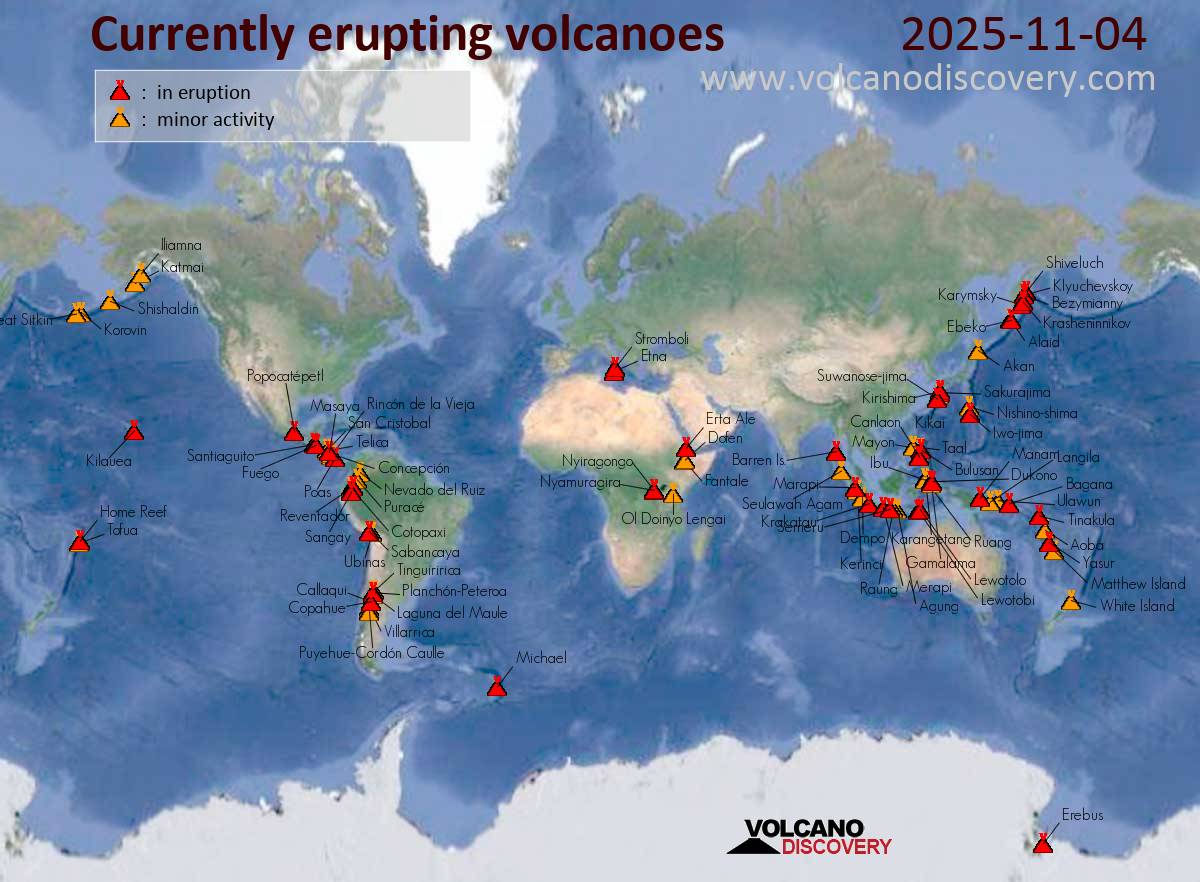
Map of today’s active volcanoes
Krasheninnikov (Kamchatka, Russia): (4 Nov) Explosive activity continues. Volcanic Ash Advisory Center (VAAC) Tokyo warned about a volcanic ash plume that rose up to estimated 8000 ft (2400 m) altitude or flight level 080 and is moving at 20 kts in SE direction.
The full report is as follows: VA EMISSIONS CONTINUING OBS VA DTG:04/0520Z to 8000 ft (2400 m)
Shiveluch (Kamchatka): Explosive activity continues. Volcanic Ash Advisory Center (VAAC) Tokyo warned about a volcanic ash plume that rose up to estimated 15000 ft (4600 m) altitude or flight level 150 and is moving at 40 kts in E direction.
The full report is as follows: POSS ERUPTION OBS AT 20251104/1550Z FL150 EXTD E OBS VA DTG:04/1620Z to 15000 ft (4600 m)
Semeru (East Java, Indonesia): Explosive activity continues. Volcanic Ash Advisory Center (VAAC) Darwin warned about a volcanic ash plume that rose up to estimated 15000 ft (4600 m) altitude or flight level 150 and is moving at 10 kts in NE direction.
The full report is as follows: VA TO FL150 LAST REPORTED AT 04/1454Z EST VA DTG:04/1510Z to 15000 ft (4600 m)
White Island (New Zealand): (4 Nov) Since recent observations of weak eruptions last week, the MetService has detected volcanic ash in satellite imagery from Sunday, 2 November. Sulfur dioxide (SO₂) emissions was also identified in satellite data on 30 October and 2 November.
An observation flight confirmed that the ash plume was rising 400–500 m above sea level and drifting southeast for about 5–8 km. According to the modelling, the activity is unlikely to cause ashfall on the mainland. Continued minor ashfall on the island has led to the accumulation of fine ash on the main crater floor. Vent temperatures are around 250 °C—higher than the previous two measurements before the latest activity, but still well below the peak of about 500 °C recorded earlier this year.
Based on recent observations, the Volcanic Alert Level remains at Level 3 (minor volcanic eruption), and the Aviation Colour Code remains Orange. These levels reflect both the prevailing low-level activity and the uncertainty surrounding volcanic behaviour due to the current absence of real-time monitoring equipment on the island.
Popocatépetl (Central Mexico): (4 Nov) Explosive activity continues. Volcanic Ash Advisory Center (VAAC) Washington warned about a volcanic ash plume that rose up to estimated 20000 ft (6100 m) altitude or flight level 200 .
The full report is as follows: OCNL VA EMS to 20000 ft (6100 m)
Fuego (Guatemala): Volcanic Ash Advisory Center Washington (VAAC) issued the following report: PSBL VA EMS
Sangay (Ecuador): Explosive activity continues. Volcanic Ash Advisory Center (VAAC) Washington warned about a volcanic ash plume that rose up to estimated 20000 ft (6100 m) altitude or flight level 200 .
The full report is as follows: ONGOING VA EMS to 20000 ft (6100 m)
Reventador (Ecuador): Volcanic Ash Advisory Center Washington (VAAC) issued the following report: ONGOING VA EMS
Brazil: Police massacre in Rio de Janeiro is evidence yet again of systemic and racist violence
Amnesty International urges a prompt, independent, impartial and internationally supervised investigation into the deadliest police operation in the state’s history.
Amnesty International strongly condemns the massacre that occurred during “Operation Containment” carried out on 28 October in the Alemão and Penha favelas in Rio de Janeiro – the deadliest in the state’s history – which left at least 121 people dead, including four police officers, and multiple reports of extrajudicial executions by civilian and military police.
“What took place in Rio de Janeiro was not a security operation, it was a massacre. Over a hundred people, most of them black and living in poverty, were killed in an operation planned and carried out by the state itself. The authorities must urgently conduct a prompt, independent and impartial investigation, and request international oversight to ensure its effectiveness,” said Ana Piquer, Americas director at Amnesty International. “The government of Cláudio Castro in Rio de Janeiro has turned its security policy into a policy of death. This must cease immediately,” she added.
What took place in Rio de Janeiro was not a security operation, it was a massacre. Over a hundred people, most of them black and living in poverty, were killed in an operation planned and carried out by the state itself.
Ana Piquer, Americas director at Amnesty International.
Extrajudicial killings and systematic repression
According to local organizations and statements from residents, the operation, in which more than 2,500 civil and military police officers were involved, allegedly saw shots being fired from helicopters, raids being carried out without a warrant, and assistance to injured persons being prevented. Testimonies and local reports claim that several bodies were found with signs of possible extrajudicial execution, including shots from behind or to the back of the head and bound hands. Under international human rights law, lethal force may be used only when strictly necessary to protect life or prevent serious injury in the face of an imminent threat.
However, public statements made by the governor of Rio de Janeiro have attempted to legitimize the illegal use of police force, claiming that “only police officers were victims” and that the state can “exceed its powers” in the so-called “war on crime”. This rhetoric seeks to legitimize a lethal and failed policy to guarantee impunity for human rights violations committed by the security forces, thereby perpetuating them.
“People in the favelas live under a constant state of alert and threat. Police operations in Brazil have become synonymous with terror, racism and a total lack of protection,” said Jurema Werneck, executive director at Amnesty International Brazil. “There is no possible justification for this lethal use of force. The security forces must protect lives, not destroy them.”
People in the favelas live under a constant state of alert and threat. Police operations in Brazil have become synonymous with terror, racism and a total lack of protection.
Jurema Werneck, executive director at Amnesty International Brazil.
Structural racism and impunity
The pattern of police violence in Rio de Janeiro reflects the racism embedded in Brazil’s drugs and public security policies. The government of Cláudio Castro has been responsible for four of the five deadliest operations in the state’s history, including those in Jacarezinho in 2021 and Vila Cruzeiro in 2022.
Despite repeated warnings from the United Nations (UN) and the Inter-American Commission on Human Rights (IACHR) regarding the discriminatory nature of the so-called “war on drugs”, the Brazilian state continues to systematically carry out police operations that clearly violate international standards on the use of force.
Amnesty International warns that the Rio de Janeiro authorities have sought to criminalize relatives and neighbours who, in the absence of the state, recovered the bodies of the victims to guarantee their identification and dignified burial.
The criminalization of relatives, neighbours and human rights defenders constitutes an institutional practice that reflects structural police violence in Brazil, characterized by racism and impunity. Given this situation, the authorities have a duty to promptly and effectively investigate, prosecute and provide redress for the extrajudicial executions and other human rights violations that occurred during Operation Containment. They must also provide ongoing support and assistance to the victims’ families, allowing them to participate in the investigation in a formal and meaningful manner, pursuant to international protocols such as the Minnesota Protocol.
The authorities must also facilitate the creation of a verification commission of international experts to oversee investigations and inquiries into the human rights violations that occurred during this police operation.
“Silence and impunity are complicit in violence. Until such a time as the state assumes its responsibility and guarantees the right to truth, justice and reparation, this cycle of abuse will continue, disproportionately affecting black, mixed-raced and marginalized communities in Brazil,” said Ana Piquer.
Silence and impunity are complicit in violence. Until such a time as the state assumes its responsibility and guarantees the right to truth, justice and reparation, this cycle of abuse will continue, disproportionately affecting black, mixed-raced and marginalized communities in Brazil.
Ana Piquer, Americas director at Amnesty International.
For further information or to arrange an interview, please contact press@amnesty.org
The post Brazil: Police massacre in Rio de Janeiro is evidence yet again of systemic and racist violence appeared first on Amnesty International.