The “Intellexa Leaks”, a new joint investigation by Inside Story, Haaretz and WAV Research Collective with technical analysis provided by Amnesty International, exposes the internal operations of Intellexa, – a company notorious for selling highly invasive spyware Predator linked to human rights abuses in multiple countries.
Responding to the investigation published today,Jurre van Bergen, Technologist at Amnesty International’s Security Lab said:
“This investigation provides one of the clearest and most damning views yet into Intellexa’s internal operations and technology.
Jurre van Bergen, Technologist at Amnesty International’s Security Lab
“The fact that, at least in some cases, Intellexa appears to have retained the capability to remotely access Predator customer logs – allowing company staff to see details of surveillance operations and targeted individuals raises questions about its own human rights due diligence processes. If a mercenary spyware company is found to be directly involved in the operation of its product, then by human rights standards, it could potentially leave them open to claims of liability in cases of misuse and if any human rights abuses are caused by the use of spyware.
“Predator spyware was also implicated in surveillance attacks in 2021, such as against the Greek journalist Thanasis Koukakis, based on digital forensic research by Citizen Lab. Information in the leaked files now adds to the evidence connecting Intellexa’s products to violations of human rights, such as rights to privacy and freedom of expression.
“These revelations come at a time when new cases of Predator spyware abuse are coming to light, showing that Intellexa’s product continues to be used to unlawfully surveil activists, journalists and human rights defenders around the world. Amnesty International’s Security Lab uncovered an attack against a human rights lawyer from Pakistan’s Balochistan province over WhatsApp during the summer of 2025, proving that the Predator spyware is being actively used in Pakistan, gravely violating privacy and freedom of expression rights.
“Even more alarming is the company’s latest development of a new spyware product called Aladdin which can infect mobiles through online advertisements.”
Background
The “Intellexa Leaks” is a months-long investigation drawing on a set of highly sensitive documents and other materials leaked from the company, including internal company documents, sales and marketing material, as well as training videos. An in-depth analysis of the leaked materials, as well as details of the reply received by Haaretz from Intellexa’s founder, responding to a request for comment from the company, can be found in Amnesty International’s Security Lab technical briefing, “To Catch a Predator: Leak exposes the internal operations of Intellexa’s spyware”.
Amnesty International has previously documented Intellexa’s technical capabilities and numerous cases of abuse linked to their spyware products as part of “Predator Files” in 2023. Ongoing investigations into the attack campaign in Pakistan and other instances of abuse will be released in a series of upcoming Amnesty International reports.
Amnesty International is working closely with communities and partner organizations to combat violence against women and girls in Burkina Faso, Senegal and Sierra Leone. In these West African countries, they are subjected to different forms of gender-based violence (GBV), including early and forced marriage and female genital mutilation (FGM), but also physical, psychological, and economic violence, exposing them to many vulnerabilities and multiple human rights violations.
Meet five activists who are speaking out, working to raise community awareness, challenging gender-based violence and supporting survivors.
Mariama Seydi
A GBV survivor herself, Mariama Seydi, 17, studies at Djibanar High School in the Sédhiou region in Southern Senegal. She has been involved in activities with Amnesty International since 2017 as an active member of her school’s human rights club.
Mariama has been involved in the school club set up by Amnesty International since she was 8 years old
“My greatest pride is being at school, learning and preparing for my future. My dream is to be a lawyer, to defend people who are struggling and need help.
I was cut. We are told that it is a custom, but sometimes I wonder if our ancestors would not be fighting alongside us today against female genital mutilation if they knew all the consequences of this practice. It hurts me to know that I was cut and that there will still be girls who will go through this too.
I regret that some people think that change is impossible. But I don’t let that get me down.
Mariama
In our area, there is a lot of violence against girls. The violence I see around me includes female genital mutilation and early and forced marriages. Harassment is also very common.
Amnesty’s training about GBV has enabled me, as a girl, to aspire to help and defend voiceless people who are unable to defend themselves. After my training sessions, I often share everything I have learned with my friends.
There isn’t much communication between young people and their parents. Certain topics are taboo. That’s not the case for me; I talk to my mother a lot. She explained to me that she had me cut, as she herself was, because it’s a tradition. Not having had the chance to go to school, she just repeated what she knew. She encourages me to get training, learn new things, and help my friends and those around me.
I am proud of what I have accomplished so far. I regret that some people think that change is impossible. But I don’t let that get me down because there are people who recognize the importance of what we are doing. It only motivates me more to continue raising awareness.”
Djénébou Assé Kandé
Djénébou Assé Kandé, 39, lives in Saré Tening, in the Sédhiou region in Southern Senegal. She is the secretary of the Nafore Kawral Group that works for women’s and girls’ empowerment. On the path to recovery from domestic violence, she fights for the human rights of members of her community.
A survivor of domestic violence, Djénébou is now engaged for women’s and girls’ empowerment in her community
“I don’t want other girls to go through what I went through. My ex-husband beat me so badly that I had problems with my eyesight and hearing. I was so afraid of him that I didn’t even dare to talk to him. After my divorce, while living with my parents, I was invited to attend awareness-raising activities with Amnesty. That’s where I learned a lot.
Now, when I come across girls, I never miss an opportunity to talk to them to prevent them from going through what I went through. I often visit schools to talk to students. The girls talk and ask questions. Every Friday, I also visit surrounding villages to talk to women.
I remarried and my new life as part of a couple is really different from what I knew before. With my husband, as soon as we face a problem, we talk about it. I have also learned to talk to my daughter; we talk about sexual health. I am proud of her because she got her high school diploma. Here, it is common to see girls who do not even reach high school. After elementary or middle school, they are married off. I dropped out of school very early.
Men have changed thanks to discussions about gender-based violence and sexual health. When we organize a meeting, I explain to them that the topics we discuss are realities that we experience and that we need to talk about them. Before, men rejected everything we said. Today, their perspective is beginning to change. To bring about change, we need to raise even more awareness among men.”
Médard Ouédraogo, 50, works as a farmer and is a member of a community alert committee set up by Amnesty International and its partners in the village of Roumtenga, in the Passoré province of Burkina Faso, to combat gender-based violence. He is also a member of the Association for the Promotion of Women and Children (APFE).
Médard is a member of a community alert committee set up by Amnesty International and its partners to combat gender-based violence
“I have been committed to fighting gender-based violence since my first contact with APFE five years ago. I was moved by the issues we discussed because we were experiencing them too. So I joined the Roumtenga alert committee.
Since we have been sensitized about early and forced marriage, there has been a big change. But awareness must also reach the surrounding villages.
Médard
We had a woman practicing female genital mutilation in the village. We, the members of the alert committee, went to her house after informing her husband and children of our intention to talk to her. She had already been to prison and was afraid of being arrested again. We took a humble and respectful approach. We explained the harmful consequences of FGM to her. She was touched by our approach and committed to stopping her activity. She did not perform any more female genital mutilation until her death this year.
In cases of early and forced marriages, as soon as we receive the information, we take action. We visit the family of the suitor or groom and explain to them that girls under the age of 18 should not get married. Often, people understand and accept this. When the girl is already at their home, they tell us they will take her back to her parents. But we insist on accompanying her back to her house. In cases where the man refuses to let the girl return to her family, we report him to either the police or social services.
Since we have been sensitized about early and forced marriage, there has been a big change. Girls are no longer given in marriage against their will. But awareness must also reach the surrounding villages. While Roumtenga has abandoned the practice of early and forced marriages, this is not the case elsewhere.
These are issues that are important to me. We are setting an example, and we are truly proud of it.”
Pauline Kaboré
Pauline Kaboré, 45, works at the provincial directorate for humanitarian action and national solidarity in the Passoré province, in Burkina Faso.
Pauline is a social worker who supports gender-based violence survivors
“The cases of GBV that I encounter most often are early and forced marriages, physical violence, and social exclusion, for example when women are accused of witchcraft. In total, we receive five to seven cases per week.
I remember a 16-year-old girl who was about to be forced into marriage. She came to us on her own the day before her engagement to report her situation. She was able to receive care and protection.
Since I started working with Amnesty International, I have changed my approach. A survivor who comes to us is overwhelmed with fear and sadness, and lacks confidence. Before, I thought I had to act quickly. Now I know not to rush. I adapt my tone and reassure her by showing her that she is in good hands.
When I meet with someone in a complex situation, it stirs up emotions in me, but I have learned to put them aside. My priority is that we find solutions together. If the survivor is aware of her situation and no longer wishes to continue with follow-up, we are obliged to stop. We don’t force anyone.
Our work is not limited to survivors. We also work with families and the community. We have conducted awareness campaigns and invited community leaders. Some of them are unfamiliar with the law and are stuck in their traditions. But they are really receptive to what we say.
I have managed to reintegrate young girls, resolve issues of forced marriages, and reconcile families. I can say that there has been improvement, but GBV is persistent. There is still a long way to go to eradicate it.”
Mohamed Tejan Jalloh is a human rights ambassador in Konakry Dee Community, Port Loko District, in Northwestern Sierra Leone. Aged 27, he works as a teacher and has been volunteering for about 10 years in his community.
To raise awareness about gender-based violence in his community, Mohamed uses a megaphone
“When I was going to school, I saw girls interrupting their education because they were forced into marriage. Their parents married their daughters to fishermen because of their money and influence, no matter how brilliant the girls were. They saw fishermen having two or three boats and only look at the immediate benefit. All this is due to poverty. At that time, I was 16. I had a friend who was a victim of child marriage and I felt bad about it. From that time, I decided to volunteer and to champion this cause. In this community, I am now known as a human rights ambassador.
I am committed to doing this as long as I am alive.
Mohamed
Now, child marriage has been reduced in our community. It’s difficult to make people change. When Amnesty first came to our village, the reaction of the community was not encouraging. There was a lot of confrontation between the volunteers and the parents. But we managed to bring awareness by making them understand that if their daughters can access education, they will acquire knowledge and be in a better position in society.
As volunteers, we go to schools and hold educational sessions. We also talk to Muslim leaders during Friday prayers. We tell them how important it is to allow children to go to school. Our town chief also supports us.
We have some challenges. I’m using a megaphone and I can’t reach more than 50 or 60 people per awareness raising session in the field because it is not loud enough. We would like to buy a loudspeaker. Another challenge is the accessibility of our town. When a GBV case is reported in our community, we need the police to intervene. But our road is not good, so it can take time.
Some people continue to criticize what I do, and I have been threatened. But I am not afraid. I am committed to doing this as long as I am alive.”
Through a human rights education programme implemented since 2017 in Burkina Faso, Senegal and Sierra Leone, Amnesty International is working alongside local partners and organizations to combat gender-based violence through education, awareness-raising and advocacy, with a view to changing attitudes and behaviours and helping to reform legislation in these countries.
Gender-based violence affects us all, but together we can create a safer world for everyone.
EnrolL On Amnesty’s online course on confronting and countering gender-based violence.
After more than eight months of diplomatic efforts by the United States and Qatar to end the conflict in the Democratic Republic of Congo (DRC), civilians continue to face serious human rights abuses by the Rwanda-backed March 23 Movement (M23) and the Wazalendo, a coalition of armed groups supported by the Congolese army. As the presidents of Rwanda and DRC prepare to sign a peace agreement at the White House today, Amnesty International has said:
“The upcoming signature of the peace deal between the presidents of DRC and Rwanda in Washington takes place as the violence continues in eastern DRC with immense suffering for civilians,” said Tigere Chagutah, Amnesty International’s Regional Director for East and Southern Africa.
“Months of discussions and the signing of multiple agreements in Washington and Doha have had no tangible impact on the lives of Congolese civilians. President Trump must press M23, Rwandan and Congolese leaders to end ongoing human rights abuses against civilians in the country and clearly indicate that they will be held individually accountable for their failure to respect the agreement.”
The upcoming signature of the peace deal between the presidents of DRC and Rwanda in Washington takes place as the violence continues in eastern DRC with immense suffering for civilians.
Tigere Chagutah, Amnesty International’s Regional Director for East and Southern Africa
Amnesty International has received credible reports of abuses committed by Wazalendo fighters and revenge killings by M23 against civilians suspected of collaborating with the Wazalendo. Tens of thousands of residents were displaced in October. In parts of North Kivu province, many civilians have resorted to living in forests for fear of attacks by armed groups.
“Congolese are fed up with lofty rhetoric and diplomatic language,” said Tigere Chagutah “They are tired of waiting. Thousands of civilians are caught between two brutal forces. On one side, they face summary killings, torture, gang rape and abductions by Rwandan-backed M23. On the other side, they are killed, ill-treated, abducted and raped by members of the Wazalendo.”
President Trump must press M23, Rwandan and Congolese leaders to end ongoing human rights abuses against civilians in the country and clearly indicate that they will be held individually accountable for their failure to respect the agreement.
Tigere Chagutah
“It’s appalling that international diplomats, including those from the US, European Union and African Union, are shirking their moral and international obligations by not applying direct and consistent pressure on Rwandan and DRC leaders to stop supporting abusive armed groups,” said Tigere Chagutah.
“World leaders are aware of the killings and rapes committed by the warring parties in DRC and choose to disregard them. Officials from the US, European Union and the African Union must prioritise stopping human rights abuses. Until diplomats impose consequences on the backers of the M23 and the Wazalendo, Congolese civilians will continue to suffer,” said Tigere Chagutah.
Background
US, Congolese and Rwandan diplomats have worked on the peace deal set to be signed in Washington since April. Rwandan and DRC officials signed a peace agreement in Washington on 27 June, which allows Rwanda to maintain their “defensive measures” in eastern Congo until the Democratic Forces for the Liberation of Rwanda (FDLR) and affiliated armed groups are “neutralized.”
The FDLR is an armed opposition group operating in eastern DRC mainly composed of Rwandan Hutu. It contains remnants of the Interahamwe and former Rwandan soldiers responsible for the 1994 Rwandan genocide, as well as fighters not involved in the genocide, including many too young to have participated in the genocide. Rwandan President Paul Kagame has called the FDLR an “existential threat” to Rwanda.
Rwanda and M23 signed a framework for a peace agreement in Qatar on 15 November 2025 designed to end the fighting in DRC. The deal included eight protocols, most of which still required negotiation by the two parties.
On 12/4/2025 7:44:06 AM, an earthquake occurred in China potentially affecting 2 thousand (in MMI>=VII). The earthquake had Magnitude 5.8M, Depth:10km.
Volcanic Ash Advisory Center Darwin (VAAC) issued the following report:
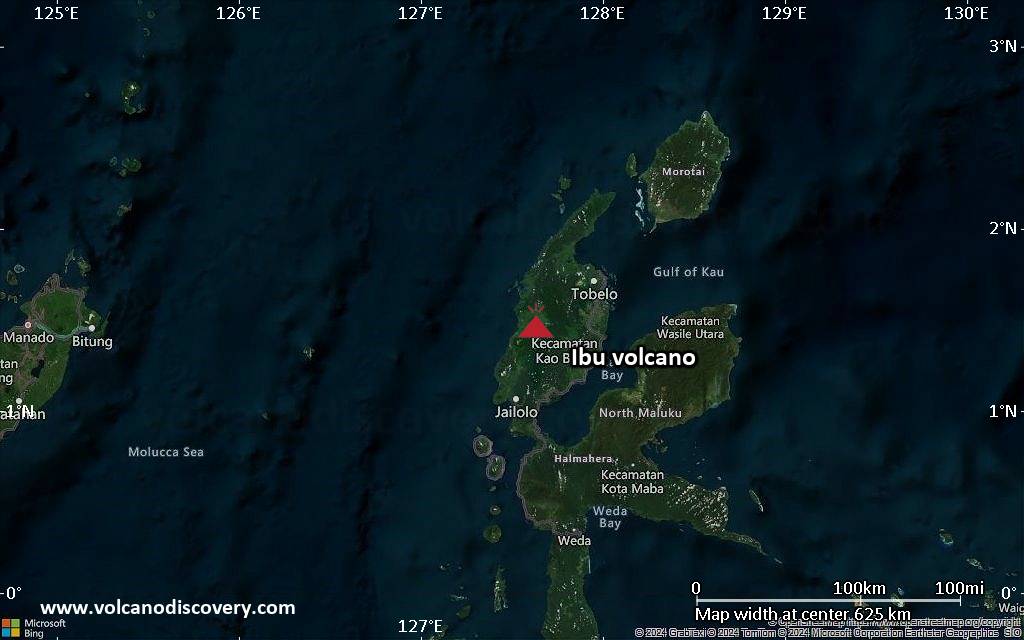
FVAU01 at 03:50 UTC, 04/12/25 from ADRM VA ADVISORY DTG: 20251204/0350Z VAAC: DARWIN VOLCANO: IBU 268030 PSN: N0129 E12738 AREA: INDONESIA SOURCE ELEV: 1325M AMSL ADVISORY NR: 2025/1354 INFO SOURCE: CVGHM HIMAWARI-9 ERUPTION DETAILS: VA REPORTED TO FL070 MOV NE AT 04/0240Z EST VA DTG: 04/0330Z EST VA CLD: SFC/FL070 N0128 E12737 – N0131 E12736 – N0146 E12758 – N0140 E12805 – N0132 E12804 MOV NE 15KT FCST VA CLD +6 HR: 04/0930Z NO VA EXP FCST VA CLD +12 HR: 04/1530Z NO VA EXP FCST VA CLD +18 HR: 04/2130Z NO VA EXP RMK: VA NOT IDENTIFIABLE ON LATEST SAT IMAGERY DUE TO MET CLOUD. VA IS EXPECTED TO DISSIPATE WITHIN 6HRS. HEIGHT AND MOV BASED ON GROUND REPORT AND MODEL GUIDANCE. NXT ADVISORY: NO LATER THAN 20251204/0950Z=