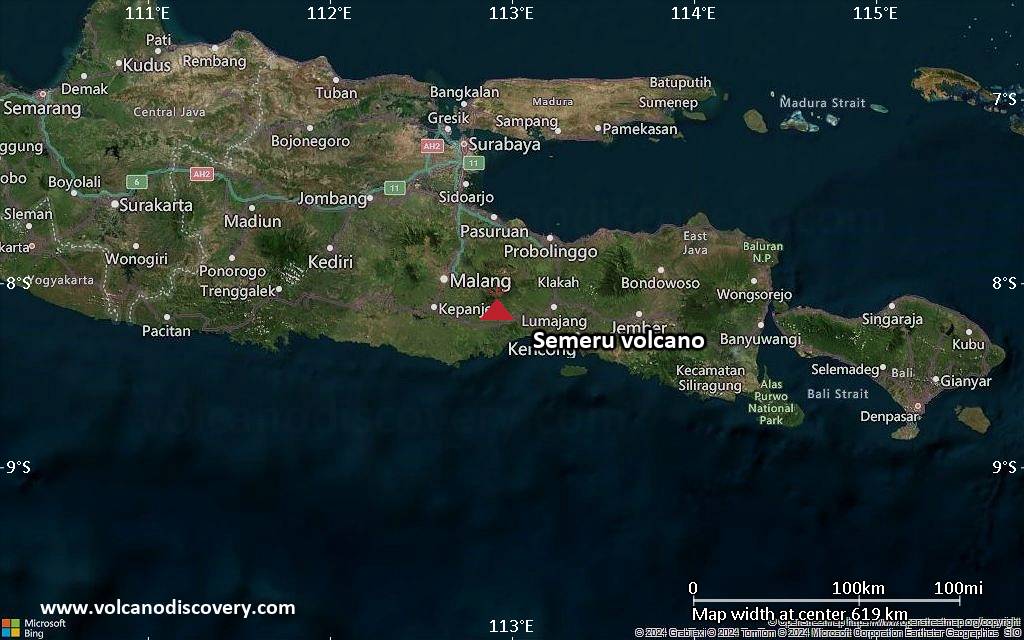
Explosive activity continues. Volcanic Ash Advisory Center (VAAC) Darwin warned about a volcanic ash plume that rose up to estimated 15000 ft (4600 m) altitude or flight level 150 and is moving at 05 kts in E direction. The full report is as follows:
FVAU02 at 23:10 UTC, 19/12/25 from ADRM VA ADVISORY DTG: 20251219/2310Z VAAC: DARWIN VOLCANO: SEMERU 263300 PSN: S0806 E11255 AREA: INDONESIA SOURCE ELEV: 3657M AMSL ADVISORY NR: 2025/1449 INFO SOURCE: CVGHM, HIMAWARI-9, WEBCAM ERUPTION DETAILS: VA TO FL150 LAST REPORTED AT 19/2253Z OBS VA DTG: 19/2253Z OBS VA CLD: SFC/FL150 S0809 E11251 – S0802 E11251 – S0753 E11315 – S0806 E11323 – S0820 E11315 MOV E 05KT FCST VA CLD +6 HR: 20/0453Z SFC/FL150 S0809 E11251 – S0802 E11251 – S0753 E11317 – S0806 E11323 – S0820 E11315 FCST VA CLD +12 HR: 20/1053Z SFC/FL150 S0809 E11251 – S0802 E11251 – S0753 E11317 – S0806 E11323 – S0820 E11315 FCST VA CLD +18 HR: 20/1653Z SFC/FL150 S0809 E11251 – S0802 E11251 – S0754 E11318 – S0806 E11323 – S0819 E11317 RMK: VA NOT IDENTIFIABLE ON LATEST SATELLITE IMAGERY DUE TO MET CLOUD. RECENT GROUND REPORTS INDICATE INTERMITTENT DISCRETE EMISSIONS ARE ONGOING. VA HEIGHT AND MOVEMENT BASED ON HIMAWARI-9 SATELLITE IMAGERY, GROUND REPORTS AND MODEL GUIDANCE. NXT ADVISORY: NO LATER THAN 20251220/0510Z=
Canlaon (Central Philippines): The Philippine Institute of Volcanology and Seismology (PHIVOLCS) reported that the eruption continued at Kanlaon on 18 December 2025 (local). The alert level remained at „2 – Moderate Level of Volcanic Unrest“ (level 2 on a 0–5 level scale). Source: Philippine Institute of Volcanology and Seismology (PHIVOLCS) … [read more] … [show less] Current Alerts: Observatory alert level: „2 – Moderate Level of Volcanic Unrest“ (level 2 on a 0–5 level scale)
Taal (Luzon, Philippines): The Philippine Institute of Volcanology and Seismology (PHIVOLCS) reported that the eruption continued at Taal on 18 December 2025 (local). The alert level remained at „1 – Low-Level Unrest“ (on a 0–5 level scale). Source: Philippine Institute of Volcanology and Seismology (PHIVOLCS) … [read more] … [show less] Current Alerts: Observatory alert level: „1 – Low-Level Unrest“ (on a 0–5 level scale)
Mayon (Luzon Island, Philippines): The Philippine Institute of Volcanology and Seismology (PHIVOLCS) reported that unrest continued at Mayon on 18 December 2025 (local). The alert level remained at „1 – Low Level of Volcanic Unrest“ (on a 0–5 level scale). Source: Philippine Institute of Volcanology and Seismology (PHIVOLCS) … [read more] … [show less] Current Alerts: Observatory alert level: „1 – Low Level of Volcanic Unrest“ (on a 0–5 level scale)
Karangetang (Siau Island, Sangihe Islands, Indonesia): The Center for Volcanology and Geological Hazard/Pusat Vulkanologi dan Mitigasi Bencana Geologi (CVGHM/PVMBG) reported that unrest continued at Karangetang on 18 December 2025 (local). The alert level remained at „Level 2 – Alert“ (on a 4-level scale). Source: Center for Volcanology and Geological Hazard/Pusat Vulkanologi dan Mitigasi Bencana Geologi (CVGHM/PVMBG) … [read more] … [show less] Current Alerts: Observatory alert level: „Level 2 – Alert“ (on a 4-level scale)
Raung (East Java): The Center for Volcanology and Geological Hazard/Pusat Vulkanologi dan Mitigasi Bencana Geologi (CVGHM/PVMBG) reported that the eruption continued at Raung on 18 December 2025 (local). The alert level remained at „Level 2 – Alert“ (on a 4-level scale). Source: Center for Volcanology and Geological Hazard/Pusat Vulkanologi dan Mitigasi Bencana Geologi (CVGHM/PVMBG) … [read more] … [show less] Current Alerts: Observatory alert level: „Level 2 – Alert“ (on a 4-level scale)
Ibu (Halmahera, Indonesia): Volcanic Ash Advisory Center Darwin (VAAC) issued the following report: VA LAST REPORTED AT 19/1337Z MOV NE EST VA DTG:19/1600Z …19 Dec: The Center for Volcanology and Geological Hazard/Pusat Vulkanologi dan Mitigasi Bencana Geologi (CVGHM/PVMBG) reported that the eruption continued at Ibu on 18 December 2025 (local). Ash and gas plume(s) rose to a maximum of 700 m (2,297 ft) above the vent. There were 112 seismically detected explosions reported. The alert level remained at „Level 2 – Alert“ (on a 4-level scale). Source: Center for Volcanology and Geological Hazard/Pusat Vulkanologi dan Mitigasi Bencana Geologi (CVGHM/PVMBG) … [read more] … [show less] Current Alerts: Observatory alert level: „Level 2 – Alert“ (on a 4-level scale)
Talang (Sumatra): The Center for Volcanology and Geological Hazard/Pusat Vulkanologi dan Mitigasi Bencana Geologi (CVGHM/PVMBG) reported that unrest continued at Talang on 18 December 2025 (local). The alert level remained at „Level 2 – Alert“ (on a 4-level scale). Source: Center for Volcanology and Geological Hazard/Pusat Vulkanologi dan Mitigasi Bencana Geologi (CVGHM/PVMBG) … [read more] … [show less] Current Alerts: Observatory alert level: „Level 2 – Alert“ (on a 4-level scale)
Lewotobi (Flores): The Center for Volcanology and Geological Hazard/Pusat Vulkanologi dan Mitigasi Bencana Geologi (CVGHM/PVMBG) reported that the eruption continued at Lewotobi (Laki-Laki) on 18 December 2025 (local). The alert level remained at „Level 3 – Standby“ (on a 4-level scale). Source: Center for Volcanology and Geological Hazard/Pusat Vulkanologi dan Mitigasi Bencana Geologi (CVGHM/PVMBG) … [read more] … [show less] Current Alerts: Observatory alert level: „Level 3 – Standby“ (on a 4-level scale)
Soputan (North Sulawesi, Indonesia): The Center for Volcanology and Geological Hazard/Pusat Vulkanologi dan Mitigasi Bencana Geologi (CVGHM/PVMBG) reported that unrest continued at Soputan on 18 December 2025 (local). The alert level remained at „Level 2 – Alert“ (on a 4-level scale). Source: Center for Volcanology and Geological Hazard/Pusat Vulkanologi dan Mitigasi Bencana Geologi (CVGHM/PVMBG) … [read more] … [show less] Current Alerts: Observatory alert level: „Level 2 – Alert“ (on a 4-level scale)
Lewotolo (Lesser Sunda Islands): The Center for Volcanology and Geological Hazard/Pusat Vulkanologi dan Mitigasi Bencana Geologi (CVGHM/PVMBG) reported that the eruption continued at Lewotolok on 18 December 2025 (local). Gas and vapor plume(s) rose to a maximum of 50 m (164 ft) above the vent. The alert level remained at „Level 2 – Alert“ (on a 4-level scale). Source: Center for Volcanology and Geological Hazard/Pusat Vulkanologi dan Mitigasi Bencana Geologi (CVGHM/PVMBG) … [read more] … [show less] Current Alerts: Observatory alert level: „Level 2 – Alert“ (on a 4-level scale)
Merapi (Central Java, Indonesia): The Center for Volcanology and Geological Hazard/Pusat Vulkanologi dan Mitigasi Bencana Geologi (CVGHM/PVMBG) reported that the eruption continued at Merapi on 18 December 2025 (local). Gas and vapor plume(s) rose to a maximum of 25 m (82 ft) above the vent. There were 3 hot rockfalls, traveling up to 1,500 m. There were 89 seismically detected rockfalls. The alert level remained at „Level 3 – Standby“ (on a 4-level scale). Source: Center for Volcanology and Geological Hazard/Pusat Vulkanologi dan Mitigasi Bencana Geologi (CVGHM/PVMBG) … [read more] … [show less] Current Alerts: Observatory alert level: „Level 3 – Standby“ (on a 4-level scale)
Bromo (East Java, Indonesia): The Center for Volcanology and Geological Hazard/Pusat Vulkanologi dan Mitigasi Bencana Geologi (CVGHM/PVMBG) reported that unrest continued at Tengger Caldera on 18 December 2025 (local). The alert level remained at „Level 2 – Alert“ (on a 4-level scale). Source: Center for Volcanology and Geological Hazard/Pusat Vulkanologi dan Mitigasi Bencana Geologi (CVGHM/PVMBG) … [read more] … [show less] Current Alerts: Observatory alert level: „Level 2 – Alert“ (on a 4-level scale)
Semeru (East Java, Indonesia): The Center for Volcanology and Geological Hazard/Pusat Vulkanologi dan Mitigasi Bencana Geologi (CVGHM/PVMBG) reported that the eruption continued at Semeru on 18 December 2025 (local). Ash and gas plume(s) rose to a maximum of 800 m (2,625 ft) above the vent. There were 161 seismically detected explosions reported. There were 6 seismically detected rockfalls. The alert level remained at „Level 3 – Standby“ (on a 4-level scale). Source: Center for Volcanology and Geological Hazard/Pusat Vulkanologi dan Mitigasi Bencana Geologi (CVGHM/PVMBG) … [read more] … [show less] Current Alerts: Observatory alert level: „Level 3 – Standby“ (on a 4-level scale)
Marapi (Western Sumatra, Indonesia): The Center for Volcanology and Geological Hazard/Pusat Vulkanologi dan Mitigasi Bencana Geologi (CVGHM/PVMBG) reported that the eruption continued at Marapi on 18 December 2025 (local). The alert level remained at „Level 2 – Alert“ (on a 4-level scale). Source: Center for Volcanology and Geological Hazard/Pusat Vulkanologi dan Mitigasi Bencana Geologi (CVGHM/PVMBG) … [read more] … [show less] Current Alerts: Observatory alert level: „Level 2 – Alert“ (on a 4-level scale)
Dukono (Halmahera): The Center for Volcanology and Geological Hazard/Pusat Vulkanologi dan Mitigasi Bencana Geologi (CVGHM/PVMBG) reported that the eruption continued at Dukono on 18 December 2025 (local). Ash and gas plume(s) rose to a maximum of 600 m (1,969 ft) above the vent. The alert level remained at „Level 2 – Alert“ (on a 4-level scale). Source: Center for Volcanology and Geological Hazard/Pusat Vulkanologi dan Mitigasi Bencana Geologi (CVGHM/PVMBG) … [read more] … [show less] Current Alerts: Observatory alert level: „Level 2 – Alert“ (on a 4-level scale)
Awu (Sulawesi & Sangihe Islands): The Center for Volcanology and Geological Hazard/Pusat Vulkanologi dan Mitigasi Bencana Geologi (CVGHM/PVMBG) reported that unrest continued at Awu on 18 December 2025 (local). The alert level remained at „Level 2 – Alert“ (on a 4-level scale). Source: Center for Volcanology and Geological Hazard/Pusat Vulkanologi dan Mitigasi Bencana Geologi (CVGHM/PVMBG) … [read more] … [show less] Current Alerts: Observatory alert level: „Level 2 – Alert“ (on a 4-level scale)
Kerinci (Sumatra): The Center for Volcanology and Geological Hazard/Pusat Vulkanologi dan Mitigasi Bencana Geologi (CVGHM/PVMBG) reported that unrest continued at Kerinci on 18 December 2025 (local). The alert level remained at „Level 2 – Alert“ (on a 4-level scale). Source: Center for Volcanology and Geological Hazard/Pusat Vulkanologi dan Mitigasi Bencana Geologi (CVGHM/PVMBG) … [read more] … [show less] Current Alerts: Observatory alert level: „Level 2 – Alert“ (on a 4-level scale)
Lokon-Empung (North Sulawesi, Indonesia): The Center for Volcanology and Geological Hazard/Pusat Vulkanologi dan Mitigasi Bencana Geologi (CVGHM/PVMBG) reported that unrest continued at Lokon-Empung on 18 December 2025 (local). The alert level remained at „Level 2 – Alert“ (on a 4-level scale). Source: Center for Volcanology and Geological Hazard/Pusat Vulkanologi dan Mitigasi Bencana Geologi (CVGHM/PVMBG) … [read more] … [show less] Current Alerts: Observatory alert level: „Level 2 – Alert“ (on a 4-level scale)
Kilauea (Hawai’i): The United States Geological Survey – Hawaiian Volcano Observatory (USGS-HVO) reported that the eruption continued at Kilauea on 18 December 2025 (local). The alert level remained at „Watch“ (level 3 on a 4-level scale). The aviation alert level remained at „Orange“ (level 3 on a 4-level scale). Source: United States Geological Survey – Hawaiian Volcano Observatory (USGS-HVO) … [read more] … [show less] Current Alerts: Observatory alert level: „Watch“ (level 3 on a 4-level scale)
Shishaldin (Aleutian Islands, Alaska): The United States Geological Survey – Alaska Volcano Observatory (USGS-AVO) reported that unrest continued at Shishaldin between 17 December 2025 (local) and 18 December 2025 (local). The alert level remained at „Advisory“ (level 2 on a 4-level scale). The aviation alert level remained at „Yellow“ (level 2 on a 4-level scale). Source: United States Geological Survey – Alaska Volcano Observatory (USGS-AVO) … [read more] … [show less] Current Alerts: Observatory alert level: „Advisory“ (level 2 on a 4-level scale)
Great Sitkin (United States, Aleutian Islands): The United States Geological Survey – Alaska Volcano Observatory (USGS-AVO) reported that the eruption continued at Great Sitkin between 17 December 2025 (local) and 18 December 2025 (local). The alert level remained at „Watch“ (level 3 on a 4-level scale). The aviation alert level remained at „Orange“ (level 3 on a 4-level scale). Source: United States Geological Survey – Alaska Volcano Observatory (USGS-AVO) … [read more] … [show less] Current Alerts: Observatory alert level: „Watch“ (level 3 on a 4-level scale)
Popocatépetl (Central Mexico): The Centro Nacional de Prevención de Desastres (CENAPRED) reported that the eruption continued at Popocatépetl between 17 December 2025 (local) and 18 December 2025 (local). The alert level remained at „Yellow Alert – Phase 2“ (level 4 on a 7-level scale). Source: Centro Nacional de Prevención de Desastres (CENAPRED) … [read more] … [show less] Current Alerts: Observatory alert level: „Yellow Alert – Phase 2“ (level 4 on a 7-level scale)
Fuego (Guatemala): Explosive activity continues. Volcanic Ash Advisory Center (VAAC) Washington warned about a volcanic ash plume that rose up to estimated 16000 ft (4900 m) altitude or flight level 160 . The full report is as follows: ONGOING VA EMS to 16000 ft (4900 m)
Turrialba (Costa Rica): The Observatorio Vulcanológico y Sismológico de Costa Rica – Universidad Nacional (OVSICORI-UNA) reported that unrest continued at Turrialba on 18 December 2025 (local). The alert level remained at „Level 2 – Warning“ (on a 0–4 level scale). Source: Observatorio Vulcanológico y Sismológico de Costa Rica – Universidad Nacional (OVSICORI-UNA) … [read more] … [show less] Current Alerts: Observatory alert level: „Level 2 – Warning“ (on a 0–4 level scale)
Rincón de la Vieja (Costa Rica): The Observatorio Vulcanológico y Sismológico de Costa Rica – Universidad Nacional (OVSICORI-UNA) reported that unrest continued at Rincón de la Vieja on 18 December 2025 (local). The alert level remained at „Level 2 – Warning“ (on a 0–4 level scale). The aviation alert level remained at „Yellow“ (level 2 on a 4-level scale). Source: Observatorio Vulcanológico y Sismológico de Costa Rica – Universidad Nacional (OVSICORI-UNA) … [read more] … [show less] Current Alerts: Observatory alert level: „Level 2 – Warning“ (on a 0–4 level scale)
Poas (Costa Rica): The Observatorio Vulcanológico y Sismológico de Costa Rica – Universidad Nacional (OVSICORI-UNA) reported that the eruption continued at Poás on 18 December 2025 (local). The alert level remained at „Level 2 – Warning“ (on a 0–4 level scale). The aviation alert level remained at „Yellow“ (level 2 on a 4-level scale). Source: Observatorio Vulcanológico y Sismológico de Costa Rica – Universidad Nacional (OVSICORI-UNA) … [read more] … [show less] Current Alerts: Observatory alert level: „Level 2 – Warning“ (on a 0–4 level scale)
Puracé (Colombia): Explosive activity continues. Volcanic Ash Advisory Center (VAAC) Washington warned about a volcanic ash plume that rose up to estimated 19000 ft (5800 m) altitude or flight level 190 . The full report is as follows: OCNL VA EMS to 19000 ft (5800 m) …19 Dec: The Servicio Geológico Colombiano (SGC) reported that the eruption continued at Puracé on 18 December 2025 (local). The alert level remained at „Orange“ (level 3 on a 4-level scale). Source: Servicio Geológico Colombiano (SGC) … [read more] … [show less] Current Alerts: Observatory alert level: „Orange“ (level 3 on a 4-level scale)
Sangay (Ecuador): The Instituto Geofísico-Escuela Politécnica Nacional (IG-EPN) reported that the eruption continued at Sangay between 17 December 2025 (local) and 18 December 2025 (local). The alert level remained at „2 – Yellow“ (on a 4-level scale). Source: Instituto Geofísico-Escuela Politécnica Nacional (IG-EPN) … [read more] … [show less] Current Alerts: Observatory alert level: „2 – Yellow“ (on a 4-level scale)
Reventador (Ecuador): Explosive activity continues. Volcanic Ash Advisory Center (VAAC) Washington warned about a volcanic ash plume that rose up to estimated 15000 ft (4600 m) altitude or flight level 150 . The full report is as follows: FREQUENT VA EMS to 15000 ft (4600 m) …19 Dec: The Instituto Geofísico-Escuela Politécnica Nacional (IG-EPN) reported that the eruption continued at Reventador between 17 December 2025 (local) and 18 December 2025 (local). The alert level remained at „3 – Orange“ (on a 4-level scale). Source: Instituto Geofísico-Escuela Politécnica Nacional (IG-EPN) … [read more] … [show less] Current Alerts: Observatory alert level: „3 – Orange“ (on a 4-level scale)
Sabancaya (Peru): The Centro Vulcanológico Nacional del Instituto Geofísico del Perú (CENVUL-IGP) reported that the eruption continued at Sabancaya between 17 December 2025 (local) and 18 December 2025 (local). The alert level remained at „Orange“ (level 3 on a 4-level scale). Source: Centro Vulcanológico Nacional del Instituto Geofísico del Perú (CENVUL-IGP) … [read more] … [show less] Current Alerts: Observatory alert level: „Orange“ (level 3 on a 4-level scale)
Volcanic Ash Advisory Center Darwin (VAAC) issued the following report:
FVAU01 at 16:16 UTC, 19/12/25 from ADRM VA ADVISORY DTG: 20251219/1620Z VAAC: DARWIN VOLCANO: IBU 268030 PSN: N0129 E12738 AREA: INDONESIA SOURCE ELEV: 1325M AMSL ADVISORY NR: 2025/1417 INFO SOURCE: CVGHM, HIMAWARI-9 ERUPTION DETAILS: VA LAST REPORTED AT 19/1337Z MOV NE EST VA DTG: 19/1600Z EST VA CLD: SFC/FL070 N0127 E12737 – N0130 E12735 – N0146 E12748 – N0131 E12756 MOV NE 10KT FCST VA CLD +6 HR: 19/2200Z SFC/FL070 N0127 E12737 – N0130 E12736 – N0144 E12749 – N0129 E12757 FCST VA CLD +12 HR: 20/0400Z SFC/FL070 N0127 E12737 – N0130 E12736 – N0145 E12753 – N0130 E12759 FCST VA CLD +18 HR: 20/1000Z SFC/FL070 N0127 E12737 – N0131 E12736 – N0142 E12756 – N0128 E12800 RMK: VA NOT IDENTIFIABLE ON LATEST SATELLITE IMAGERY DUE TO MET CLOUD. RECENT GROUND REPORTS INDICATE INTERMITTENT DISCRETE EMISSIONS ARE ONGOING. VA HEIGHT AND MOVEMENT BASED ON GROUND REPORTS AND MODEL GUIDANCE. NXT ADVISORY: NO LATER THAN 20251219/2220Z=
Ellinor Guttorm Utsi, 60, is a Sami reindeer herder from Norway. The Sami people are an Indigenous People with distinct culture, languages, and traditions who inhabit the northernmost regions of Norway, Sweden, Finland, and Russia.
Now, this land and way of life are under threat. The Norwegian Government is planning to build several hundred wind turbines, which would disrupt the reindeer’s herding patterns. Ellinor is calling for a stop to these wind turbines, in a bid to protect her land and her culture. Her case is part of Amnesty International’s Write for Rights campaign for 2025.
My family and I have always been reindeer herders. It’s an integral part of the Sami culture. We see the value of nature and we make an income from it. We’re proud of who we are and what we do.
I grew up in a in a small place called Tana, where there were just 12 people in my school class. Of the five of us who were Sami, two came from families who were reindeer herders. I thought the rest were Norwegian. While I was at school, the Norwegian government wanted all Sami people to be known as Norwegian and they demanded we speak the national language, rather than our own.
We’ve struggled to achieve the rights we deserve
We weren’t allowed to speak Sami at school or sing Sami songs. At one point, the Norwegian church decided that we weren’t allowed to use the drum to connect with nature’s spirits. And these stories are true in other countries where Sami people live, such as the USA and New Zealand.
Later, I found out that everyone in my class was actually Sami, but their parents had thought they had to be something different. They didn’t have the opportunity to learn the language. Thankfully, I’ve always been proud of my heritage, and I am thankful my parents allowed me to speak the speak the forbidden language.
The government is taking our land
I decided early on that I wanted to be a reindeer herder. It felt like a natural path for me, and I remember feeling so inspired by the life we were living. My husband and I married when we were young, and we wanted to follow in our ancestors’ footsteps. We lived a peaceful existence, and I saw myself doing the same as my ancestors.
However, life hasn’t been very peaceful. Lately, it has been hard work for numerous reasons, and I haven’t been able to live the life I want.
Now the Norwegian government is taking our land from us, which will affect our income hugely and affect the herding patterns of the reindeer. From winter to spring, our reindeers graze in one area, before they migrate for summer. They migrate by themselves and give birth in the same place every year. It’s our job to follow them.
Our ancient reindeer herding traditions are at great risk. In 2023, several hundred wind turbines were suddenly proposed directly on our summer grazing lands in Čorgaą, threatening to damage grazing land, break migration routes and destroy our culture. Despite fierce opposition, the authorities are rushing approvals.
For us, we know the effect of the wind turbines and what impact it will have on the reindeer – they won’t be able to use the land anymore. And while the land belongs to the Norwegians, we were granted the right to use it hundreds of years ago. Now we’re at risk of losing our land to this industry, and our children will be left with nothing.
We’re at risk of losing everything
The reindeer provide many resources for our community, such as meat and materials for handicrafts. My family and I have a company, where we offer knowledge about Sami culture. Every year, around 4,000 people from all the world come and visit us, and we tell them about our lifestyle and sell our products. If these wind turbines go ahead, we’re at risk of losing everything.
It’s frustrating as they just want more and more electricity – and for what? They have enough electricity. Why don’t they value nature in the same way? We’re the ones who are experiencing climate change and its impacts. When I was growing up, the winter periods would be as low as minus 40 degrees. Today it’s not like that anymore. Sometimes it rains in winter, and when that happens, the reindeer can find it difficult to find food – the snow turns into ice and the reindeer can’t break through the ice to graze. We need this land for the future.
We are alone in this fight
For over a year, I have been defending my land and community. I arrange meetings with these companies to explain the effect wind turbines will have on our livelihoods and how it will harm the animals. We are trying to explain our case to the government, by attending as many meetings as we can, but it’s not easy.
I am so happy to have the support of people who do this work every day. This is our life – I don’t know another way of living.
Ellinor Guttorm Utsi
Today I feel there is no one listening. We are alone in this fight. They’ve decided to implement seven wind farm projects, consisting of several hundred wind turbines now, and I’ve tried to explain the devastating impact it will have, but no one cares. I am losing my life, trying to fight these processes so I can protect our land.
I have another life I want to live. I have three children and eight grandchildren, and I am sad about the impact it will have on them. I’m worried for the young people who have to grow up facing all these fights.
I’m doing this for all the community
It is tough and now I’m still processing how to make things good in my head, and how I can survive the impact on my mental health. My community supports me the best they can, they tell me I am strong, which makes me feel stronger. They tell me I am doing good work and hug me. It means a lot as I am not just doing this for my children, I’m doing for all the community.
I am determined to carry on though. I take part in protests outside the Norwegian government buildings with my friends and there’s always a group of us that go together. I cannot just sit down and watch them take this land from us. While I still have power to fight, I will.
I’ve always been an activist. I remember when I was six, how I fought to speak Sami at my school. I wanted it to be the first language, not the second – and I wasn’t afraid to share my opinion with my mum and teachers. I am so pleased Amnesty International, an organization focused on activism, is supporting my campaign today. I am so happy to have the support of people who do this work every day. This is our life – I don’t know another way of living. We need to fight for our land, to protect future generations.
In eastern Democratic Republic of the Congo (DRC), across a vast swathe of mountainous terrain, a conflict is raging that the world has forgotten.
The Allied Democratic Forces, an Islamic State-linked armed group commonly called the ADF, are abducting and killing civilians with alarming frequency, and abusing women and girls as sexual slaves in North Kivu and Ituri provinces. The vast majority of these incidents barely make news headlines.
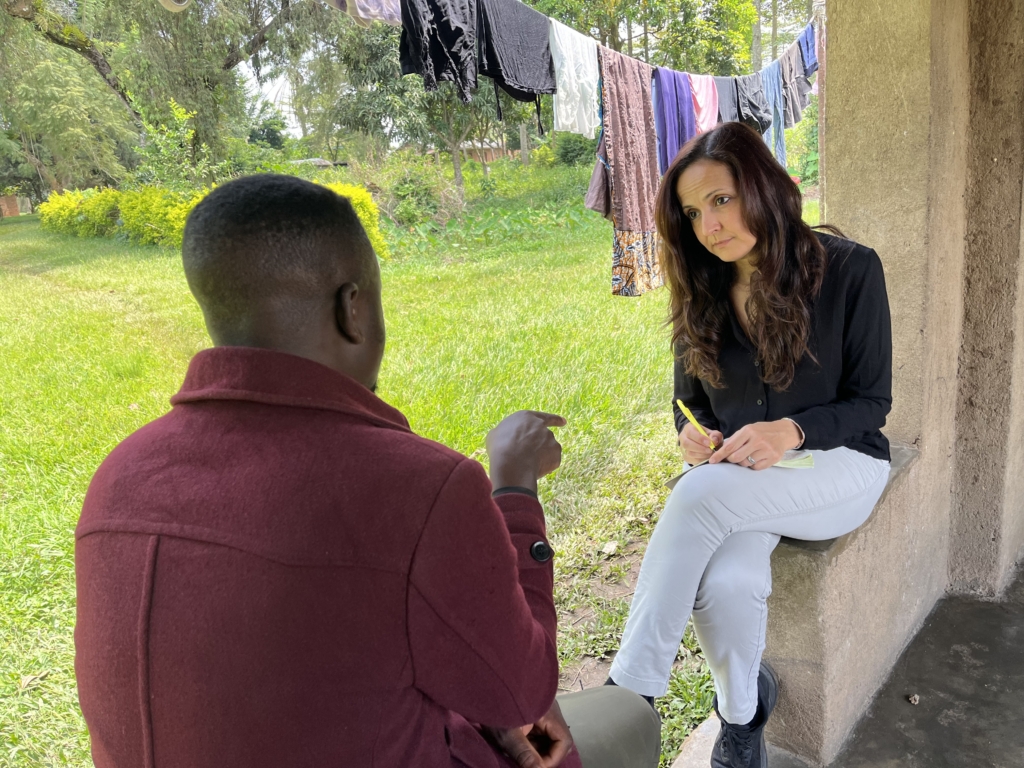
As a researcher with Amnesty International’s team tasked with investigating war crimes and abuses in crises, I visited North Kivu last month to document the abuses committed by the ADF. Even as I was traveling from one city to another to speak to witnesses of recent attacks, new hit-and-run incursions were taking place in real time.
Men, women and children told me how they ran for their lives as fighters armed with blades and guns descended on their villages. Several shared horror stories about watching loved ones being killed and abducted. Released hostages talked of agonizing spells – sometimes months and years – spent in captivity, practically starved and forced to do various tasks in ADF camps scattered in the region’s thick forests.
However, global media coverage about these attacks has been minimal. While I was in eastern Congo, the steady stream of headlines about DRC focused mostly on the US and Qatari-mediated peace processes in relation to the conflict with the Rwanda-backed March 23 Movement (M23). Meanwhile, the territory of Lubero in North Kivu was experiencing a week-long assault during which ADF fighters went from village to village, hacking people to death with machetes and burning down homes and vital facilities.
ADF attacks on civilians
ADF, which originated in Uganda, has been targeting Congolese civilians since the early 2000s when it moved to eastern DRC. In 2019, the group pledged allegiance to the Islamic State, officially becoming part of an international enterprise. The DRC’s armed forces (FARDC) and their Ugandan counterpart (UPDF) have been engaged in a joint operation against the group since 2021. The UN mission, MONUSCO, has provided support to various Congolese state bodies over the years, though its direct involvement in facing off with the group has had its limitations.
With international and domestic attention shifting to M23’s advances in early 2025, the ADF has seized on the diversion of troops and focus. ADF’s signature ruthlessness expanded both in intensity and geographic reach, further accelerating since August, with civilians rather than security forces primarily being on the receiving end.
I started my investigation in Beni city, the now de facto capital of North Kivu province that has long suffered from ADF violence. Given the group’s deeper push into Lubero Territory, I also traveled to the city of Butembo to speak with survivors who witnessed one of ADF’s bloodiest attacks this year, the 8 September massacre in Ntoyo village.
In that attack, fighters killed more than 60 people, many of whom were attending a funeral wake. Witnesses told me how ADF members had discretely mingled among mourners for hours, before suddenly starting to strike people’s heads with hammers. Throngs of other camouflage-clad fighters soon joined, burning homes and killing more civilians in the village with machetes and guns.
Rawya Rageh interviews a survivor of ADF attacks in the DRC. Copyright: Amnesty International
On the way to Butembo, I started receiving messages from sources about a new attack in Lubero’s Byambwe village. We reached out to community leaders and human rights defenders to help connect us to witnesses to gather their testimony.
Witnesses told me that, as they had in Ntoyo, ADF fighters initially arrived as a nondescript group that included women and children, this time asking for directions to the local hospital. Then suddenly gunshots rang out at the medical facility. An older person, who managed to escape from the hospital alongside a grandchild, described crawling out of the facility: “You couldn’t stand; they shot at anything that moved.” In total, the fighters killed more than 30 people, including 17 at the health facility.
The fighters did not stop at Byambwe; their rampage continued for days. We held our interviews in Butembo at a medical facility and bodies of ADF victims kept arriving at its morgue during our visit. At one point, we saw relatives packing a body bag into a casket to take it for burial. Grief engulfed not only the mourners, but also the hospital staff who told me of their horror at the string of killings. One said: “Tell everyone we are being massacred.”
The sense of helplessness was clear in the hospital worker’s tone. It echoed the sentiments of scores of victims with whom I spoke. One group that particularly felt abandoned were the girls and women abducted by the group and forced into “marriages” with ADF fighters. I spoke to six survivors – the “choice”, they were told, was to accept or be killed.
Most escaped from a life of sexual slavery and domestic servitude after operations by FARDC and UPDF that targeted their camps. But they remained shackled by suspicious looks and whispers from their neighbors in their villages, they said.
Those who came home with children described how their own families have rejected the little ones. One woman said pressure by family members to kill her own child almost drove her to taking her own life. These testimonies highlighted the prolonged impact of the group’s violence and the hidden struggle of thousands of victims who need significant and multifaceted support and do not have it.
Civilians must be protected
The international community must step up efforts to support the Congolese authorities to assist survivors, protect civilians and investigate and prosecute ADF’s pervasive war crimes. Despite shortcomings, MONUSCO’s support to Congolese authorities should continue – something the UN Security Council, led by France as the penholder on this file, must bear in mind when the mission’s mandate is up for renewal this month.
In UN hallways, there are whispers that not much shocks anymore when it comes to DRC. But civilians being systematically abducted and murdered with such frequency should not be seen as just another day in eastern DRC.
A comprehensive approach to security, justice and accountability is needed. The world cannot continue to ignore the brutality being meted out by the ADF in eastern DRC. As one survivor told me: “How much more must we suffer before this ends?”