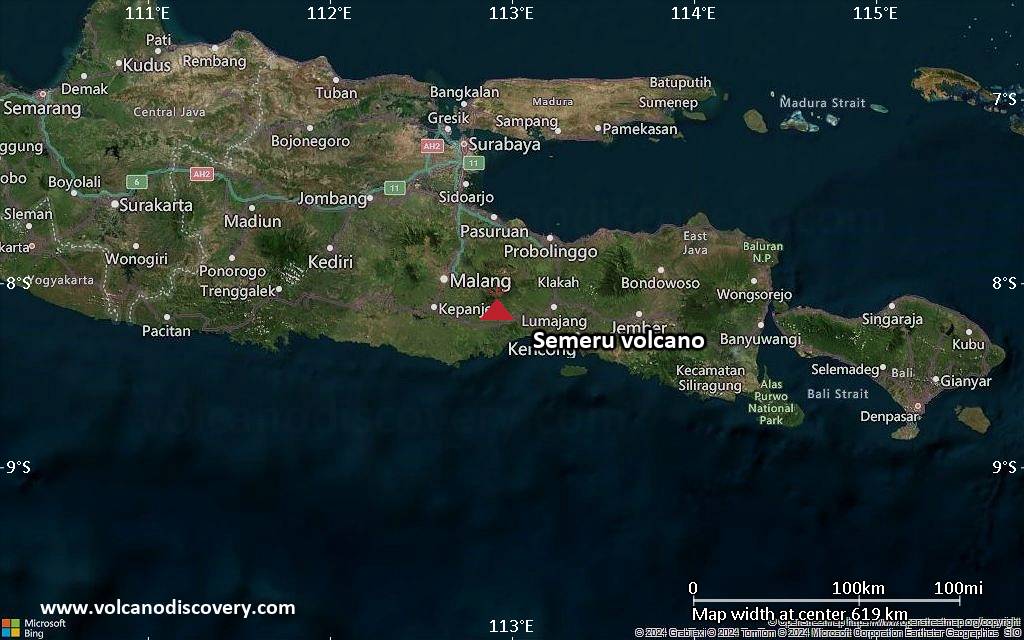
Semeru Volcano Volcanic Ash Advisory: VA TO FL150 REPORTED AT 08/2241Z MOV NE EST VA DTG: 08/2250Z to 15000 ft (4600 m)

Explosive activity continues. Volcanic Ash Advisory Center (VAAC) Darwin warned about a volcanic ash plume that rose up to estimated 15000 ft (4600 m) altitude or flight level 150 .
The full report is as follows:

FVAU02 at 23:00 UTC, 08/01/26 from ADRM
VA ADVISORY
DTG: 20260108/2310Z
VAAC: DARWIN
VOLCANO: SEMERU 263300
PSN: S0806 E11255
AREA: INDONESIA
SOURCE ELEV: 3657M AMSL
ADVISORY NR: 2026/32
INFO SOURCE: CVGHM, HIMAWARI-9
ERUPTION DETAILS: VA TO FL150 REPORTED AT 08/2241Z MOV NE
EST VA DTG: 08/2250Z
EST VA CLD: SFC/FL150 S0804 E11251 – S0752 E11309 – S0814
E11314 – S0811 E11253 MOV NE 05KT
FCST VA CLD +6 HR: 09/0450Z SFC/FL150 S0809 E11250 – S0801
E11251 – S0801 E11316 – S0817 E11313
FCST VA CLD +12 HR: 09/1050Z SFC/FL150 S0803 E11251 – S0758
E11313 – S0817 E11314 – S0810 E11251
FCST VA CLD +18 HR: 09/1650Z SFC/FL150 S0808 E11250 – S0801
E11252 – S0802 E11321 – S0824 E11314
RMK: VA CURRENTLY NOT IDENTIFIABLE ON SAT IMG DUE TO MET
CLOUD. GROUND REPORTS REPORTS INDICATE INTERMITTENT DISCRETE
EMISSIONS ARE ONGOING. VA HEIGHT AND MOVEMENT BASED ON
GROUND REPORTS AND MODEL GUIDANCE.
NXT ADVISORY: NO LATER THAN 20260109/0510Z=

Iran: Deaths and injuries rise amid authorities’ renewed cycle of protest bloodshed

Iranian authorities have unleashed a deadly crackdown on protesters across the country since 28 December 2025, marked by security forces’ unlawful use of force and firearms and mass arbitrary arrests, Amnesty International and Human Rights Watch said today.

The organizations’ findings reveal how security forces, including the Islamic Revolutionary Guard Corps (IRGC) and Iran’s police force, known by its Persian acronym FARAJA, have unlawfully used rifles, shotguns loaded with metal pellets, water cannon, tear gas and beatings to disperse, intimidate and punish largely peaceful protesters.

The crackdown has resulted in the killing of at least 28 protesters and bystanders, including children, in 13 cities across eight provinces between 31 December 2025 and 3 January 2026, based on credible information gathered by Amnesty International and Human Rights Watch. 

“People in Iran daring to express their anger at decades of repression and demand fundamental change are once again being met with a deadly pattern of security forces unlawfully firing at, chasing, arresting and beating protesters, in scenes reminiscent of the Woman Life Freedom uprising of 2022. Iran’s top security body, the Supreme National Security Council, must immediately issue orders for security forces to stop the unlawful use of force and firearms,” said Diana Eltahawy, Amnesty International’s Deputy Director for the Middle East and North Africa.

Protests erupted on 28 December 2025 following a sharp currency collapse, amid soaring inflation, chronic state mismanagement of essential services, including access to water, and worsening living conditions. Starting with shop closures and strikes in Tehran’s Grand Bazaar, protests quickly spread nationwide, evolving into street demonstrations calling for the downfall of the Islamic Republic system and demanding human rights, dignity and freedom. The authorities responded with violent dispersals and mass arrests, with hundreds already arbitrarily detained and at risk of torture and other ill-treatment.

“The frequency and persistence with which the Iranian security forces have unlawfully used force, including lethal force, against protesters, combined with systematic impunity for members of security force who commit grave violations, indicate that the use of such weapons to crush protests remains entrenched as state policy,” said Michael Page, Deputy Middle East and North Africa Director at Human Rights Watch.

Human Rights Watch and Amnesty International spoke to 26 people, including protesters, eyewitnesses, human rights defenders, journalists, and a medical professional, reviewed official statements, and analysed dozens of verified videos published online or shared with the organizations. An independent pathologist consulted by Amnesty International reviewed images of protesters injured or killed.

Iran’s top security body, the Supreme National Security Council, must immediately issue orders for security forces to stop the unlawful use of force and firearms. 

Diana Eltahawy, Amnesty International’s Deputy Director for the Middle East and North Africa

Senior state officials have demonized protesters as “rioters” and vowed a “firm” crackdown.

On 3 January 2026, when security forces killed at least 11 protesters, Supreme Leader Ali Khamenei said “rioters should be put in their place.” On the same day, the IRGC’s provincial corps of Lorestan province declared that the period of “tolerance” was over, pledging to target “rioters, organizers and leaders of anti-security movements … without leniency.”

On 5 January 2026, the Head of the Judiciary also ordered prosecutors to show “no leniency” to protesters and to expedite their trials.

UN member states and regional bodies, such as the EU, should issue unequivocal public condemnations and undertake urgent diplomatic action to pressure the Iranian authorities to stop the bloodshed, Amnesty International and Human Rights Watch said.

Given the prevailing climate of systemic impunity that has enabled Iranian authorities to repeatedly commit  crimes under international law documented by Amnesty International and Human Rights Watch, including murder, torture, rape, and enforced disappearances to eliminate and punish dissent, the organizations call on other countries’ prosecution authorities to initiate criminal investigations under the principle of universal jurisdiction, with a view to issuing arrest warrants for those suspected of responsibility.

Unlawful use of force and killings

The 28 victims were all shot by security forces, including with metal pellets fired from shotguns. Consistent with well-documented patterns of state denial and silencing, authorities have denied responsibility for the killings. Officials forced some victims’ families to appear on state media to blame deaths on accidents or protesters and threatened them with reprisals and secret burials of their loved ones if they do not comply.

Amnesty International and Human Rights Watch found that protesters have been largely peaceful. While the organizations have reviewed some footage and reports indicating that some protesters have engaged in acts of violence, in all the incidents of shootings investigated by the organizations, there was no imminent threat to life or serious injury justifying the use of firearms.

According to evidence gathered by Amnesty International and Human Rights Watch, the provinces of Lorestan and Ilam, home to Kurdish and Luri ethnic minorities, saw the deadliest repression, with at least eight killed in Lorestan and five killed in Ilam. Other provinces where killings took place between 31 December 2025 and 3 January 2026 include Chaharmahal and Bakhtiari, Fars, and Kermanshah, each with at least four deaths, as well as Esfahan, Hamedan and Qom, each with one death.

A protester in Azna, Lorestan province, told Amnesty International that on the evening of 1 January 2026, security forces opened fire on peaceful protesters near the county governor’s office in Azadegan Square. She shared a video, which the organizations verified, showing an IRGC agent firing at protesters. After the crowd dispersed, some protesters regrouped outside a nearby police station, where security forces opened fire again.

Verified videos published online on 1 January 2026 show protesters outside the station chanting. The sounds of gunshots can be heard in at least one verified video.

Information reviewed indicates that at least six protesters were killed in Azna, including Vahab Mousavi, Mostafa Falahi, Shayan Asadollahi, Ahmadreza Amani, and Reza Moradi Abdolvand. The authorities continue to withhold the body of Taha Safari, aged 16, who was initially reported as missing. An informed source told Amnesty International that on 3 January 2026, Taha Safari’s family members went to a police station to inquire about his whereabouts and an official there showed them pictures of several deceased individuals; the family identified Taha Safari among them. The image of his body showed visible severe head injuries.

A protester in Malekshahi, Ilam province, told Amnesty International that on the afternoon of 3 January 2026, hundreds of peaceful protesters marched from Shohada Square toward an IRGC Basij base:

“IRGC agents opened fire from inside the base, shooting … without regard for who they shot … Three to four people were killed instantly, and many others were injured. The protesters were completely unarmed.”

Two verified videos from Malekshahi taken in the afternoon show protesters outside the Basij base, fleeing amid the sound of gunshots. Another video posted online shows six agents inside the base with at least one firing a weapon toward protesters. Three victims with visible injuries, motionless, are seen in two videos.

Informed sources said that three protesters – Reza Azimzadeh, Latif Karimi and Mehdi Emamipour – were killed instantly. Two others, Fares (Mohsen) Agha Mohammadi and Mohammad Reza Karami, died later from their injuries.

In Jafarabad area in Kermanshah, Kermanshah province, Reza Ghanbary and two brothers, Rasoul Kadivarian and Reza Kadivarian,were fatally shot on 3 January 2026. A human rights defender said that plain-clothes agents, who arrived in three white vehicles, fired metal pellets at the brothers who were among a group of protesters trying to block a road.

In Chaharmahal and Bakhtiari province, Ahmad Jalil and Sajad Valamanesh were killed by security forces during protests in Lordegan on 1 January 2026 and Soroush Soleimani in Hafshejan on 3 January 2026, according to information received from a human rights defender. Amnesty International and Human Rights Watch reviewed images of their bodies, showing classic spray patterns of metal pellet wounds on their torsos.

Protesters gravely injured

The organizations documented large-scale harm from the widespread use of metal pellets fired from shotguns, including head and eye injuries, as well as injuries caused by beatings and gunfire from rifles.

A protester from Dehdasht, Kohgiluyeh and Boyer-Ahmad province, said that security forces shot him during protests on 3 January 2026. Fearing arrest, he avoided hospital care despite risk of losing his leg. An independent pathologist consulted by Amnesty International who reviewed a photograph of the protester’s injury noted that it could have been caused by a single shotgun pellet wound. 

On 6 January 2026, a photographer from Ilam city posted a video on social media showing his bloodied face covered with wounds from metal pellets. Showing a metal pellet to the camera, he said that security forces are using hunting ammunition against protesters: “Killing a human is a game to them. They think we are prey and they are hunters.”

A woman in Esfahan city told Amnesty International that an agent pushed her on the ground and stomped on her back as she was fleeing from security forces who were violently dispersing protests. She shared images showing her bloodied face with multiple abrasions.

“The more I struggled, the harder he pressed down,” she said. “I couldn’t move. I cried out but he told me to shut up.”

The organizations found that the presence of security forces at hospitals has deterred many injured protesters from seeking medical care, increasing the risk of death. According to a human rights defender, Mohsen Armak died in Hafshejan, Chaharmahal and Bakhtiari province, when he was taken to a livestock farm instead of a hospital after being wounded with a metal pellet on 3 January.

On 4 January 2026, the Special Forces of FARAJA and IRGC attacked Imam Khomeini Hospital in Ilam, where injured protesters were being treated. According to a human rights defender and verified video footage, agents fired shotguns loaded with metal pellets and tear gas into the hospital grounds, smashed glass doors, and beat patients, their relatives and medical workers.

Mass arbitrary arrests

Security forces have arbitrarily arrested hundreds of protesters, including children as young as 14, during protest dispersals and nightly raids on homes. Some were taken from hospitals.

The authorities  subjected many to enforced disappearance and incommunicado detention, placing them at risk of torture and other ill-treatment.

The authorities have already broadcast coerced “confessions” of detainees. On 5 January 2026, Tasnim News, affiliated with the IRGC, aired “confessions” of an 18-year-old woman and 16-year-old girl, accusing them of “leading riots”.

The Iranian authorities should immediately and unconditionally release anyone detained solely for peacefully taking part in or expressing support for demonstrations. All detainees should be protected from torture and other ill-treatment and immediately granted access to their families, lawyers and any medical care they need.

The post Iran: Deaths and injuries rise amid authorities’ renewed cycle of protest bloodshed appeared first on Amnesty International.

Volcanic activity worldwide 8 Jan 2026: Santiaguito volcano, Fuego, Popocatépetl, Krakatau, Soputan…

Map of today's active volcanoes

Map of today’s active volcanoes

Shiveluch (Kamchatka): (8 Jan) Volcanic Ash Advisory Center Tokyo (VAAC) issued the following report: VA AT 20260108/0458Z FL200 EXTD E MOV 5KT REPORTED OBS VA DTG:08/0600Z

Kusatsu-Shirane (Honshu): The Japan Meteorological Agency (JMA) reported that unrest continued at Kusatsu-Shiranesan between 5 January 2026 (local) and 7 January 2026 (local). The alert level remained at „Level 2 – Restriction on proximity to the crater“ (on a 5-level scale).
Source: Japan Meteorological Agency (JMA)
… [read more]

Canlaon (Central Philippines): The Philippine Institute of Volcanology and Seismology (PHIVOLCS) reported that eruptive activity increased at Kanlaon on 7 January 2026 (local). Ash plume(s) rose to a maximum of 900 m (2,953 ft) above the vent. The alert level remained at „2 – Moderate Level of Volcanic Unrest“ (level 2 on a 0–5 level scale).
Source: Philippine Institute of Volcanology and Seismology (PHIVOLCS)
… [read more]

Taal (Luzon, Philippines): The Philippine Institute of Volcanology and Seismology (PHIVOLCS) reported that the eruption continued at Taal on 7 January 2026 (local). Plume(s) were reported. The alert level remained at „1 – Low-Level Unrest“ (on a 0–5 level scale).
Source: Philippine Institute of Volcanology and Seismology (PHIVOLCS)
… [read more]

Mayon (Luzon Island, Philippines): Volcanic Ash Advisory Center Tokyo (VAAC) issued the following report: ERUPTION AT 20260108/1654Z VA CLD UNKNOWN REPORTED OBS VA DTG:08/1810Z
…8 Jan:
The effusive eruption from the volcano continues.
The PHIVOLCS volcano observatory reported that a new lava dome has been already forming at the summit atop. Visual observations confirmed the growth of the new lava dome as the continuing rise of fresh magma accumulates into the lava dome and oozes out from there in the form of glowing avalanches andr/or pyroclastic flows. They tumbles down over the Miisi gully on the southern flank. It has been reported about 49 pyroclastic flow events since this morning.
The alert level for the volcano remains at 3.
…8 Jan:
The Philippine Institute of Volcanology and Seismology (PHIVOLCS) reported that the eruption continued at Mayon on 7 January 2026 (local). As of 0600 on 7 January, a total of 3,515 individuals (comprising 964 families) were evacuated from communities within Mayon’s 6-km permanent danger zone (PDZ), primarily in Camalig, Guinobatan, Ligao city, Malilipot, and Tabaco city. There were 162 seismically detected rockfalls. A total of 50 pyroclastic density currents (PDCs), or pyroclastic flows, were observed primarily descending the Bonga Gully (SE flank). Plume(s) from pyroclastic flow rose to a maximum of 200 m (656 ft) above the vent. Camera footage from 1836 to 1900 on 7 January showed crater glow (banaag) illuminating the sky above the summit. The alert level remained at „3 – Increased Tendency Towards Hazardous Eruption“ (on a 0–5 level scale). Activity also included: plume(s) from pyroclastic flow.
Source: Philippine Institute of Volcanology and Seismology (PHIVOLCS)
… [read more]
…8 Jan:
A new eruption started at the volcano.
A new batch of magma has been shifting and accumulating inside the volcano’s feeder pipe over the past period. From the latest satellite imagery and webcam, new magma arrived in the summit crater and broke through the lava dome last evening.
More and more unstable hot lava material has been accumulating and later collapsed into hot rock falls, which might develop into dangerous pyroclastic flows.

Telong (northern Sumatra, Indonesia): The Center for Volcanology and Geological Hazard/Pusat Vulkanologi dan Mitigasi Bencana Geologi (CVGHM/PVMBG) reported that unrest activity decreased at Telong, Bur ni on 7 January 2026 (local). The alert level remained at „Level 2 – Alert“ (on a 4-level scale).
Source: Center for Volcanology and Geological Hazard/Pusat Vulkanologi dan Mitigasi Bencana Geologi (CVGHM/PVMBG)
… [read more]

Karangetang (Siau Island, Sangihe Islands, Indonesia): The Center for Volcanology and Geological Hazard/Pusat Vulkanologi dan Mitigasi Bencana Geologi (CVGHM/PVMBG) reported that unrest continued at Karangetang on 7 January 2026 (local). The alert level remained at „Level 2 – Alert“ (on a 4-level scale).
Source: Center for Volcanology and Geological Hazard/Pusat Vulkanologi dan Mitigasi Bencana Geologi (CVGHM/PVMBG)
… [read more]

Raung (East Java): The Center for Volcanology and Geological Hazard/Pusat Vulkanologi dan Mitigasi Bencana Geologi (CVGHM/PVMBG) reported that unrest continued at Raung on 7 January 2026 (local). Gas and vapor plume(s) rose to a maximum of 100 m (328 ft) above the vent. The alert level remained at „Level 2 – Alert“ (on a 4-level scale).
Source: Center for Volcanology and Geological Hazard/Pusat Vulkanologi dan Mitigasi Bencana Geologi (CVGHM/PVMBG)
… [read more]

Gamalama (Halmahera): The Center for Volcanology and Geological Hazard/Pusat Vulkanologi dan Mitigasi Bencana Geologi (CVGHM/PVMBG) reported that unrest continued at Gamalama on 7 January 2026 (local). The alert level remained at „Level 2 – Alert“ (on a 4-level scale).
Source: Center for Volcanology and Geological Hazard/Pusat Vulkanologi dan Mitigasi Bencana Geologi (CVGHM/PVMBG)
… [read more]

Ibu (Halmahera, Indonesia): Explosive activity continues. Volcanic Ash Advisory Center (VAAC) Darwin warned about a volcanic ash plume that rose up to estimated 7000 ft (2100 m) altitude or flight level 070 .
The full report is as follows: VA TO FL070 REPORTED AT 08/0820Z MOV S EST VA DTG:08/1124Z to 7000 ft (2100 m)
…8 Jan:
The Center for Volcanology and Geological Hazard/Pusat Vulkanologi dan Mitigasi Bencana Geologi (CVGHM/PVMBG) reported that the eruption continued at Ibu on 7 January 2026 (local). There were 59 seismically detected explosions reported. The alert level remained at „Level 2 – Alert“ (on a 4-level scale).
Source: Center for Volcanology and Geological Hazard/Pusat Vulkanologi dan Mitigasi Bencana Geologi (CVGHM/PVMBG)
… [read more]

Egon (Flores): The Center for Volcanology and Geological Hazard/Pusat Vulkanologi dan Mitigasi Bencana Geologi (CVGHM/PVMBG) issued a report for Egon on 7 January 2026 (local). The alert level remained at „Level 1 – Normal“ (on a 4-level scale).
Source: Center for Volcanology and Geological Hazard/Pusat Vulkanologi dan Mitigasi Bencana Geologi (CVGHM/PVMBG)
… [read more]

Sangeang Api (Flores Sea, Indonesia): The Center for Volcanology and Geological Hazard/Pusat Vulkanologi dan Mitigasi Bencana Geologi (CVGHM/PVMBG) reported that unrest continued at Sangeang Api on 7 January 2026 (local). The alert level remained at „Level 2 – Alert“ (on a 4-level scale).
Source: Center for Volcanology and Geological Hazard/Pusat Vulkanologi dan Mitigasi Bencana Geologi (CVGHM/PVMBG)
… [read more]

Talang (Sumatra): The Center for Volcanology and Geological Hazard/Pusat Vulkanologi dan Mitigasi Bencana Geologi (CVGHM/PVMBG) reported that unrest continued at Talang on 7 January 2026 (local). Gas and vapor plume(s) rose to a maximum of 50 m (164 ft) above the vent. The alert level remained at „Level 2 – Alert“ (on a 4-level scale).
Source: Center for Volcanology and Geological Hazard/Pusat Vulkanologi dan Mitigasi Bencana Geologi (CVGHM/PVMBG)
… [read more]

Lewotobi (Flores): The Center for Volcanology and Geological Hazard/Pusat Vulkanologi dan Mitigasi Bencana Geologi (CVGHM/PVMBG) reported that the eruption continued at Lewotobi (Laki-Laki) on 7 January 2026 (local). Gas and vapor plume(s) rose to a maximum of 300 m (984 ft) above the vent. There was 1 seismically detected rockfall. The alert level remained at „Level 4 – Caution“ (on a 4-level scale). Activity also included: seismically detected flowage event(s).
Source: Center for Volcanology and Geological Hazard/Pusat Vulkanologi dan Mitigasi Bencana Geologi (CVGHM/PVMBG)
… [read more]

Soputan (North Sulawesi, Indonesia): The Center for Volcanology and Geological Hazard/Pusat Vulkanologi dan Mitigasi Bencana Geologi (CVGHM/PVMBG) reported that unrest continued at Soputan on 7 January 2026 (local). The alert level remained at „Level 2 – Alert“ (on a 4-level scale).
Source: Center for Volcanology and Geological Hazard/Pusat Vulkanologi dan Mitigasi Bencana Geologi (CVGHM/PVMBG)
… [read more]

Lewotolo (Lesser Sunda Islands): The Center for Volcanology and Geological Hazard/Pusat Vulkanologi dan Mitigasi Bencana Geologi (CVGHM/PVMBG) reported that the eruption continued at Lewotolok on 7 January 2026 (local). Ash and gas plume(s) rose to a maximum of 500 m (1,640 ft) above the vent. There were 116 seismically detected explosions reported. The alert level remained at „Level 2 – Alert“ (on a 4-level scale).
Source: Center for Volcanology and Geological Hazard/Pusat Vulkanologi dan Mitigasi Bencana Geologi (CVGHM/PVMBG)
… [read more]

Krakatau (Sunda Strait, Indonesia): The Center for Volcanology and Geological Hazard/Pusat Vulkanologi dan Mitigasi Bencana Geologi (CVGHM/PVMBG) reported that unrest continued at Krakatau on 7 January 2026 (local). Gas and vapor plume(s) rose to a maximum of 5 m (16 ft) above the vent. The alert level remained at „Level 2 – Alert“ (on a 4-level scale).
Source: Center for Volcanology and Geological Hazard/Pusat Vulkanologi dan Mitigasi Bencana Geologi (CVGHM/PVMBG)
… [read more]

Merapi (Central Java, Indonesia): The Center for Volcanology and Geological Hazard/Pusat Vulkanologi dan Mitigasi Bencana Geologi (CVGHM/PVMBG) reported that the eruption continued at Merapi on 7 January 2026 (local). The alert level remained at „Level 3 – Standby“ (on a 4-level scale).
Source: Center for Volcanology and Geological Hazard/Pusat Vulkanologi dan Mitigasi Bencana Geologi (CVGHM/PVMBG)
… [read more]

Semeru (East Java, Indonesia): The Center for Volcanology and Geological Hazard/Pusat Vulkanologi dan Mitigasi Bencana Geologi (CVGHM/PVMBG) reported that the eruption continued at Semeru on 7 January 2026 (local). Ash and gas plume(s) rose to a maximum of 1,000 m (3,281 ft) above the vent. There were 123 seismically detected explosions reported. There were 4 seismically detected rockfalls. The alert level remained at „Level 3 – Standby“ (on a 4-level scale).
Source: Center for Volcanology and Geological Hazard/Pusat Vulkanologi dan Mitigasi Bencana Geologi (CVGHM/PVMBG)
… [read more]

Marapi (Western Sumatra, Indonesia): The Center for Volcanology and Geological Hazard/Pusat Vulkanologi dan Mitigasi Bencana Geologi (CVGHM/PVMBG) reported that the eruption continued at Marapi on 7 January 2026 (local). Gas and vapor plume(s) rose to a maximum of 250 m (820 ft) above the vent. There was 1 seismically detected explosion reported. The alert level remained at „Level 2 – Alert“ (on a 4-level scale).
Source: Center for Volcanology and Geological Hazard/Pusat Vulkanologi dan Mitigasi Bencana Geologi (CVGHM/PVMBG)
… [read more]

Dukono (Halmahera): The Center for Volcanology and Geological Hazard/Pusat Vulkanologi dan Mitigasi Bencana Geologi (CVGHM/PVMBG) reported that the eruption continued at Dukono on 7 January 2026 (local). There were 3 seismically detected explosions reported. The alert level remained at „Level 2 – Alert“ (on a 4-level scale).
Source: Center for Volcanology and Geological Hazard/Pusat Vulkanologi dan Mitigasi Bencana Geologi (CVGHM/PVMBG)
… [read more]

Awu (Sulawesi & Sangihe Islands): The Center for Volcanology and Geological Hazard/Pusat Vulkanologi dan Mitigasi Bencana Geologi (CVGHM/PVMBG) reported that unrest continued at Awu on 7 January 2026 (local). The alert level remained at „Level 2 – Alert“ (on a 4-level scale).
Source: Center for Volcanology and Geological Hazard/Pusat Vulkanologi dan Mitigasi Bencana Geologi (CVGHM/PVMBG)
… [read more]

Kerinci (Sumatra): The Center for Volcanology and Geological Hazard/Pusat Vulkanologi dan Mitigasi Bencana Geologi (CVGHM/PVMBG) reported that unrest continued at Kerinci on 7 January 2026 (local). The alert level remained at „Level 2 – Alert“ (on a 4-level scale).
Source: Center for Volcanology and Geological Hazard/Pusat Vulkanologi dan Mitigasi Bencana Geologi (CVGHM/PVMBG)
… [read more]

Iliwerung (Lesser Sunda Islands): The Center for Volcanology and Geological Hazard/Pusat Vulkanologi dan Mitigasi Bencana Geologi (CVGHM/PVMBG) reported that unrest continued at Iliwerung on 7 January 2026 (local). The alert level remained at „Level 2 – Alert“ (on a 4-level scale).
Source: Center for Volcanology and Geological Hazard/Pusat Vulkanologi dan Mitigasi Bencana Geologi (CVGHM/PVMBG)
… [read more]

Lokon-Empung (North Sulawesi, Indonesia): The Center for Volcanology and Geological Hazard/Pusat Vulkanologi dan Mitigasi Bencana Geologi (CVGHM/PVMBG) reported that unrest continued at Lokon-Empung on 7 January 2026 (local). Gas and vapor plume(s) rose to a maximum of 25 m (82 ft) above the vent. The alert level remained at „Level 2 – Alert“ (on a 4-level scale).
Source: Center for Volcanology and Geological Hazard/Pusat Vulkanologi dan Mitigasi Bencana Geologi (CVGHM/PVMBG)
… [read more]

Kilauea (Hawai’i): The United States Geological Survey – Hawaiian Volcano Observatory (USGS-HVO) reported that the eruption continued at Kilauea on 7 January 2026 (local). Lava spattering activity was occasionally observed within the north vent. Intermittent glow was observed from both vents overnight. The alert level remained at „Watch“ (level 3 on a 4-level scale). The aviation alert level remained at „Orange“ (level 3 on a 4-level scale).
Source: United States Geological Survey – Hawaiian Volcano Observatory (USGS-HVO)
… [read more]

Shishaldin (Aleutian Islands, Alaska): The United States Geological Survey – Alaska Volcano Observatory (USGS-AVO) reported that unrest continued at Shishaldin between 6 January 2026 (local) and 7 January 2026 (local). A steam/vapor plume was observed rising above the summit in webcam images from 6–7 January. The alert level remained at „Advisory“ (level 2 on a 4-level scale). The aviation alert level remained at „Yellow“ (level 2 on a 4-level scale).
Source: United States Geological Survey – Alaska Volcano Observatory (USGS-AVO)
… [read more]

Great Sitkin (United States, Aleutian Islands): The United States Geological Survey – Alaska Volcano Observatory (USGS-AVO) reported that the eruption continued at Great Sitkin between 6 January 2026 (local) and 7 January 2026 (local). Lava continued to slowly erupt in the summit crater. The alert level remained at „Watch“ (level 3 on a 4-level scale). The aviation alert level remained at „Orange“ (level 3 on a 4-level scale).
Source: United States Geological Survey – Alaska Volcano Observatory (USGS-AVO)
… [read more]

Popocatépetl (Central Mexico): Explosive activity continues. Volcanic Ash Advisory Center (VAAC) Washington warned about a volcanic ash plume that rose up to estimated 19000 ft (5800 m) altitude or flight level 190 .
The full report is as follows: ONGOING VA EM to 19000 ft (5800 m)
…8 Jan:
The Centro Nacional de Prevención de Desastres (CENAPRED) reported that the eruption continued at Popocatépetl between 6 January 2026 (local) and 7 January 2026 (local). Ash, gas, and vapor plume(s) were reported. At 1022 on 6 January, a M1.0 volcano-tectonic (VT) earthquake was recorded. At 1621 on 6 January, a M1.4 volcano-tectonic (VT) earthquake was recorded. The alert level remained at „Yellow Alert – Phase 2“ (level 4 on a 7-level scale).
Source: Centro Nacional de Prevención de Desastres (CENAPRED)
… [read more]

Santiaguito (Guatemala): The Instituto Nacional de Sismología, Vulcanología, Meteorología e Hidrología (INSIVUMEH) reported that the eruption continued at Santa María between 6 January 2026 (local) and 7 January 2026 (local). Gas and vapor plume(s) rose to a maximum of 500 m (1,640 ft) above the vent. Ash and gas plume(s) rose to a maximum of 3,500 m (11,483 ft) above sea level. Crater glow was observed during the early morning and nighttime hours. Blocky lava effusion continued from the Caliente Dome crater. There were explosions reported, occurring at a rate of up to 2 per hour. The descent of incandescent blocks occasionally generated very small pyroclastic density currents (PDCs), or pyroclastic flows, that did not extend beyond the base of the dome. There were incandescent rockfalls.
Source: Instituto Nacional de Sismología, Vulcanología, Meteorología e Hidrología (INSIVUMEH)
… [read more]

Fuego (Guatemala): Volcanic Ash Advisory Center Washington (VAAC) issued the following report: SML VA EMS
…8 Jan:
The Instituto Nacional de Sismología, Vulcanología, Meteorología e Hidrología (INSIVUMEH) reported that the eruption continued at Fuego between 6 January 2026 (local) and 7 January 2026 (local). Ash and gas plume(s) rose to a maximum of 1,037 m (3,402 ft) above the vent. Explosions ejected lava fragments up to 200 meters above the crater, which fell back around it and into the upper Santa Teresa, Ceniza, and Las Lajas ravines, occasionally reaching the vegetation edge. There were explosions reported, occurring at a rate of up to 12 per hour.
Source: Instituto Nacional de Sismología, Vulcanología, Meteorología e Hidrología (INSIVUMEH)
… [read more]

Turrialba (Costa Rica): The Observatorio Vulcanológico y Sismológico de Costa Rica – Universidad Nacional (OVSICORI-UNA) reported that unrest continued at Turrialba between 6 January 2026 (local) and 7 January 2026 (local). The alert level remained at „Level 2 – Warning“ (on a 0–4 level scale).
Source: Observatorio Vulcanológico y Sismológico de Costa Rica – Universidad Nacional (OVSICORI-UNA)
… [read more]

Rincón de la Vieja (Costa Rica): The Observatorio Vulcanológico y Sismológico de Costa Rica – Universidad Nacional (OVSICORI-UNA) reported that unrest continued at Rincón de la Vieja between 6 January 2026 (local) and 7 January 2026 (local). At 0200 on 7 January, there was a sudden decrease in background seismic tremor. The alert level remained at „Level 2 – Warning“ (on a 0–4 level scale).
Source: Observatorio Vulcanológico y Sismológico de Costa Rica – Universidad Nacional (OVSICORI-UNA)
… [read more]

Poas (Costa Rica): The Observatorio Vulcanológico y Sismológico de Costa Rica – Universidad Nacional (OVSICORI-UNA) reported that the eruption continued at Poás between 6 January 2026 (local) and 7 January 2026 (local). The alert level remained at „Level 2 – Warning“ (on a 0–4 level scale).
Source: Observatorio Vulcanológico y Sismológico de Costa Rica – Universidad Nacional (OVSICORI-UNA)
… [read more]

Puracé (Colombia): Volcanic Ash Advisory Center Washington (VAAC) issued the following report: OCNL VA EMS
…8 Jan:
The Servicio Geológico Colombiano (SGC) reported that the eruption continued at Puracé between 6 January 2026 (local) and 7 January 2026 (local). A total of 2 ash emission events were recorded, with plumes rising to a maximum of 700 m above the crater rim. Elevated surface temperatures continued to be observed in the crater area. On 6 January at 1530, a secondary lahar was detected in the Cocuy River basin on the NE flank, caused by heavy rainfall remobilizing ash deposited in recent weeks. Seismicity associated with low-magnitude rock-fracturing activity was recorded primarily beneath the Piocollo volcano, at depths between 1 and 2 km. Pulses of seismic tremor were also recorded at depths of less than 1 km. Long-period (LP) seismic events continued to be recorded at depths of less than 1 km beneath the crater. Degassing activity was observed from fissures in the craters of the Curiquinga and Piocollo volcanoes. The alert level remained at „Orange“ (level 3 on a 4-level scale).
Source: Servicio Geológico Colombiano (SGC)
… [read more]

Sangay (Ecuador): Explosive activity continues. Volcanic Ash Advisory Center (VAAC) Washington warned about a volcanic ash plume that rose up to estimated 24000 ft (7300 m) altitude or flight level 240 .
The full report is as follows: VA EM DETECTED to 24000 ft (7300 m)
…8 Jan:
The Instituto Geofísico-Escuela Politécnica Nacional (IG-EPN) reported that eruptive activity decreased at Sangay between 6 January 2026 (local) and 7 January 2026 (local). Ash plume(s) rose to a maximum of 800 m (2,625 ft) above the vent. Seismicity was not recorded due to ongoing technical issues. The alert level remained at „2 – Yellow“ (on a 4-level scale). Activity also included: SO2 degassing, thermal anomaly(ies).
Source: Instituto Geofísico-Escuela Politécnica Nacional (IG-EPN)
… [read more]

Reventador (Ecuador): Explosive activity continues. Volcanic Ash Advisory Center (VAAC) Washington warned about a volcanic ash plume that rose up to estimated 14000 ft (4300 m) altitude or flight level 140 .
The full report is as follows: OCNL VA EMS to 14000 ft (4300 m)
…8 Jan:
The Instituto Geofísico-Escuela Politécnica Nacional (IG-EPN) reported that the eruption continued at Reventador between 6 January 2026 (local) and 7 January 2026 (local). Ash plume(s) rose to a maximum of 800 m (2,625 ft) above the vent. Seismicity was not recorded due to ongoing technical issues. The alert level remained at „3 – Orange“ (on a 4-level scale). Activity also included: SO2 degassing.
Source: Instituto Geofísico-Escuela Politécnica Nacional (IG-EPN)
… [read more]

Sabancaya (Peru): The Centro Vulcanológico Nacional del Instituto Geofísico del Perú (CENVUL-IGP) reported that the eruption continued at Sabancaya between 6 January 2026 (local) and 7 January 2026 (local). Ash, gas, and vapor plume(s) rose to a maximum of 500 m (1,640 ft) above the vent. A total of 18 earthquakes related to the movement of magma and gases were recorded. Ground deformation data indicated slight inflation centered on the N sector of the volcano complex (nevado Hualca Hualca, located approximately 7 km N). The alert level remained at „Orange“ (level 3 on a 4-level scale). Activity also included: thermal anomaly(ies).
Source: Centro Vulcanológico Nacional del Instituto Geofísico del Perú (CENVUL-IGP)
… [read more]

Mayon volcano (Philippines): eruption continues from new lava dome, several pyroclastic flows reported

The pyroclastic flow from the summit of Mayon as collapsing parts of viscous lava tumble down the southern flank (image: @WeatherMonitors)

The effusive eruption from the volcano continues.

The PHIVOLCS volcano observatory reported that a new lava dome has been already forming at the summit atop. Visual observations confirmed the growth of the new lava dome as the continuing rise of fresh magma accumulates into the lava dome and oozes out from there in the form of glowing avalanches andr/or pyroclastic flows. They tumbles down over the Miisi gully on the southern flank. It has been reported about 49 pyroclastic flow events since this morning.
The alert level for the volcano remains at 3.

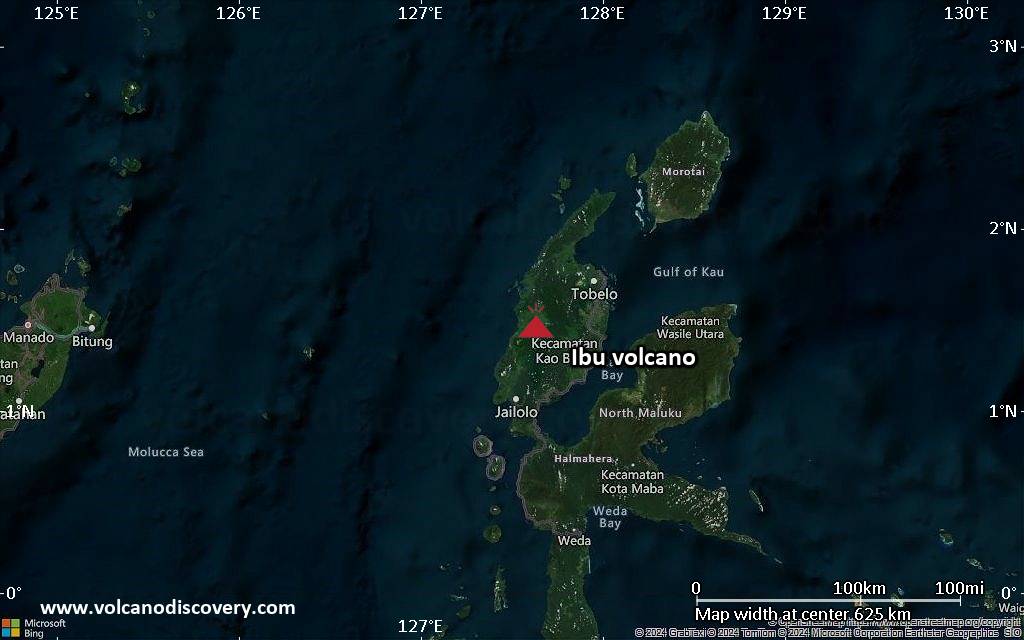
Ibu Volcano Volcanic Ash Advisory: VA TO FL070 REPORTED AT 08/0820Z MOV S EST VA DTG: 08/1124Z to 7000 ft (2100 m)

Explosive activity continues. Volcanic Ash Advisory Center (VAAC) Darwin warned about a volcanic ash plume that rose up to estimated 7000 ft (2100 m) altitude or flight level 070 .
The full report is as follows:

FVAU01 at 11:31 UTC, 08/01/26 from ADRM
VA ADVISORY
DTG: 20260108/1131Z
VAAC: DARWIN
VOLCANO: IBU 268030
PSN: N0129 E12738
AREA: INDONESIA
SOURCE ELEV: 1325M AMSL
ADVISORY NR: 2026/29
INFO SOURCE: CVGHM, HIMAWARI-9
ERUPTION DETAILS: VA TO FL070 REPORTED AT 08/0820Z MOV S
EST VA DTG: 08/1124Z
EST VA CLD: SFC/FL070 N0131 E12737 – N0131 E12739 – N0116
E12743 – N0117 E12730 MOV S 10KT
FCST VA CLD +6 HR: 08/1724Z SFC/FL070 N0131 E12737 – N0131
E12739 – N0116 E12743 – N0117 E12730
FCST VA CLD +12 HR: 08/2324Z NO VA EXP
FCST VA CLD +18 HR: 09/0524Z NO VA EXP
RMK: VA CURRENTLY OBSCURED BY MET CLOUD AND ASH FROM EARLIER
ERUPTION IS EXPECTED TO DISSIPATE WITHIN 12HRS. VA HEIGHT
AND MOVEMENT BASED ON GROUND REPORT AND MODEL GUIDANCE.
NXT ADVISORY: NO LATER THAN 20260108/1731Z=