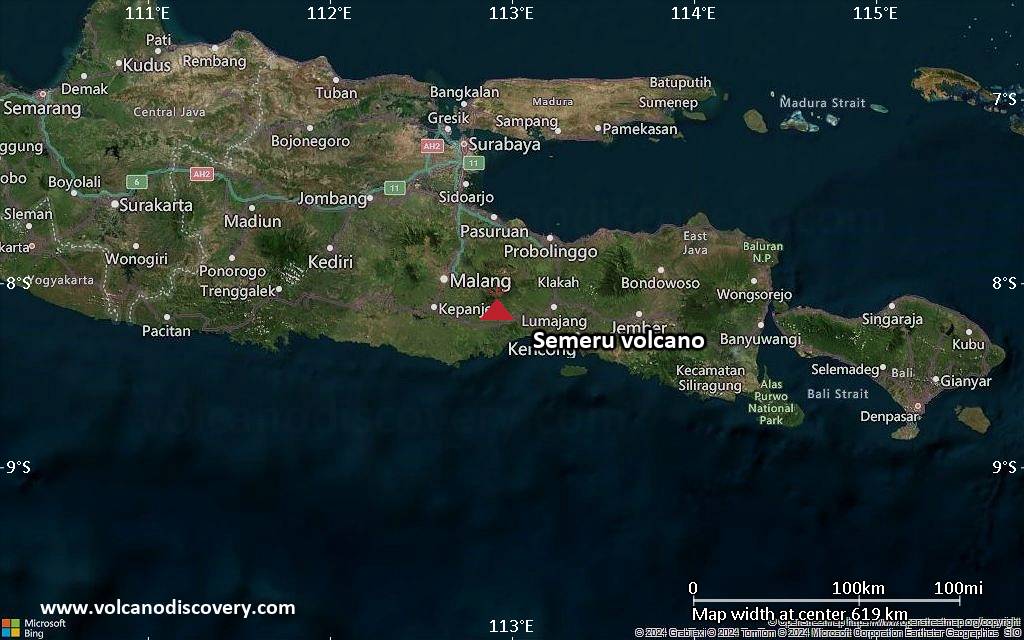
Semeru Volcano Volcanic Ash Advisory: VA ERUPTION TO FL150 LAST REPORTED AT 17/2221Z

Volcanic Ash Advisory Center Darwin (VAAC) issued the following report:

FVAU02 at 22:57 UTC, 17/02/26 from ADRM
VA ADVISORY
DTG: 20260217/2300Z
VAAC: DARWIN
VOLCANO: SEMERU 263300
PSN: S0806 E11255
AREA: INDONESIA
SOURCE ELEV: 3657M AMSL
ADVISORY NR: 2026/197
INFO SOURCE: CVGHM, HIMAWARI-9
ERUPTION DETAILS: VA ERUPTION TO FL150 LAST REPORTED AT
17/2221Z
EST VA DTG: 17/2240Z
EST VA CLD: SFC/FL150 S0803 E11249 – S0800 E11253 – S0810
E11321 – S0823 E11315 – S0827 E11302 MOV SE 10KT
FCST VA CLD +6 HR: 18/0440Z SFC/FL150 S0804 E11249 – S0800
E11252 – S0810 E11321 – S0823 E11317 – S0826 E11306
FCST VA CLD +12 HR: 18/1040Z SFC/FL150 S0805 E11249 – S0800
E11252 – S0805 E11318 – S0816 E11320 – S0826 E11309
FCST VA CLD +18 HR: 18/1640Z SFC/FL150 S0807 E11248 – S0802
E11249 – S0801 E11320 – S0815 E11322 – S0824 E11313
RMK: VA NOT IDENTIFIABLE ON SATELLITE IMAGERY DUE TO MET
CLOUD COVER. VA EMISSIONS ARE EXPECTED TO BE ONGOING. VA
HEIGHT AND MOVEMENT BASED ON GROUND REPORTS AND MODEL
GUIDANCE.
NXT ADVISORY: NO LATER THAN 20260218/0500Z=

Shiveluch Volcano Volcanic Ash Advisory: VA AT 20260217/1820Z FL170 EXTD E OBS VA DTG: 17/1820Z to 17000 ft (5200 m)

Satellite image of Shiveluch volcano on 17 Feb 2026

Explosive activity continues. Volcanic Ash Advisory Center (VAAC) Tokyo warned about a volcanic ash plume that rose up to estimated 17000 ft (5200 m) altitude or flight level 170 and is moving at 30 kts in E direction.
The full report is as follows:

FVFE01 at 18:46 UTC, 17/02/26 from RJTD
VA ADVISORY
DTG: 20260217/1846Z
VAAC: TOKYO
VOLCANO: SHEVELUCH 300270
PSN: N5639 E16122
AREA: RUSSIA
SOURCE ELEV: 3283M AMSL
ADVISORY NR: 2026/61
INFO SOURCE: HIMAWARI-9
ERUPTION DETAILS: VA AT 20260217/1820Z FL170 EXTD E
OBS VA DTG: 17/1820Z
OBS VA CLD: SFC/FL170 N5644 E16117 – N5647 E16419 – N5631 E16419 –
N5636 E16118 MOV E 30KT
FCST VA CLD +6 HR: 18/0020Z SFC/FL180 N5710 E17219 – N5642 E17156 –
N5635 E16121 – N5747 E16600
FCST VA CLD +12 HR: 18/0620Z SFC/FL170 N5757 W17921 – N5714 W17937 –

N5723 E17125 – N5634 E16121 – N5844 E17112
FCST VA CLD +18 HR: NO VA EXP
RMK: NIL
NXT ADVISORY: 20260218/0000Z=

Azerbaijan: Ruben Vardanyan’s 20-year prison term culminates “travesty” of a trial against ethnic Armenian leaders

Responding to the conviction and 20-year sentence of Ruben Vardanyan, the last of 16 ethnic Armenians put on trial by Azerbaijan in connection with their roles in Azerbaijan’s break-away region of Nagorno-Karabakh (Karabakh) prior to its takeover by Azerbaijani forces in 2023, Marie Struthers, Amnesty International’s Director for Eastern Europe and Central Asia, said:

“The conviction of the 16 defendants, culminating in this sentence against Ruben Vardanyan, is nothing short of a travesty. The fact that Ruben Vardanyan and the others, several civilians like himself, were tried before a military court in itself raises serious concerns and is incompatible with fair trial guarantees. While victims of the decades-long conflict over Nagorno-Karabakh in both Armenia and Azerbaijan deserve truth, justice, reparations and assurances of non-repetition, these convictions constitute an affront to all victims of crimes under international law.”

While victims of the decades-long conflict over Nagorno-Karabakh in both Armenia and Azerbaijan deserve truth, justice, reparations and assurances of non-repetition, these convictions constitute an affront to all victims of crimes under international law

Marie Struthers, Amnesty International’s Director for Eastern Europe and Central Asia

“Accused of a plethora of extremely serious crimes, Ruben Vardanyan and other defendants were tried in an effectively closed hearing, based on ‘evidence’ in a language they could not understand and that was not adequately translated. Even the charges – over 40 against Vardanyan alone – including “terrorism” and “crimes against humanity” were not fully publicly disclosed during proceedings. Amnesty International requested information from the Azerbaijani authorities about the trial and the evidence but received no response.

“Azerbaijan must comply with its obligations under international human rights law and ensure that all those accused of crimes are tried in full compliance with international law and fair trial standards.”

Background

A prominent businessman, Ruben Vardanyan moved from Russia to Nagorno-Karabakh in 2022 and was detained by the Azerbaijani authorities on 27 September 2023 amid the mass exodus of ethnic Armenians following Azerbaijan’s military takeover of the region. He faced multiple charges, including “financing terrorism,” “creating illegal armed group” and “violent seizure of power.”

Amnesty International expressed concern regarding his fair trial rights, citing allegations of ill-treatment, coerced signature of falsified case materials and denial of adequate time to prepare his defence, and called for an investigation into these reported violations.

On 5 February, the same court sentenced 15 other defendants, including former leaders of the self-proclaimed “Republic of Artsakh.” Five, including the former de facto President Arayik Harutyunyan, received life sentences. The defendants, both civilian and military, were accused of 2,548 crimes overall, including “genocide,” “slavery,” “enforced disappearance” and “financing terrorism.”

The post Azerbaijan: Ruben Vardanyan’s 20-year prison term culminates “travesty” of a trial against ethnic Armenian leaders appeared first on Amnesty International.
Meet four students speaking out on what they expect from Bangladesh’s new government

Following Bangladesh’s national elections last week, the new government, led by Prime Minister Tarique Rahman’s Bangladesh Nationalist Party (BNP), was sworn into power today. The elections – the first since nationwide student-led protests deposed the government of former prime minister Sheikh Hasina in August 2024 – are widely seen as a pivotal moment for human rights in Bangladesh. Since the country was founded in 1971, successive administrations have failed to respect the human rights obligations laid down in its constitution, with violations including enforced disappearances, extrajudicial executions, and repression of freedom of expression, peaceful assembly and association. commonplace.

Here, four young Bangladeshis, united in their hope that the new government will make a break with the past, share their expectations on what it must deliver.

Omar Faruk

Omar Faruk, 21,works with a local organization to help mobilize and coordinate student volunteers for community-based initiatives. Alarmed by the effects that climate change is already having on Bangladesh’s most marginalized communities, he wants the new government to prioritize action to deliver climate justice.

“Climate change is not only an environmental crisis; it is a profound human rights issue. Climate justice recognizes that the impacts of climate change are distributed unequally, and that those who have contributed the least to the problem are the ones who often suffer the worst effects. Women, so-called lower-caste communities, and marginalized groups face disproportionate risks due to systemic inequality.

In many societies, women are primarily responsible for water collection, food security, and household care. Climate-related disasters such as floods, droughts, and cyclones increase their workload, expose them to health risks, and limit their access to education and economic opportunities.

A just climate response must challenge social hierarchies while protecting the environment.

Marginalized communities often live in environmentally fragile areas with limited infrastructure and state support. When disasters strike, these communities face greater displacement, loss of livelihood, and barriers to recovery due to social exclusion.

Addressing climate change without considering gender and caste intersections risks reinforcing existing injustices. A just climate response must challenge social hierarchies while protecting the environment. Only through inclusive and rights-based approaches can climate justice contribute to long-term sustainability and human dignity and justice.”

Umma Sadia Prapty

Umma Sadia Prapty, a 24-year-old from Shariatpur, is studying for a master’s degree in Applied Linguistics and English Language Teaching.Frustrated by the barriers that have prevented young people from fully participating in public discourse, she wants the new government to ensure that the rights to freedom of expression and association are protected.

“Governance becomes more effective and transparent when people can express their opinions and criticism openly about authorities. The right to share diverse perspectives and organize protests against injustice should be guaranteed. Misinformation, fear, and polarization can fill the vacuum left by stifled debate if these rights are denied.

The younger generation in Bangladesh is increasingly educated, globally connected, and politically aware, so these rights are particularly important for them. Young people use social media platforms to share their opinions, communicate with one another, and bring reforms in areas such as climate justice, economic rights, and democratic participation.

We need laws that protect freedom of expression and association that allow people to enjoy their rights legally without fear of being targeted

Yet, restrictive political laws and the lack of proper legal safeguards can discourage youth engagement or push activism underground.

Instead, we need laws that protect freedom of expression and association that allow people to enjoy their rights legally without fear of being targeted. Governance should be transparent and accountable to the people. The press should be allowed to publish news and events freely without being pressured by political actors. Youth participation in policymaking should be ensured by creating youth councils or civic forums. By strengthening these pillars of civic life, Bangladesh can build a democratic culture that nurtures good governance, empowers all people, and strengthens justice, accountability, and shared progress.”

Tahsin Ahmed Tanmoy

Media Studies and Journalism student Tahsin Ahmed Tanmoy, 19,believes that the elections must herald a new era in Bangladesh characterized by transparency and inclusive governance. Committed to using his skills to help build a more just and participatory society, he wants the new government to show its strength by protecting the right to protest.

“From an early age, I learned that peaceful protest was a democratic right. It was something written into laws and spoken about in classrooms. But as I became more engaged in society, I began to see a contradiction.

Silence often feels safer than speaking out, even when issues directly affect our lives. Many young people hesitate before raising their voices, weighing their desire to speak against the risks of being labeled as troublemakers.

Many young people in Bangladesh face obstacles when they try to organize or participate in peaceful protests. They face administrative restrictions, fear of retaliation, or social pressure to remain silent. Over time, this creates an environment where exercising a fundamental right feels risky.

We want a country where peaceful protest is protected rather than criminalized

The impact goes beyond individual fear. When peaceful protest is discouraged, trust in democratic institutions begins to erode. Young people start to feel that their voices matter only at specific moments, rather than as part of an ongoing democratic process. This distances an entire generation from meaningful participation.

Our expectations are clear and reasonable. We want a country where peaceful protest is protected rather than criminalized, where law enforcement safeguards rights instead of intimidating those who exercise them, and where dissent is recognized as a contribution to society rather than a threat.

A confident and legitimate government does not fear peaceful protest. It understands that listening to criticism strengthens governance and builds long-term stability.”

Md. Nahid Hasan Sharif

Md. Nahid Hasan Sharif, 24, is a Statistics student from Dhaka. Shaped by his experiences during the protests of summer 2024, he believes that the government must address the legacy of that uprising by overseeing changes including reform of the police and an end to impunity.

“For me, the July Revolution is a sequence of flashes that continue to plague my evenings. They are more than a chapter in a history book.

I recall being close to the Vatara Police Station on a hot Friday afternoon in July. The thundering thud of sound grenades and the sting of tear gas filled the air. The open flames appeared. I still recall how horrified I was to learn that a rickshaw puller had been shot in front of the station. The crowd exploded in genuine panic as well as rage.

Open and equitable trials must be held for those who ordered the deadly force

The regime’s overthrow on 5 August was not the end of our role. I participated in the victory processions, but I also realized that a city without leaders needs its youth. I went back on the streets in the days that followed, but this time with duty rather than slogans. I controlled traffic when the system failed, stood watch at police stations to stop violence, and painted graffiti that expressed resistance and hope on the walls of our city.

Throughout the election, we have been calling for a New Social Contract that holds people in positions of authority to account. We’re calling for complete rehabilitation for all those injured [during the protests] by the state, including guarantees of employment and financial security. We need institutional reform that safeguards the public, and ensures that no one is ever covertly detained for their opinions. Open and equitable trials must be held for those who ordered the deadly force.”

LEARN ABOUT THE RIGHT TO PROTEST

The post Meet four students speaking out on what they expect from Bangladesh’s new government appeared first on Amnesty International.

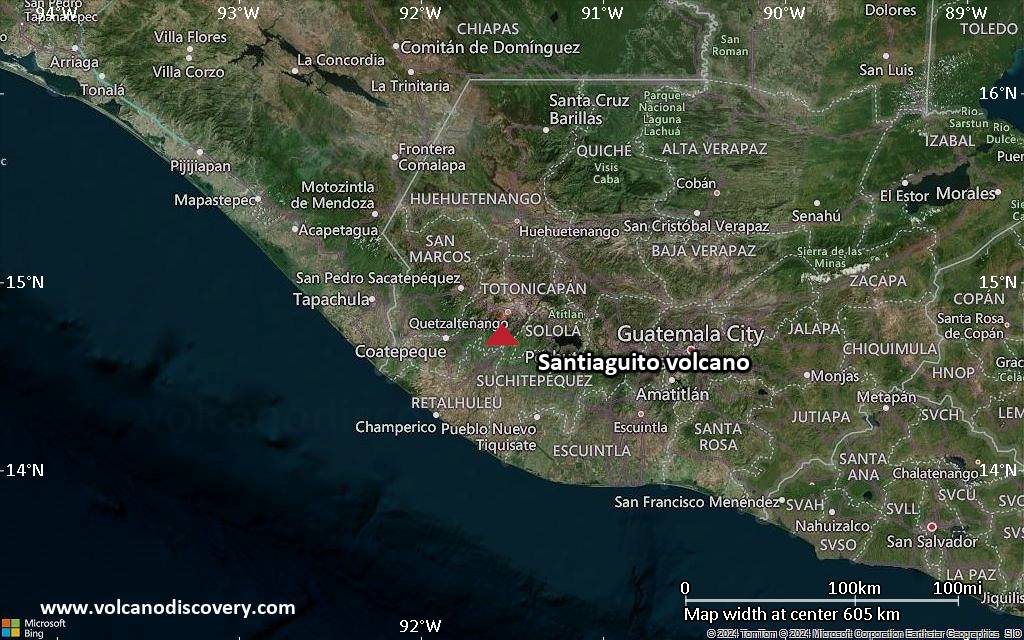
Santiaguito Volcano Volcanic Ash Advisory: VA MOVG S to 14000 ft (4300 m)

Explosive activity continues. Volcanic Ash Advisory Center (VAAC) Washington warned about a volcanic ash plume that rose up to estimated 14000 ft (4300 m) altitude or flight level 140 .
The full report is as follows:

FVXX21 at 12:06 UTC, 17/02/26 from KNES
VA ADVISORY
DTG: 20260217/1204Z

VAAC: WASHINGTON

VOLCANO: SANTA MARIA 342030
PSN: N1445 W09133

AREA: GUATEMALA

SOURCE ELEV: 12287 FT AMSL

ADVISORY NR: 2026/110

INFO SOURCE: GOES-19. WEBCAM. NWP MODELS.

ERUPTION DETAILS: VA MOVG S

OBS VA DTG: 17/1140Z

OBS VA CLD: SFC/FL140 N1446 W09133 – N1445 W09132
– N1433 W09130 – N1434 W09138 – N1446 W09133 MOV
S 5KT

FCST VA CLD +6HR: 17/1730Z SFC/FL140 N1446 W09133
– N1446 W09132 – N1416 W09134 – N1425 W09152 –
N1446 W09133

FCST VA CLD +12HR: 17/2330Z SFC/FL140 N1446
W09133 – N1445 W09132 – N1426 W09143 – N1435
W09152 – N1446 W09133

FCST VA CLD +18HR: 18/0530Z NO VA EXP

RMK: VA EMS OBS IN STLT IMAGERY AND WEBCAM MOVG
APPRX 10NM S FM SUMMIT. VA FCST THRU T+12 HRS
BASED ON NWP MDL GUIDANCE. …COVERDALE

NXT ADVISORY: WILL BE ISSUED BY 20260217/1800Z