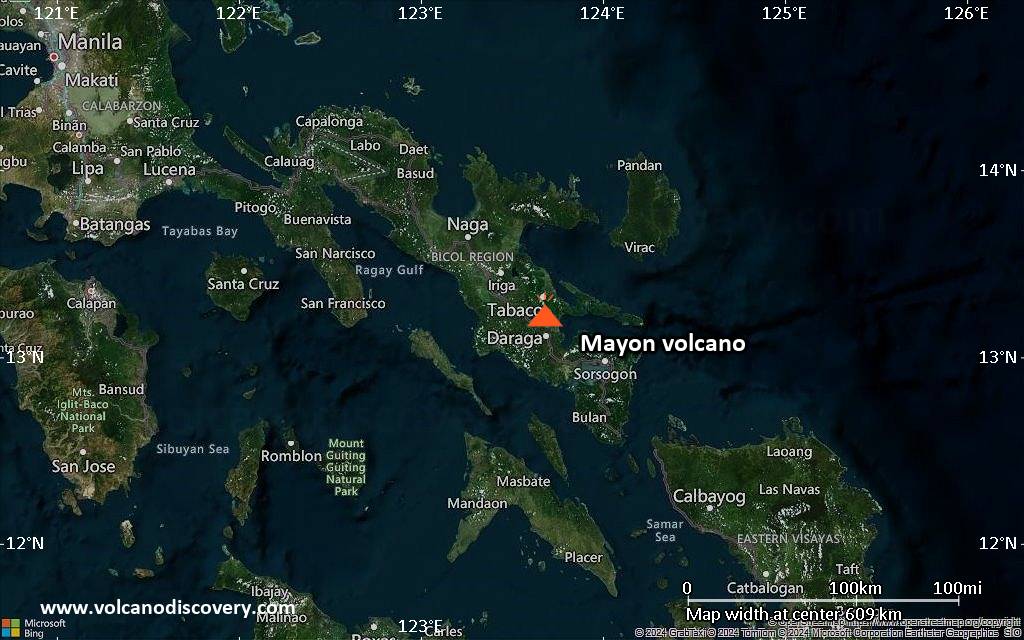
Volcanic Ash Advisory Center Tokyo (VAAC) issued the following report:
FVFE01 at 01:23 UTC, 13/03/26 from RJTD VA ADVISORY DTG: 20260313/0123Z VAAC: TOKYO VOLCANO: MAYON 273030 PSN: N1315 E12341 AREA: PHILIPPINES SOURCE ELEV: 2462M AMSL ADVISORY NR: 2026/306 INFO SOURCE: HIMAWARI-9 PHIVOLCS ERUPTION DETAILS: ERUPTION AT 20260313/0105Z VA CLD UNKNOWN REPORTED OBS VA DTG: 13/0110Z OBS VA CLD: VA NOT IDENTIFIABLE FM SATELLITE DATA WIND FL180 280/28KT
FCST VA CLD +6 HR: NOT AVBL FCST VA CLD +12 HR: NOT AVBL FCST VA CLD +18 HR: NOT AVBL RMK: WE WILL ISSUE FURTHER ADVISORY IF VA IS DETECTED IN SATELLITE IMAGERY. NXT ADVISORY: NO FURTHER ADVISORIES=
Explosive activity continues. Volcanic Ash Advisory Center (VAAC) Darwin warned about a volcanic ash plume that rose up to estimated 15000 ft (4600 m) altitude or flight level 150 . The full report is as follows:
FVAU02 at 21:27 UTC, 12/03/26 from ADRM VA ADVISORY DTG: 20260312/2126Z VAAC: DARWIN VOLCANO: SEMERU 263300 PSN: S0806 E11255 AREA: INDONESIA SOURCE ELEV: 3657M AMSL ADVISORY NR: 2026/291 INFO SOURCE: HIMAWARI-9, CVGHM ERUPTION DETAILS: DISCRETE VA EMISSIONS TO FL150 OBS AT 12/2110Z MOV NE OBS VA DTG: 12/2110Z OBS VA CLD: SFC/FL150 S0810 E11255 – S0805 E11251 – S0739 E11304 – S0753 E11321 MOV NE 15KT FCST VA CLD +6 HR: 13/0310Z SFC/FL150 S0808 E11253 – S0804 E11252 – S0745 E11316 – S0807 E11323 FCST VA CLD +12 HR: 13/0910Z SFC/FL150 S0804 E11252 – S0747 E11320 – S0808 E11325 – S0809 E11253 FCST VA CLD +18 HR: 13/1510Z SFC/FL150 S0809 E11253 – S0804 E11252 – S0751 E11321 – S0810 E11322 RMK: VA IDENTIFIABLE ON LATEST SATELLITE IMAGERY. GROUND REPORTS INDICATE INTERMITTENT ERUPTIONS ARE ONGOING. VA HEIGHT AND MOVEMENT BASED ON SATELLITE IMAGERY, GROUND REPORTS AND MODEL GUIDANCE. NXT ADVISORY: NO LATER THAN 20260313/0326Z=
Update (March 17, 2026): In an incredible, last-minute victory for compassion and common sense, the power of your voice has forced Washington State University’s College of Veterinary Medicine to cancel its planned horse-killing laboratory, saving eight healthy and adoptable horses from certain death. With just days left to save them, PETA supporters joined compassionate veterinarian group Our Honor, peppering school officials with pleas from more than 36,000 calls and e-mails. They listened, and just four days after we launched our action alert, officials canceled the planned laboratory—the final time it was to be held—in which the horses were slated to be used by veterinary students to practice complicated abdominal surgeries before killing them. The goat laboratory, sadly, had already run its course. But the university is now reviewing its curriculum to determine whether it will continue in the future. PETA strongly urges the university to stop harming and killing goats in this lab and continues to press the school to send the horses to a reputable sanctuary.
Join us by sending polite comments to WSU officials.
You can do so by copying and pasting this block of e-mail addresses in the “To” field of your e-mail:
Please feel free to use these talking points (but remember that using your own words is always more effective):
The horses who were slated for invasive surgery and death in your third-year surgery lab are eligible for adoption since the school has canceled that lab, and I urge WSU to ensure they are immediately sent to a reputable sanctuary where they can live safely and peacefully.
WSU has stated that it is reviewing its curriculum, and I hope the university will permanently move away from using healthy animals for harmful and terminal training labs.
Many veterinary schools successfully train students using humane clinical programs and modern simulation methods instead of killing healthy animals.
Original post:
Eight healthy horses and 60 goats are reportedly slated to be killed after pointless practice surgeries at the Washington State University College of Veterinary Medicine. WE HAVE LITTLE TIME to save their lives, and PETA is urging your IMMEDIATE help.
PETA has joined with veterinarians, veterinary students, and alumni by sending a letter calling on the university to cancel its plans to kill the adoptable animals in an antiquated Junior Surgery laboratory, where veterinary students cut into the animals to practice complicated abdominal surgeries. All of these animals are slated to be killed after the procedures.
Compassionate veterinarian group Our Honor, which took on the issue after veterinary students raised concerns, says sanctuaries and alternative placements are ready to accept all the animals. The university appears committed to killing them anyway.
The university’s animal use policy states that only animals destined for slaughter may be used in the Junior Surgery laboratory. But these eight horses are healthy and adoptable. They were transferred from a U.S. Department of Agriculture research program, raising questions about whether the school’s animal care committee—the last line of defense for animals in laboratories—was given proper information.
Many veterinary schools have replaced terminal laboratories with clinical-based surgical training programs, where students perform necessary procedures for animal guardians under supervision. These programs often partner with rural communities lacking access to veterinary services. PETA urges the university to adopt these and other widely available humane simulation methods.