Israel/OPT: Decision to drop charges against soldiers accused of abuse of Palestinian detainee disgraceful

Responding to the decision by Israel’s Military Advocate General to drop charges against five Israeli soldiers accused of abusing and sexually assaulting a Palestinian detainee at Israel’s notorious Sde Teiman military prison, Amnesty International’s Senior Director for Research Advocacy and Policy, Erika Guevara Rosas said:

“This decision marks yet another unconscionable chapter in the Israeli legal system’s long-standing history of granting impunity to perpetrators of grave crimes against Palestinians. This, and Prime Minister Benjamin Netanyahu’s welcoming of the decision, illustrate the Israeli system’s “unwillingness or inability” to prosecute crimes under international law, stressing the urgent need for international justice as the only remaining avenue for Palestinians.

This decision marks yet another unconscionable chapter in the Israeli legal system’s long-standing history of granting impunity to perpetrators of grave crimes against Palestinians.

Erika Guevara Rosas

Since the start of Israel’s genocide against Palestinians in the occupied Gaza Strip, and despite overwhelming evidence of widespread torture and abuse, including sexual violence, against Palestinians in Israeli detention centres, only one Israeli soldier has been so far sentenced over torturing a Palestinian detainee. At least 98 Palestinians are known to have died in Israeli custody since October 2023, with Israeli authorities failing to hold any independent, transparent, and impartial investigation into any of these cases, while continuing to block independent monitors, including the ICRC, from visiting Palestinian detainees.  

“Amidst rising regional tensions, the world cannot look the other way while Palestinians continue to be denied even a semblance of justice. State parties to the Rome Statute must do all that in their power to support ICC investigation of ongoing crimes in Palestine and Israel.”

According to Israel NGO HaMoked there are currently 9,446 Palestinians held in custody in Israeli prisons. Amnesty International has previously documented how Palestinians detained at Sde Teiman have been held incommunicado and subjected to torture and other ill-treatment.

Updated on 14 March: The original article published incorrectly referred to Palestinian detainees rather than a single Palestinian detainee

The post Israel/OPT: Decision to drop charges against soldiers accused of abuse of Palestinian detainee disgraceful appeared first on Amnesty International.

Kazakhstan: Proposed new Constitution reflects erosion of human rights standards and rule of law

Kazakhstan’s proposed new Constitution represents an alarming rollback of human rights protections and the rule of law and a blatant attempt to concentrate presidential power, Amnesty International said ahead of a referendum on the sweeping changes scheduled for 15 March.

“The project of the new Constitution of Kazakhstan reflects what we have been witnessing over the last years – the erosion of international human rights standards and fundamental principle of the law in the country,” Marie Struthers, Amnesty International’s Director for Eastern Europe and Central Asia, said.

The draft Constitution, which was prepared without inclusive public consultations or meaningful input from independent civil society, would permit greater restrictions on human rights including the rights to freedom of expression, association and peaceful assembly, based on overly broad and vague concepts of “constitutional order” and “public morality.”

It also defines marriage as a union between a man and a woman, further enshrining discrimination against LGBTI people, whose rights have already been severely curtailed by a law banning so-called propaganda of “non-traditional sexual relations” enacted in December 2025.

“By including in the draft Constitution undue restrictions on the rights to freedom of expression, peaceful assembly, association, and the right to protection from discrimination, Kazakhstan is joining an accelerating rollback on international human rights standards and the rule of law that we have documented throughout Central Asia and the wider region,” Marie Struthers said.

By including in the draft Constitution undue restrictions on the rights to freedom of expression, peaceful assembly, association, and the right to protection from discrimination, Kazakhstan is joining an accelerating rollback on international human rights standards and the rule of law that we have documented throughout Central Asia and the wider region

Marie Struthers, Amnesty International’s Director for Eastern Europe and Central Asia

“The draft Constitution places human rights within the framework of broad and vague concepts such as the “idea of a Just Kazakhstan,” the principle of “Law and Order,” and “promotion of the idea of a responsible, creative patriotism.”

“Kazakhstan authorities must immediately revoke or remove the repressive provisions and ensure the draft Constitution contains human rights guarantees that are entirely consistent and compatible with the country’s international human rights obligations.”

As one human rights defender from Kazakhstan put it, “Law becomes a substitute for rights, and Order – for freedoms”.”

Primacy of national law

The Constitution would no longer contain the provision that international treaties to which Kazakhstan is a state party take precedence over national laws which are inconsistent with the country’s international human rights obligations. Instead, as has been the case in Russia since 2020, the draft Constitution grants the Constitutional Court the authority to overrule the implementation of decisions by international human rights bodies which “do not comply with the Constitution,” thereby undermining the country’s international human rights obligations. Kazakhstan may not invoke the provisions of its internal law as justification for its failure to perform its treaty obligations.

In what appears to be a bid to tighten control over civil society, the draft Constitution would require NGOs to ensure that all information on financial transactions relating to foreign sources of their funding and all related assets is “open and accessible.”

“Although framed as a transparency measure, in practice such provisions are only too reminiscent of repressive ‘foreign agents’ or ‘foreign influence’ legislation likely to be used to impede NGOs’ work, replicating harmful examples from Russia, Kyrgyzstan, Georgia and elsewhere,” said Marie Struthers.

Although framed as a transparency measure, in practice such provisions are only too reminiscent of repressive ‘foreign agents’ or ‘foreign influence’ legislation likely to be used to impede NGOs’ work, replicating harmful examples from Russia, Kyrgyzstan, Georgia and elsewhere

Marie Struthers, Amnesty International’s Director for Eastern Europe and Central Asia

Background

The draft Constitution was hastily drafted by a state appointed commission. The authorities have clamped down on criticism of the proposed changes, stifling any legitimate debate by detaining journalists, lawyers and bloggers and blocking social media accounts. 

The draft Constitution further consolidates presidential power while undermining the principles of separation of powers and checks and balances and diminishing the role of Parliament, which will become unicameral and renamed the Kurultai.

It also grants the President the authority to appoint the heads of the Supreme Court, the Central Electoral Commission, the Supreme Audit Chamber, the State Security Service, the National Bank and the Human Rights Commissioner, without parliamentary approval. In addition, the President would appoint the Chairperson of the Constitutional Court and, together with the Kurultai, confirm 10 of the Court’s 11 judges.

Article 27 of the Vienna Convention on the Law of Treaties (1969) provides that, “A party may not invoke the provisions of its internal law as justification for its failure to perform a treaty.” Kazakhstan acceded to the Convention on January 5, 1994.

The post Kazakhstan: Proposed new Constitution reflects erosion of human rights standards and rule of law appeared first on Amnesty International.

Seán: A Greek court refused to criminalise rescue workers, but will the EU do the same?

For years, Seán Binder’s life was turned upside down because he believed people’s pulses should be checked before their passports. In January, he was finally acquitted of charges relating to his humanitarian work helping migrants and refugees at sea. Here, he shares his story and his concerns over a new piece of EU legislation that threatens vital humanitarian work in future. 

My ordeal started at about 2am one morning in February 2018, when I was arrested by the Greek police. People were fleeing conflicts at home and coming to Europe seeking safety in unseaworthy boats and I was helping the Emergency Response Center International to conduct search and rescue activities.

I was detained without understanding what exactly was happening; we were provided neither a lawyer nor an interpreter. After two nights, we were released “pending further investigation.” We continued to do search and rescue. After all, we had done nothing wrong. In fact, we continued to cooperate with the very authorities that had arrested us.

Then, in August 2018, six months after our initial arrest, my colleague and I were detained again. This time, we were charged with serious crimes, including forgery, the illegal use of radio frequencies, espionage, money laundering, being members of a criminal organization, and facilitating illegal entry.

The severity of the charges meant that my colleagues and I were detained in pre-trial prison. By the time we were released, 106 days later, our case had become at high-profile example of the criminalization of humanitarianism in Europe. Human rights organizations described it as the “criminalization of saving lives.” At trial, the first prosecution witness described the case in precisely those terms.  That assessment proved decisive.

Finally, on 15 January this year, I was acquitted. The prosecutor at trial stated there was no evidence of criminality, and the panel of judges unanimously agreed that my 23 co-defendants and I were motivated by, and engaged in, legal humanitarianism.

Whilst I am delighted not to be returning to prison, it has taken far too long for this absurd prosecution to collapse. In the interim, the damage has already been done. EU states’ authorities have obstructed civilian rescue efforts, and over 32,000 lives have been lost at Europe’s borders since 2014.  

Meanwhile, dozens of humanitarians across Europe face similar prosecutions, obstruction, intimidation and harassment. Sadly, my case was not the exception but part of a wider pattern of states criminalizing humanitarian work.

My colleagues and I have spent years and vast resources proving what should never have been in doubt: saving lives is a legal obligation, not a crime. Humanitarian work should be encouraged and protected in countries that claim to respect human rights.

The current effort to reform EU anti-smuggling legislation, the so-called “Facilitators Package” offers an opportunity to address some of the issues that have led to our baseless prosecution.

However, the proposed revisions to the legislation might inadvertently increase the risk of criminalizing rescue workers – meaning future prosecutions will still be possible and may not end in acquittals like mine. They will also impact migrants, people of migrant origin and racialized people who all too often suffer from these policies.

As Amnesty International has highlighted, the proposal’s broad and vague provisions risk perpetuating the criminalization of refugees, migrants and human rights defenders. Any reform should clarify explicitly and in a binding manner that acts of humanitarian assistance or solidarity should be exempted from prosecution or punishment. Migrants who may have been smuggled themselves, or people assisting their family members should also be protected from criminal liability.

Through this reform, the EU has an opportunity to align with the EU Charter, UN Conventions and Smuggling Protocols, and treaties on maritime search and rescue, and to explicitly protect the right to life, the right to seek asylum, and the duty to render assistance.

As it stands, the proposal tries to expand the avenues to pursue humanitarian workers by introducing the crime of “public instigation” of irregular migration. This vague new provision could be misconstrued to harm refugees and migrants, advocates and activists protesting unjust migration laws or professionals providing legal information or assistance.

I have seen how people fleeing persecution and poverty may have no option but to board unseaworthy boats. How in the absence of safe routes those crowded aboard cling to the sides of dinghies. How in the dead of night, in choppy waters, even children are without life vests. Criminalizing humanitarians or a passenger who takes the helm of a dinghy abandoned by the smuggler does nothing to stop that.

Prosecutors should focus on exploitation and violence, including by authorities summarily force people across land or sea borders.

Last year, the European Court of Human Rights found “serious evidence” of systematic pushbacks in Greece. Evidence of similar practices has been mounting across European borders. Without border monitoring, this already opaque crime becomes ever more obscure.

Finally, trafficking, another cross-border crime, is arguably exacerbated by EU policy. A UN report published in 2018 found that asylum seekers in Libya face “unlawful killings, torture, arbitrary detention, gang rape, slavery, forced labour and extortion,” with apparent complicity by State actors. Nevertheless, the EU has for years financed the so-called Libyan Coast Guard.

Whether in the Facilitators Package or in its wider border policies, the EU must respect the rule of law and human rights.

The way to stop people taking dangerous journeys is providing safe and legal pathways for protection, commensurate in scale with the need for protection, and channels for regular migration for those seeking a better life. By denying safe routes, the EU pushes people into the arms and boats of smugglers and traffickers.

All the while, EU laws and narratives on stopping smugglers continue being used to criminalize migrants and people doing what they can to save lives or offer assistance. Unless the reform of the Facilitators package takes serious steps to uphold the duty to rescue and defend humanitarians, people will continue to risk jail for doing what is normal, human behaviour: helping others at risk.

Watch Seán as he discusses his case, his reflections and hopes for the future.

Listen to Séan’s full story in the first season of Amnesty’s podcast ‘On the Side of Humanity’.

The post Seán: A Greek court refused to criminalise rescue workers, but will the EU do the same? appeared first on Amnesty International.
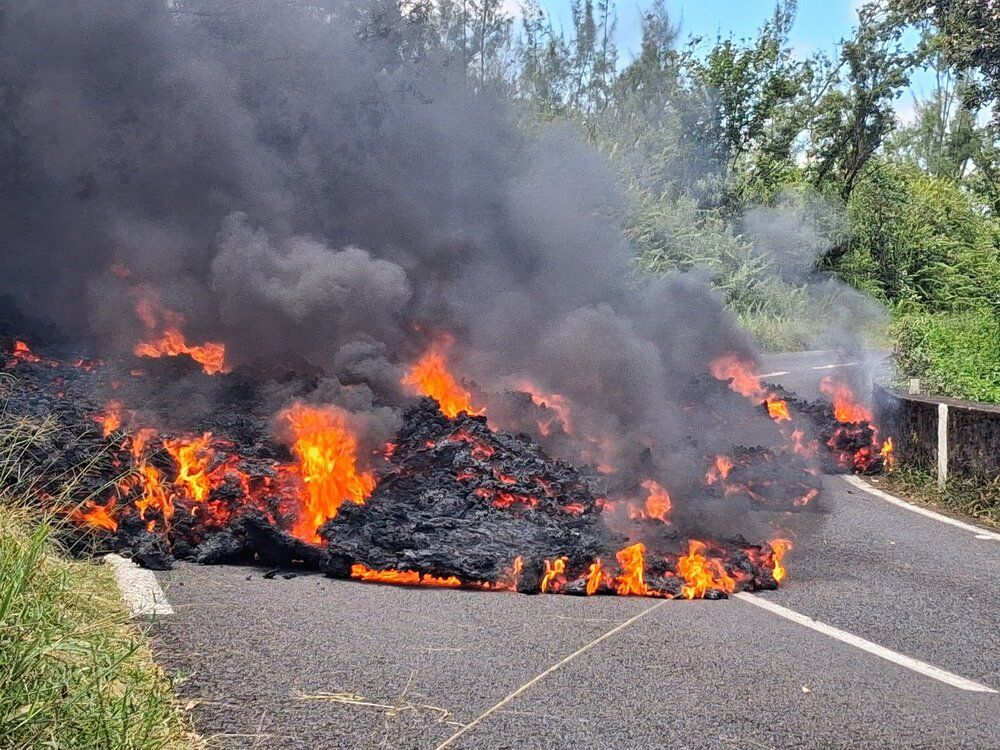
Piton de la Fournaise volcano (La Réunion): lava flow cut main road

The lava flow front has destroyed the main road on its eastern side (image: Artanis/x.com)

The lava flow front has already reached the main road and completely severed its continuity.

The lava is currently about 650 meters from reaching the ocean.