Lava effusion at Mayon led today’s activity, with multi-kilometer flows still moving down three gullies. Guatemala’s Fuego produced frequent explosions with kilometer-scale plumes, while Ecuador’s Sangay and Reventador logged dozens of blasts and hot rockfalls. In the United States, Great Sitkin held at Watch/Aviation ORANGE as Kilauea’s eruption remained paused.
United States Great Sitkin (Watch / Aviation ORANGE) kept up its long-running eruption. Kilauea remained in an eruptive pause (Advisory; Aviation YELLOW). Unrest continued at Kupreanof and Shishaldin (both Advisory; Aviation YELLOW).
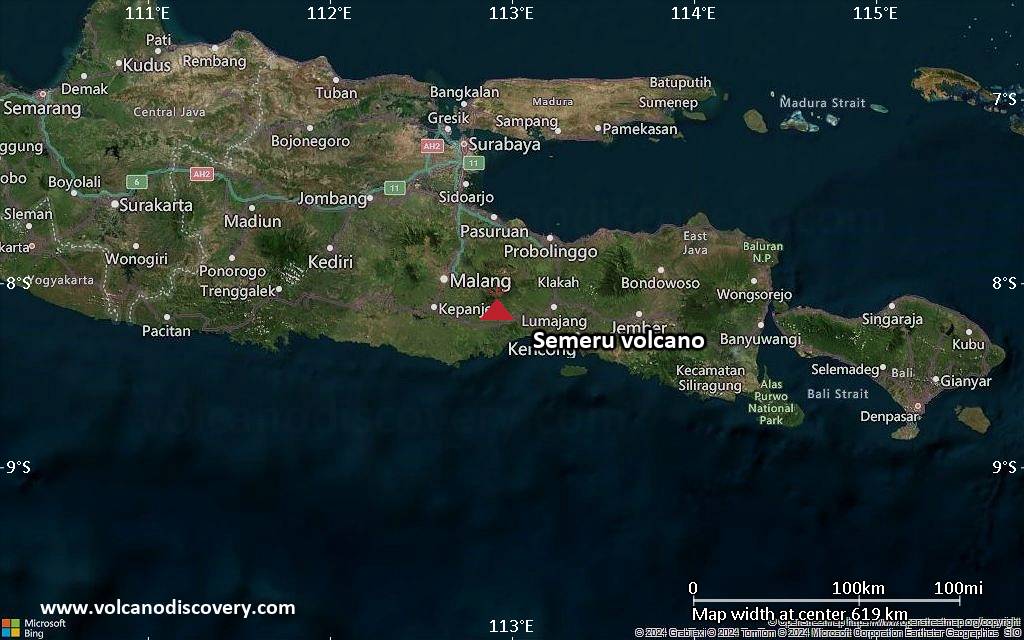
Indonesia Eruptive activity persisted at Merapi, Semeru, and Lewotobi (the last two at Level 3 – Standby). Several others—Dukono, Ibu, Lewotolok, and Marapi—also remained in eruption at Level 2. Unrest continued at Krakatau and at numerous volcanoes across Sulawesi, Maluku, and Java; see the table for the full list. Tangkuban Parahu stayed at Normal status (Level 1).
Philippines At Mayon, lava continued to pour from the summit, with flows 3.8 km E, 3.2 km SE, and 1.7 km S; plumes rose to ~1.3 km and monitoring recorded frequent rockfalls, tremor, and PDC signals. Unrest persisted at Bulusan with a 200 m plume, 148 seismic events, and inflation, while Taal held at Level 1 and Kanlaon remained at Level 2.
Mexico Popocatepetl remained in eruption under Yellow Alert – Phase 2.
South America Ecuador’s Reventador produced 74 explosions along with incandescent rockfalls descending up to 1 km below the crater. Nearby, Sangay tallied 76 explosions with ash-and-gas plumes reaching 1 km; thermal anomalies were noted at both. Peru’s Sabancaya continued its eruption at Orange Alert.
Other In Guatemala, Fuego generated up to 10 explosions per hour with plumes to about 1 km above the vent. Santa Maria also produced occasional explosions with plumes rising as high as 800 m.
RSF commander Al-Fatih Abdallah Idris, also known by his alias “Abu Lulu”, was reportedly arrested by the RSF leadership in October 2025 after multiple videos shared online showed him executing captives in civilian clothing.
“The RSF commander known as Abu Lulu has previously been accused of war crimes committed during the attacks that resulted in the fall of El Fasher last year,” said Tigere Chagutah, Amnesty International’s Regional Director for East and Southern Africa Regional Office.
“It is alarming to learn he has returned to combat without any investigation into the allegations. The RSF leadership must remove Abu Lulu from the battlefield and from their ranks immediately, and he must be investigated for the war crime of wilful killings.
“The RSF leadership must ensure that Abu Lulu is held accountable for his actions by competent and credible judicial mechanisms guaranteeing the highest standards of fair trial without resort to death penalty. It is essential that Abu Lulu, and all RSF soldiers who have committed crimes, are subject to an independent investigation for crimes under international law.”
The ongoing conflict in Sudan began in April 2023. It has killed tens of thousands of people and displaced more than 12 million, making it the world’s largest humanitarian crisis.
Amnesty International has previously documented war crimes by the RSF and allied Arab militias where they jointly carried out ethnically targeted attacks against the Masalit and other non-Arab communities in West Darfur.
Volcanic Ash Advisory Center Tokyo (VAAC) issued the following report:
FVFE01 at 11:23 UTC, 19/05/26 from RJTD VA ADVISORY DTG: 20260519/1123Z VAAC: TOKYO VOLCANO: MAYON 273030 PSN: N1315 E12341 AREA: PHILIPPINES SOURCE ELEV: 2462M AMSL ADVISORY NR: 2026/632 INFO SOURCE: HIMAWARI-9 PHIVOLCS ERUPTION DETAILS: ERUPTION AT 20260519/1103Z FL090 EXTD SW REPORTED OBS VA DTG: 19/1100Z OBS VA CLD: VA NOT IDENTIFIABLE FM SATELLITE DATA WIND FL090 100/4KT FCST VA CLD +6 HR: NOT AVBL FCST VA CLD +12 HR: NOT AVBL FCST VA CLD +18 HR: NOT AVBL RMK: WE WILL ISSUE FURTHER ADVISORY IF VA IS DETECTED IN SATELLITE IMAGERY. NXT ADVISORY: NO FURTHER ADVISORIES=
Explosive activity continues. Volcanic Ash Advisory Center (VAAC) Darwin warned about a volcanic ash plume that rose up to estimated 15000 ft (4600 m) altitude or flight level 150 . The full report is as follows:
FVAU02 at 07:51 UTC, 19/05/26 from ADRM VA ADVISORY DTG: 20260519/0750Z VAAC: DARWIN VOLCANO: SEMERU 263300 PSN: S0806 E11255 AREA: INDONESIA SOURCE ELEV: 3657M AMSL ADVISORY NR: 2026/567 INFO SOURCE: HIMAWARI-9, CVGHM ERUPTION DETAILS: VA EMISSIONS OBS MOV SE AT 19/0730Z OBS VA DTG: 19/0730Z OBS VA CLD: SFC/FL150 S0759 E11254 – S0811 E11334 – S0840 E11327 – S0810 E11248 MOV SE 10KT FCST VA CLD +6 HR: 19/1330Z SFC/FL150 S0800 E11254 – S0821 E11331 – S0851 E11325 – S0808 E11248 FCST VA CLD +12 HR: 19/1930Z SFC/FL150 S0801 E11254 – S0823 E11331 – S0840 E11329 – S0847 E11318 – S0808 E11249 FCST VA CLD +18 HR: 20/0130Z SFC/FL150 S0808 E11249 – S0759 E11255 – S0814 E11329 – S0831 E11329 – S0844 E11316 RMK: VA EMISSIONS IDENTIFIABLE ON LATEST SATELLITE IMAGERY. RECENT GROUND REPORTS INDICATE INTERMITTENT DISCRETE VA ERUPTIONS ARE ONGOING. HEIGHT AND MOVEMENT BASED ON SATELLITE, GROUND REPORTS AND MODEL GUIDANCE. NXT ADVISORY: NO LATER THAN 20260519/1350Z=
Military-connected social media accounts target activists with disinformation
Online slurs precede intimidation and violent attacks against dissidents
Meta, TikTok, X and YouTube allow harmful content to spread rapidly
Coordinated disinformation campaigns portraying government critics as “foreign agents” are silencing dissent and fueling intimidation and violence under Indonesian President Prabowo Subianto, Amnesty International said in a new report published today.
‘Building up Imaginary Enemies’ reveals a growing pattern in which Indonesian authorities – including the military – deploy online disinformation to target journalists, activists, academics and protesters in retaliation for their legitimate activism and expression. Meanwhile, tech giants Meta, TikTok, X and YouTube have allowed harmful disinformation to remain online.
This disinformation is a political weapon, deployed to consolidate the government’s power when public criticism intensifies, while demonizing and weakening those who dare to speak out.
Agnès Callamard, Secretary General at Amnesty International
“Authoritarian practices have accelerated in Indonesia under President Prabowo Subianto’s government. Amnesty’s research shows that in the 18 months since Prabowo took power, online disinformation has emerged as a key tactic to systematically discredit government critics, shut down public debate and justify repression – all while social media companies sit back and let it happen,” Amnesty International’s Secretary General Agnès Callamard said.
“This disinformation is a political weapon, deployed to consolidate the government’s power when public criticism intensifies, while demonizing and weakening those who dare to speak out. By branding protesters, journalists and human rights defenders as ‘foreign agents’, Indonesia’s authorities and their supporters are deliberately shifting attention away from people’s legitimate grievances.”
Intent to deceive
Since President Prabowo took office in October 2024, there have been multiple waves of demonstrations in Indonesia, including against corruption, budget cuts, environmental degradation and expanded powers handed to the military. Prabowo and senior officials have responded by repeatedly and publicly accusing critics of being paid, manipulated and controlled by foreign interests, and framing dissent as orchestrated rather than legitimate.
This has been followed by a proliferation of “foreign agent” slurs against civil society actors online, often based on unsubstantiated claims that they want to “undermine” or “divide” Indonesia due to the fact they receive foreign funding or other support from overseas actors.
Under international law, civil society organizations and media outlets have the right to access international funding, which is often essential for exercising the right to freedom of association.
Amnesty International’s research found that campaigns disseminating false “foreign agent” allegations against civil society have in most instances involved hundreds of accounts acting in sync to post identical videos, graphics or messages in quick succession. This false information is then amplified across Instagram, Facebook, X, TikTok and YouTube. Amnesty was able to infer from the coordinated nature of the campaigns that these accounts were spreading falsehoods with the intention to deceive, a key element of disinformation.
The implications for those branded as “foreign agents” are severe, with victims telling Amnesty it undermined their work and credibility, increased their risk of criminalization and exposed them to physical harm.
‘Your head will fall to the ground’
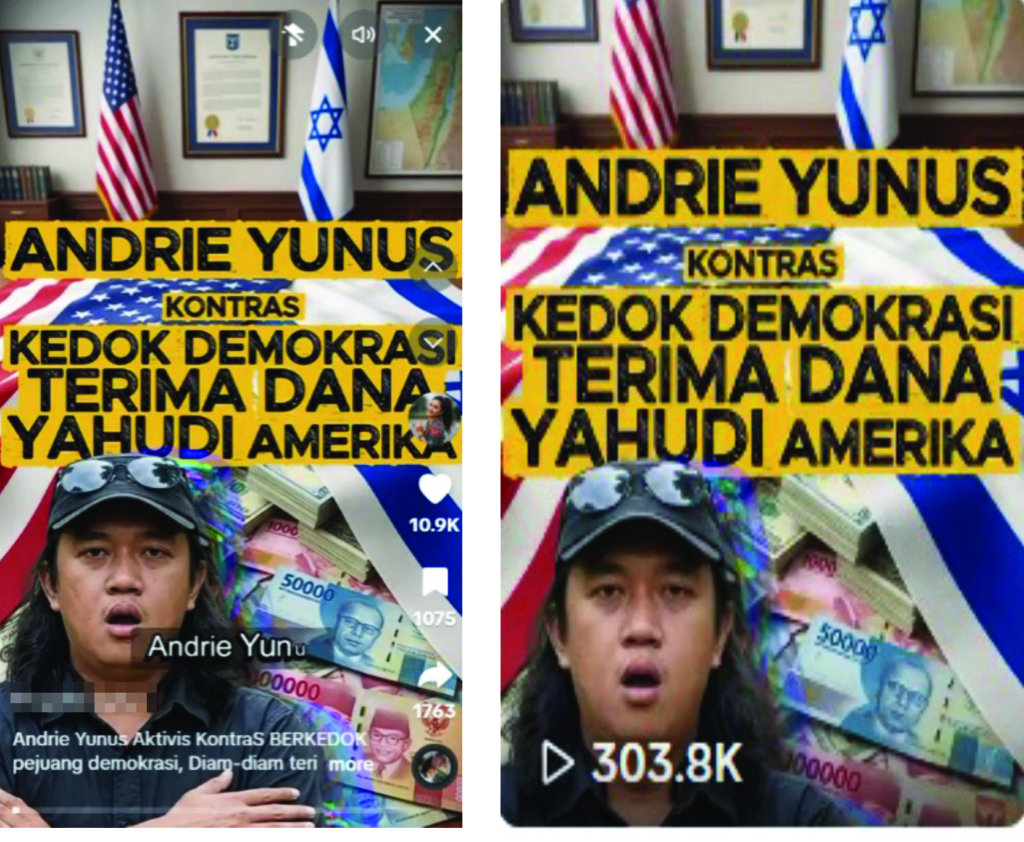
Digital disinformation campaigns have frequently spilled over into physical violence. In March 2026, Andrie Yunus, deputy coordinator of the Commission for the Disappeared and Victims of Violence (KontraS), was the victim of an acid attack in Jakarta, suffering severe chemical burns.
He had been targeted for months by coordinated online campaigns portraying him as a “foreign agent” after he helped lead peaceful protests against revisions to Indonesia’s Military Law. Dozens of accounts presenting themselves as part of the Indonesian military, together with hundreds of anonymous accounts, took part in these campaigns across different social media platforms.
State investigations later led to the arrest of four military officers. Yet even after the acid attack and arrests, disinformation continued. Coordinated videos accused Yunus of staging the assault to attract foreign funding.
Original TikTok post that attacked and labeled Andrie Yunus as a foreign agent. The post was published on 5 April 2026. The caption reads: “Andrie Yunus, a KontraS activist, DISGUISED as a democracy fighter, secretly receives funds from American Jews. Curious?? Watch this video until the end. #andrieyunus #kontras #foreignstooge #osf #soros”
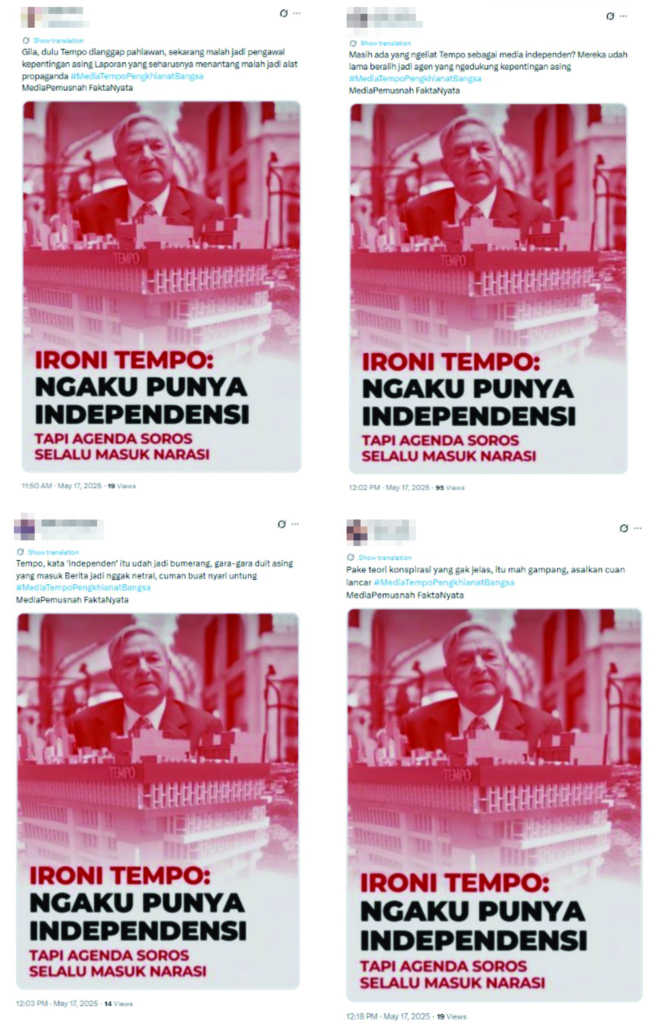
Independent media outlets have also been heavily targeted. Tempo, one of Indonesia’s most respected news organizations, faced sustained disinformation campaigns, including by Instagram accounts presenting themselves as military units, accusing it of being controlled by foreign donors after it reported critically on government policy.
Online smear campaigns were accompanied by chilling acts of intimidation, including a severed pig’s head delivered to Tempo’s newsroom and follow-up packages containing decapitated rats. Online disinformation then sought to portray the threats as staged stunts to garner foreign support.
A set of tweets from different anonymous X accounts published within the same one-hour window on 17 May 2025, featuring an identical graphic depicting a large portrait of George Soros looming over the Tempo office building. The headline reads, “The irony of Tempo: Claims to have independence,” followed by the subtext, “But Soros’s agenda always enters the narrative.” Although the accompanying captions vary slightly, they reproduce the same ‘foreign agent’ rhetoric.
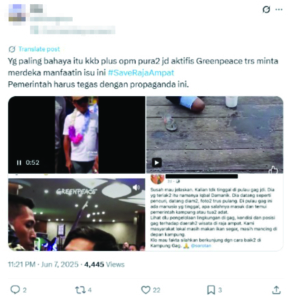
Greenpeace Indonesia activist Iqbal Damanik was targeted after he led a peaceful protest against the government’s mining activities in Raja Ampat, West Papua.
He told Amnesty: “I received so many direct messages from anonymous users. I assume they are the ones who believe the disinformation out there about me. Some threatened to kill me. One of them said, ‘Your head will fall to the ground.”
Tweet accusing Greenpeace campaigner Iqbal Damanik of being affiliated with armed groups in Papua published on 7 June 2025. The tweet shares several videos and images, including the photo of Iqbal leading a protest movement against nickel mining in Raja Ampat. The tweet reads: “The most dangerous thing is that armed criminal groups (KKB) and the OPM pretend to be Greenpeace activists and then call for independence, exploiting this issue. #SaveRajaAmpat. The government must take firm action against this propaganda.
Climate of intimidation
The pervasive use of disinformation has created a climate of fear far beyond those directly targeted, discouraging people from participating in protests, collaborating with civil society organizations or expressing critical views online.
As one journalist told Amnesty: “This is dangerous for all of us. If we all become afraid of being labelled ‘foreign agents’ and stop reporting news or any stories critical of the government, then we are back to the authoritarian atmosphere of the past.”
Amnesty’s report found that Indonesia’s domestic laws fail to protect those targeted with disinformation and are more likely to be used to prosecute and criminalize critics. A new proposed law on ‘Countering Disinformation and Foreign Propaganda’ risks deepening Indonesia’s authoritarian trajectory by being used to further restrict the right to freedom of expression.
“Instead of upholding fundamental rights to freedom of expression, association and peaceful assembly, Indonesian authorities have failed at every level: state actors participate in the attacks, victims are denied protection and a climate of intimidation is allowed to take hold,” Agnès Callamard said.
“The Indonesian government must protect journalists, activists and protesters rather than enabling and disseminating toxic disinformation against them.”
Social media companies’ responsibilities
The report also finds that Meta, TikTok, X and YouTube’s inadequate content moderation, engagement-driven algorithms and failure to address Indonesia’s heightened human rights risks allowed disinformation to spread rapidly. Most of the posts documented remained online for months – some for more than a year – and many went viral.
“Big Tech’s failures have contributed to the human rights harms documented in this report, with falsehoods spreading faster than facts. Their platforms have played a significant role in enabling an environment in which disinformation, censorship and violence can thrive,” Agnès Callamard said.
Amnesty International wrote to Meta, TikTok, X and YouTube twice: first to seek information during the research phase, and later to share its findings before publication. Only TikTok responded to Amnesty International’s letters detailing our findings, pledging to “set up additional monitoring for this specific issue”.
“Despite the increasingly hostile climate for human rights work and failures of the government and social media companies to counter disinformation, many of the activists we interviewed remain resilient. They continue to adapt, support one another and resist. However, the burden must not rest on them alone,” Agnès Callamard said.
“Amid the heightened risks under President Prabowo’s administration, Meta, TikTok, X and YouTube must stop disinformation, strengthen content moderation, conduct Indonesia-specific human rights due diligence and provide remedy to those harmed due to their failures.”
End disinformation attacks on Indonesian activists