Semeru Volcano Volcanic Ash Advisory: VA TO FL150 OBS AT 27/2340Z MOV SW OBS VA DTG: 27/2340Z to 15000 ft (4600 m)

Satellite image of Semeru volcano on 28 May 2026

Explosive activity continues. Volcanic Ash Advisory Center (VAAC) Darwin warned about a volcanic ash plume that rose up to estimated 15000 ft (4600 m) altitude or flight level 150 .
The full report is as follows:

FVAU02 at 00:01 UTC, 28/05/26 from ADRM
VA ADVISORY
DTG: 20260528/0000Z
VAAC: DARWIN
VOLCANO: SEMERU 263300
PSN: S0806 E11255
AREA: INDONESIA
SOURCE ELEV: 3657M AMSL
ADVISORY NR: 2026/602
INFO SOURCE: HIMAWARI-9, WEBCAM, CVGHM
ERUPTION DETAILS: VA TO FL150 OBS AT 27/2340Z MOV SW
OBS VA DTG: 27/2340Z
OBS VA CLD: SFC/FL150 S0802 E11255 – S0805 E11259 – S0823
E11254 – S0825 E11243 – S0814 E11239 MOV SW 05KT
FCST VA CLD +6 HR: 28/0540Z SFC/FL150 S0803 E11252 – S0803
E11258 – S0820 E11306 – S0827 E11258 – S0822 E11247
FCST VA CLD +12 HR: 28/1140Z SFC/FL150 S0809 E11251 – S0802
E11252 – S0751 E11303 – S0801 E11311 – S0814 E11310 – S0823
E11258
FCST VA CLD +18 HR: 28/1740Z SFC/FL150 S0809 E11251 – S0802
E11252 – S0756 E11309 – S0809 E11313 – S0820 E11303
RMK: INTERMITTENT DISCRETE VA EMISSIONS IDENTIFIABLE ON
LATEST SATELLITE AND WEBCAM IMAGERY. HEIGHT AND MOVEMENT
BASED ON SATELLITE IMAGERY AND MODEL GUIDANCE.
NXT ADVISORY: NO LATER THAN 20260528/0600Z=

Global: Enormous data pipelines powering major generative AI systems are rooted in mass invasions of privacy by design  

Companies are extracting vast troves of online data through unlawful web scraping to build their generative artificial intelligence (AI) products in a way that is enabling a mass invasion of privacy, making these systems unlawful by design, Amnesty International said in a new briefing today. 

Unlawful by Design: Exposing the Human Rights Costs of Generative AI documents serious risks in the large-scale data scraping and processing being used to build and train these systems, including violations of the right to privacy by design and adverse consequences for the environment and historically marginalized communities. 

“Companies across the world are supplying generative AI products under the veneer of efficiency and sophistication, but in reality, these systems perpetuate mass invasions of privacy through unlawful web scraping: an automated process for extracting data from websites, including personal data, such as images and social media activity, to train AI models,” said Likhita Banerji, Head of the Algorithmic Accountability Lab, Amnesty International.   

“The extractive data pipeline, inherent design choices made by tech companies and exploitative supply chains, to build generative AI systems have enabled a paradigm of technology development that opens up a risk of mass abuse of human rights.” 

Amnesty International researched the models powering some of the most popular publicly available standalone generative AI tools, including GPT 3 by Open AI, Google’s Gemini, Meta’s Llama, DeepSeek and tools by Midjourney and Stable Diffusion.  

Such systems rely on extracting information from billions of public online posts and images often without the explicit consent of the individuals appearing in or creating them. Not only does this infringe on privacy by design but as datasets powering AI models scale up, the presence of hateful and discriminatory content in their outputs also gets amplified, along with negative stereotypes and prejudices, especially along racial and gendered lines.  

“These choices are not inevitable. We must challenge the design choices adopted by companies who build generative AI systems by relying on training data, including personal data, that is extracted non-consensually and on a grand scale.”

Likhita Banerji, Head of the Algorithmic Accountability Lab, Amnesty International

Racial, gender and cultural biases are consistent features of generative AI systems, a product of the training data that is largely pulled from the web and therefore polluted with real-world biases which harm historically marginalized communities. Additionally, generative AI systems pose risks to the right to freedom of thought as they are capable of influencing users’ thoughts and shaping their personal beliefs through predictive suggestions. This is especially true for larger models reliant on expansive training data. 

“These choices are not inevitable. We must challenge the design choices adopted by companies who build generative AI systems by relying on training data, including personal data, that is extracted non-consensually and on a grand scale,” said Likhita Banerji. 

“This is one of the most egregious practices among AI companies operating with disregard for human rights and must urgently be addressed. A different trajectory of technology development is possible if authorities act urgently to course correct.” 

Heavy environmental costs

As the scale and speed of development has picked up at generative AI companies, so have the infrastructure requirements and associated environmental costs. 

The higher processing needs of larger models require more energy-intensive chips, larger data centres, and consequently, more energy and water for its operationalisation. Generative AI production often results in a negative impact on communities that are historically marginalized as the lands and resources that belong to these communities are exploited to build data centres and fulfill processing requirements. 

Google’s own sustainability report from 2024 noted a staggering 48 per cent increase in the company’s greenhouse gas emissions since 2019, attributable to data centre and supply chain emissions. Similarly, Microsoft’s emissions increased by 29 per cent between 2020 and 2024, attributable to data centres carrying out AI-supporting processes.  

The intensive use of resources in generative AI production has led to communities from Cerrillos in Chile, and Querétaro in Mexico, to Arizona in the United States of America, resisting data centres in areas that are already heavily affected by droughts and shortages in electricity. 

As part of its research process, Amnesty International wrote to Google, OpenAI, Meta, Stability AI, Midjourney, and DeepSeek giving them an opportunity to respond to the findings of the research briefing which states that their models are reliant on unlawful web scraping, among many other related human rights concerns.  

Amnesty International also wrote to Intel and VMware specifically regarding the risks of discrimination, and to Google, Microsoft and Amazon  about the environmental harms associated with their generative AI systems and related infrastructures. At the time of publication, only Microsoft, Amazon, Intel, OpenAI and Meta responded to Amnesty International. A summary of their responses is included in the briefing.  

Amnesty International is calling on states to prohibit standalone generative AI systems that have been built using unlawful web scraping, defined as the bulk and mass collection of training data through the web. Companies must immediately cease the practice of unlawful non-consensual web scraping of personal data for AI training purposes, and states must hold companies to account for their involvement in any human rights abuses linked to their design and business choices. 

Background

The briefing provides a human rights analysis of the ‘data pipeline’ that powers generative AI products, including the stages of data capture, analysis, and processing that are critical to the overall functioning of these systems. Specifically, this involves zooming in on the parameters and implications of design choices made in relation to the training data of generative AI models, with a focus on methods and sources of data collection, data processing, model scaling and data outputs. 

Amnesty International defines standalone generative AI tools as products that are developed, deployed and marketed for their generative AI capabilities solely and specifically, such as AI chatbots, image/video/audio/text generators, and so on. This does not include products where generative AI is an added feature or function in a larger suite of products, for example, word processing software with optional generative AI features. 

The post Global: Enormous data pipelines powering major generative AI systems are rooted in mass invasions of privacy by design   appeared first on Amnesty International.

“I was injured on my way through a warzone. Now I am advocating for proper body armour for women” – Ukrainian war veteran Natalia Lishchyshena on fighting for recognition and change

Natalia Lishchyshena is a veteran of the Russian-Ukrainian war who now works as a specialist, supporting military personnel and veterans to address legal and social issues, after she was injured by the body armour she was wearing on the way to a warzone.  

Despite facing constant setbacks, Natalia has become the first woman in Ukraine to prove the harm standard-issue body armour, designed for men, can cause to the female body, after receiving official recognition from the medical commission. In this story, she shares why protective equipment needs to be adapted for women in the military.

“I was born into a military family. My father was a serviceman, and I always wanted to be like him. After he finished his service, our family settled in the Luhansk region in eastern Ukraine. When Russia started hostilities in our region in 2014, I decided to stay in Luhansk region because my father was ill and needed care. 

I dreamt of becoming a lawyer. At the age of 38, I started studying law. Later, I volunteered for military service. My husband supported my decision. In 2021, I signed a contract with the 80th Separate Air Assault Brigade. I was 40 years old. We did not believe that a full-scale war would start. But on February 24, 2022, at 4am, we were woken up by an alarm: the first explosions, airborne troops, confusion. We did not understand who was ours and who was the enemy. The beginning of the full-scale invasion found us in the south, in the Mykolaiv region.

Our commander told us: “There are no women in the army, there are only military.” 

In the army, I performed different tasks assigned by the command: logistics, supply, and other duties. I cannot say that there is gender equality in the army, even though more than 70,000 women are currently serving in the Armed Forces of Ukraine. At the training center, during preparation, our commander told us: “There are no women in the army, there are only military. No one will help you. You knew where you were going. You can rely only on yourself.”

As for equipment, there was no proper uniform for women soldiers until 2024. Now uniforms are provided, but there is still no body armour adapted to female anatomy.

Injury, diagnosis and consequences 

Once, when we were travelling through a war zone, there was an air raid alert. As per the safety protocol, we dropped to the ground. At that moment, I was injured by my body armour. I had a large bruise on one breast, but I did not pay attention to it.

Later, I got sick, had a strong cough, and was sent to the hospital. After long treatment, I had to pass a medical commission to confirm my ability for further service. During a breast examination, I was diagnosed with breast intraductal papillomas. It is not cancer, but in many cases it can become malignant. Officially, it is a precancerous condition. The doctor explained that there wasn’t any treatment and recommended surgery.

I went through several surgeries because of complications. As a result, I had my mammary glands fully removed. Before the operation, the doctor spoke with my husband and explained the consequences. My husband said his priority was for me to stay alive.

After the surgeries and treatment, I had to fight to obtain disability status.

Step by step, I achieved justice

At first, the medical commission refused to grant me disability status, even though my illness had officially been recognized as related to military service, since the injury was caused by standard body armour. One doctor even said the decision to remove breasts was mine and there were no medical reasons for that. It was outrageous. But step by step, I achieved justice. That doctor no longer works there.

I have a lifelong disability now. There are still limitations: I cannot, stay in the sun for a long time, raise my arms high, or overwork. I also need constant medical check-ups and health monitoring.

Now Natalia uses her law degree to help veterans, families of the fallen and missing military. She also helps veterans re-integrate into everyday life through a programme called TRIBE, run by Amnesty International Ukraine and Amnesty International Denmark.

I want real changes, not just on paper 

However, I could not sit at home and feel sorry for myself for long. After a few months of rehabilitation, I returned to work and became a veteran support specialist in my community.

I use my law degree to help veterans, families of the fallen and missing military. This includes restoring lost documents, communicating with military units, and arranging legal payments. I want to help people because I have been through this myself. I understand the challenges that veterans and active military face today. Many of them simply do not know how to deal with bureaucracy.

Alongside my work as a specialist, I also help people re-integrate into everyday life through a programme called TRIBE, run by Amnesty International Ukraine and Amnesty International Denmark. TRIBE helps veterans build a supportive community, learn to advocate for their rights, and helps bridge the gap between civilians and people with combat experience.

I use my law degree to help veterans, families of the fallen and missing military

I share my experience with project participants, particularly on legal matters. I also provide individual consultations, including on issues such as obtaining disability status. I write media columns, speak publicly, and advocate for the rights of women in the military and for adequate conditions and support after discharge.

Moving forward 

At the moment, I am advocating for proper body armour for women and for a state programme for breast implants. Thanks to my advocacy work, which lasted at least four months, a state programme on reconstructive surgery and breast endoprosthetics for servicewomen and women veterans was approved in April 2026. Its official launch is currently expected. According to the doctors, for every 10 women from the military who come in for general check-ups, nine of them will have problems. It is a very sad statistic. For now, though, I tell all my friends, especially military women: “Girls, please get regular check-ups. You may not even feel that you are being injured.” 

Now that my story has become public, the issue has reached the state level and it is an ongoing process with the Ministry of Veterans Affairs and the Ministry of Health. 

For me, the most important thing is that real changes happen, not just empty words on paper.  

The post “I was injured on my way through a warzone. Now I am advocating for proper body armour for women” – Ukrainian war veteran Natalia Lishchyshena on fighting for recognition and change appeared first on Amnesty International.

Volcanic activity worldwide 27 May 2026: Santiaguito volcano, Fuego, Popocatépetl, Semeru, Ibu, Duk…

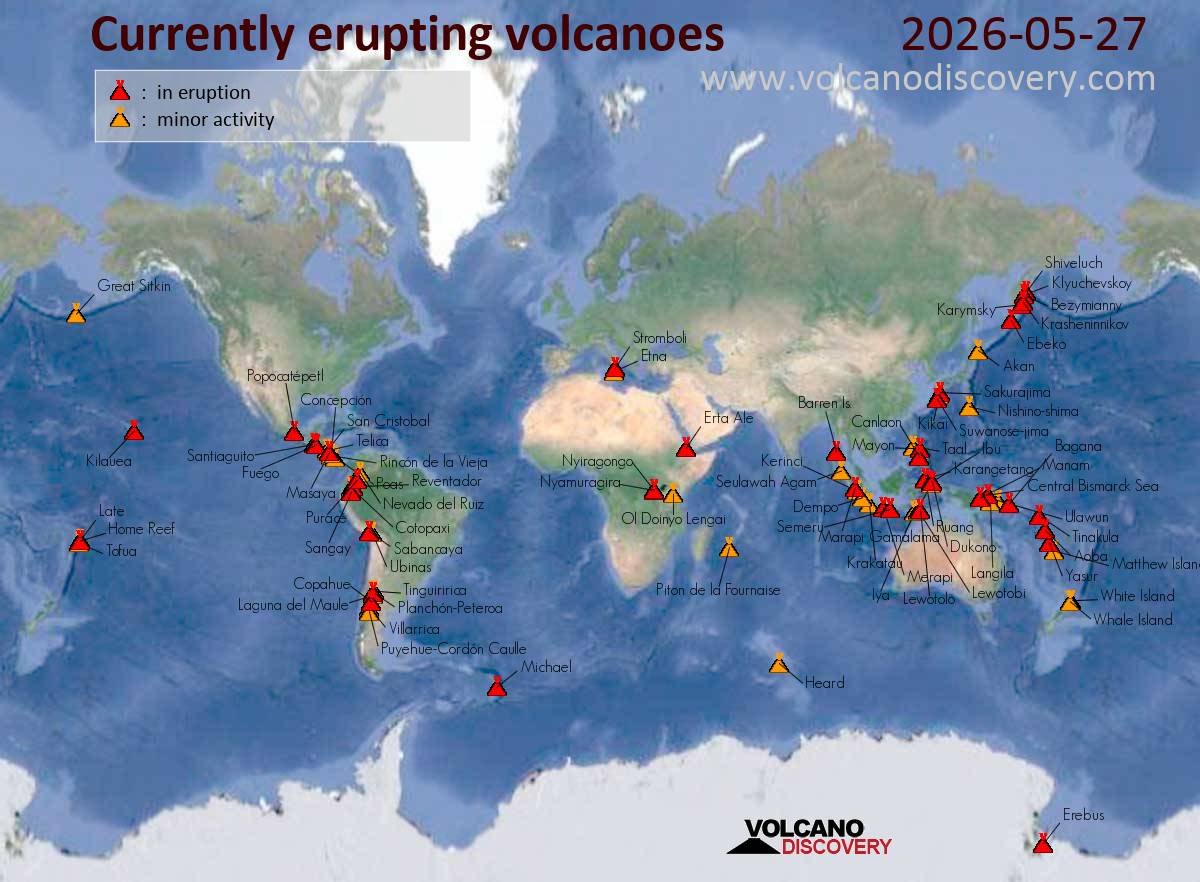
Map of today's active volcanoes

Map of today’s active volcanoes

Sakurajima (Kyushu, Japan): (27 May) Volcanic Ash Advisory Center Tokyo (VAAC) issued the following report: VA AT 20260527/0512Z 10NM SW OF HKC FL100 REPORTED OBS VA DTG:27/0500Z

Mayon (Luzon Island, Philippines): Volcanic Ash Advisory Center Tokyo (VAAC) issued the following report: ERUPTION AT 20260527/1328Z FL090 REPORTED OBS VA DTG:27/1330Z

Ibu (Halmahera, Indonesia): Volcanic Ash Advisory Center Darwin (VAAC) issued the following report: ERUPTION REPORTED AT 27/1055Z EST VA DTG:27/1710Z

Semeru (East Java, Indonesia): Explosive activity continues. Volcanic Ash Advisory Center (VAAC) Darwin warned about a volcanic ash plume that rose up to estimated 15000 ft (4600 m) altitude or flight level 150 and is moving at 05 kts in SW direction.
The full report is as follows: VA TO FL150 LAST REP AT 27/0016Z EST VA DTG:27/1140Z to 15000 ft (4600 m)

Dukono (Halmahera): (26 May) Volcanic Ash Advisory Center Darwin (VAAC) issued the following report: VA REPORTED TO FL070 MOV E AT 26/2120Z EST VA DTG:26/2220Z

Popocatépetl (Central Mexico): Volcanic Ash Advisory Center Washington (VAAC) issued the following report: NO VA EMS

Santiaguito (Guatemala): Explosive activity continues. Volcanic Ash Advisory Center (VAAC) Washington warned about a volcanic ash plume that rose up to estimated 13000 ft (4000 m) altitude or flight level 130 .
The full report is as follows: FREQUENT VA EMS to 13000 ft (4000 m)
…27 May:
A new thermal anomaly detected by Sentinel‑2 indicates that a new lava‑flow eruption is likely underway. It appears that a new flank vent has opened on the western slope, suggesting that magma has intruded into a dyke.
Regarding the explosive activity, near‑constant weak to moderate Vulcanian‑style eruptions continue at regular intervals of one to two per hour.

Fuego (Guatemala): Volcanic Ash Advisory Center Washington (VAAC) issued the following report: ONGOING VA EMS

Puracé (Colombia): Volcanic Ash Advisory Center Washington (VAAC) issued the following report: VA EMS PSBL

Sangay (Ecuador): Volcanic Ash Advisory Center Washington (VAAC) issued the following report: VA EMS PSBL

Reventador (Ecuador): Volcanic Ash Advisory Center Washington (VAAC) issued the following report: PSBL VA EMS

Sabancaya (Peru): Explosive activity continues. Volcanic Ash Advisory Center (VAAC) Buenos Aires warned about a volcanic ash plume that rose up to estimated 23000 ft (7000 m) altitude or flight level 230 and is moving at 15 kts in SE direction.
The full report is as follows: VA EMISSION to 23000 ft (7000 m)

Volcano Activity Summary for 27 May 2026: